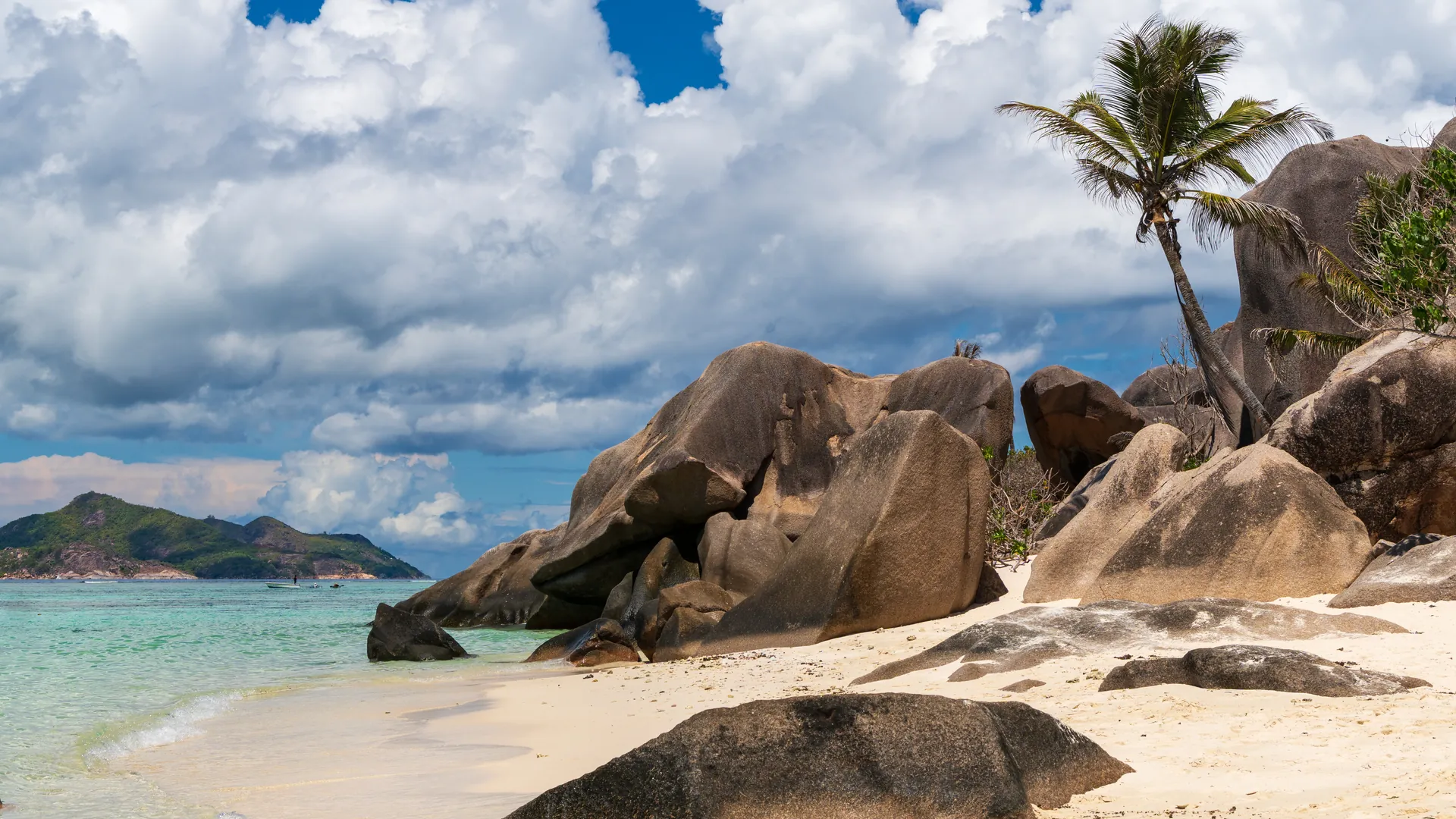
A series of small coves on La Digue island where pink-tinged granite boulders two storeys tall emerge from crystal-clear shallows between groves of coconut palms and white sand.
There is a photograph that appears in almost every travel magazine, every list of beautiful beaches, every desktop wallpaper collection — a shallow turquoise sea, white sand, enormous rounded granite boulders in shades of rose and amber, a coconut palm leaning over the water. That photograph was taken here, on the south coast of La Digue in the Seychelles.
The boulders are Precambrian granite, 750 million years old — among the oldest exposed rock on Earth''s surface. They have been rounded and shaped by billions of years of weathering, polished by the Indian Ocean into forms that look more sculpted than natural, their surfaces warm to the touch from the tropical sun, their colours shifting from grey to amber to pink depending on the angle of light.
The beach itself is not a single beach but a series of small coves separated by the boulders, each pocket of sand protected from the open sea and shallow enough to wade far out before the water deepens. The colour of the water shifts from pale aquamarine to deep cobalt within 50 metres.
La Digue has no traffic lights. Motorized vehicles are largely forbidden. Most residents travel by bicycle or ox cart. The pace of the island is the pace of the boulders — geological, patient, unbothered by urgency. The beach has been photographed millions of times. The boulders have been there for 750 million years. They will outlast every photograph ever taken of them.
Safety information
Safety information is not available yet.
Before visiting this place, check current safety guidance, access rules, local restrictions, and official updates on other trusted websites. Our editorial team does not have verified safety information for this location at the moment; it will appear here later.