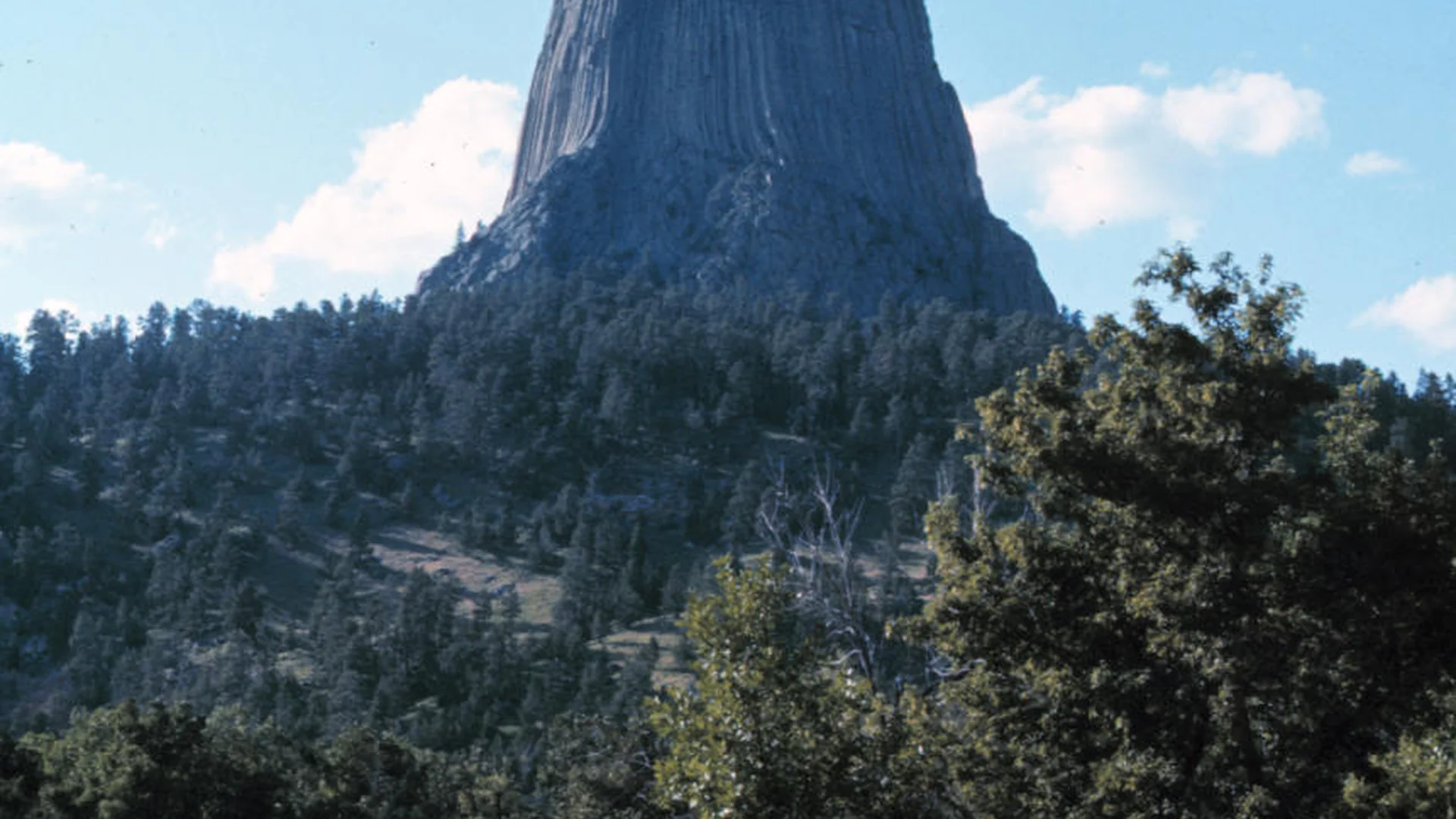
A monolithic column of phonolite igneous rock towers 265 metres above the Belle Fourche River, its sides covered in vertical columns that drew both ancient sacred stories and a film about alien contact.
The Lakota Sioux call it Mato Tipila — Bear Lodge. The Kiowa call it Tso-aa — Tree Rock. The Arapaho, Cheyenne, Crow, Shoshone — each nation that passed through this country has a name for it and a story, and in virtually every story, bears are involved. In the most common version, a group of children climbed onto a rock to escape a giant bear. The rock rose to protect them, growing taller than the bear could reach, its sides scarred by the bear''s claws — visible today as the columns that mark the tower''s surface.
The geology is less dramatic but equally improbable. Approximately 50 million years ago, magma pushed up through the overlying sedimentary rock and cooled slowly underground. The rock it formed — phonolite porphyry — contracted as it cooled, fracturing into the hexagonal and pentagonal columns that now characterize the tower''s surface. Erosion then removed the surrounding softer rock, leaving the igneous intrusion exposed. What stands today is the core of an ancient geological event that was never meant to be seen.
The columns are between 1.2 and 2.4 metres wide and hundreds of metres tall, running vertically from base to summit. They give the tower its visual logic: a bundle of stone rods, improbably regular, rising from the Wyoming grassland.
Steven Spielberg placed it at the centre of Close Encounters of the Third Kind — the one location on Earth that a human brain could credibly interpret as a meeting point for something not from here.