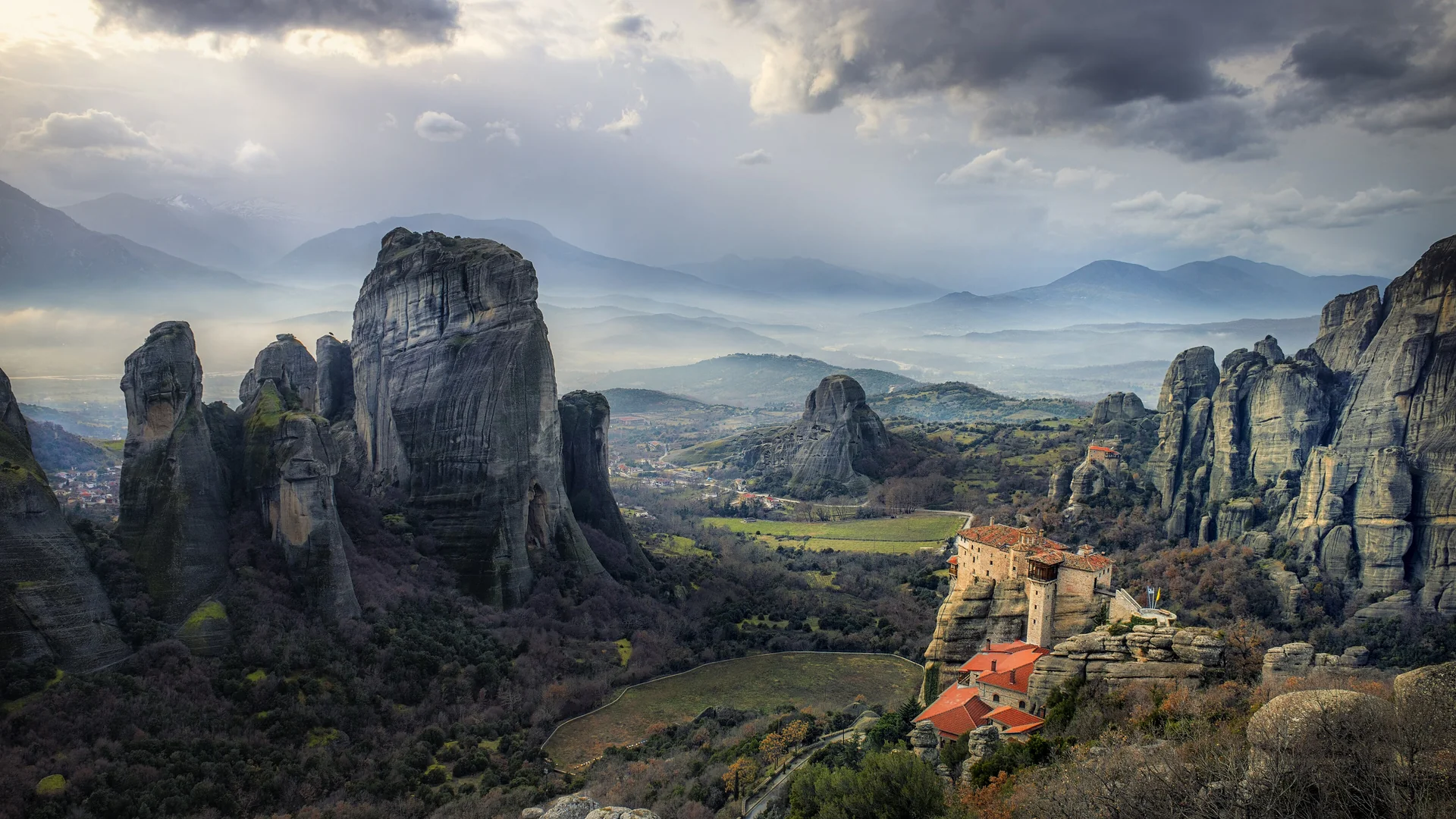
Six Orthodox Christian monasteries perch on natural sandstone pillars rising 300 metres from the Thessaly plain — a landscape that appears to defy both geology and gravity.
The word meteora means suspended in air in Greek. When you first see the pillars from the plain below, the name resolves immediately into accuracy. The rock columns rise 200 to 600 metres from the valley floor — vertical, sheer, and topped with structures that should not be there.
The geology is extraordinary. The pillars are remnants of a prehistoric delta that deposited conglomerate rock — a mixture of pebbles and sand cemented together — at the base of a sea 60 million years ago. Tectonic forces lifted the deposit vertically. Erosion then worked for millions of years, removing the softer material and leaving these isolated columns, each capped with its resistant conglomerate layer.
The first monks arrived in the 9th century, drawn precisely by the inaccessibility. They lived in rock crevices and caves, then began building. How the first structures reached the summits is debated — stories of ropes, ladders, and eagles carrying the first lines are all recorded. By the 16th century, there were 24 monasteries on the various summits. Today six survive.
Access once required rope ladders and nets. In the 20th century, steps were cut into the rock. The monasteries are no longer isolated. But standing on a summit looking across at another column with a monastery on its crown, separated by hundreds of metres of vertical air, the original impulse to build here — to be literally above the world — is entirely comprehensible.