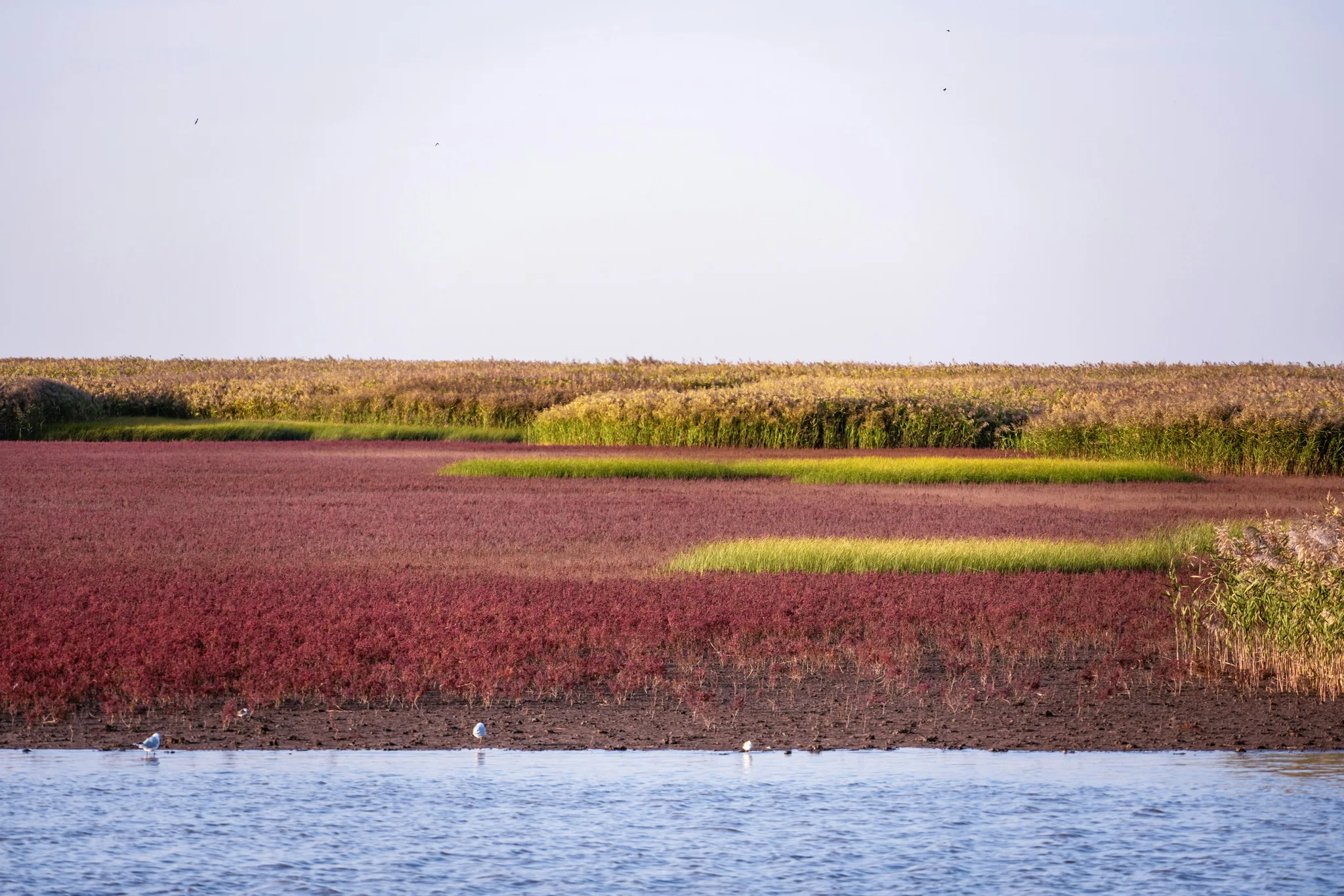
The world's largest Suaeda salsa wetland turns vivid crimson each autumn as the salt-tolerant succulent reaches peak color — a carpet of red stretching to the horizon along China's Liaohe River estuary.
Suaeda salsa is a halophyte — a plant adapted to grow in saline soils that would kill most vegetation. In the wetlands of the Liaohe River estuary in northeastern China, it has found its ideal environment. For most of the year, the Panjin wetlands look like any coastal marsh — green, boggy, bird-filled. Then September arrives. As days shorten and temperatures drop, the Suaeda begins its annual pigment shift, trading chlorophyll green for anthocyanin red. At peak color, the marsh becomes something for which red is an inadequate word — crimson, wine-dark, vermillion. The color shifting with the angle of light. From above, it reads as an impossibly saturated monochrome, interrupted only by silver threads of channels and white of migratory birds. The Red Beach covers roughly 80,000 hectares of wetland. The color lasts about six weeks, then fades as frost comes and the plants die back.