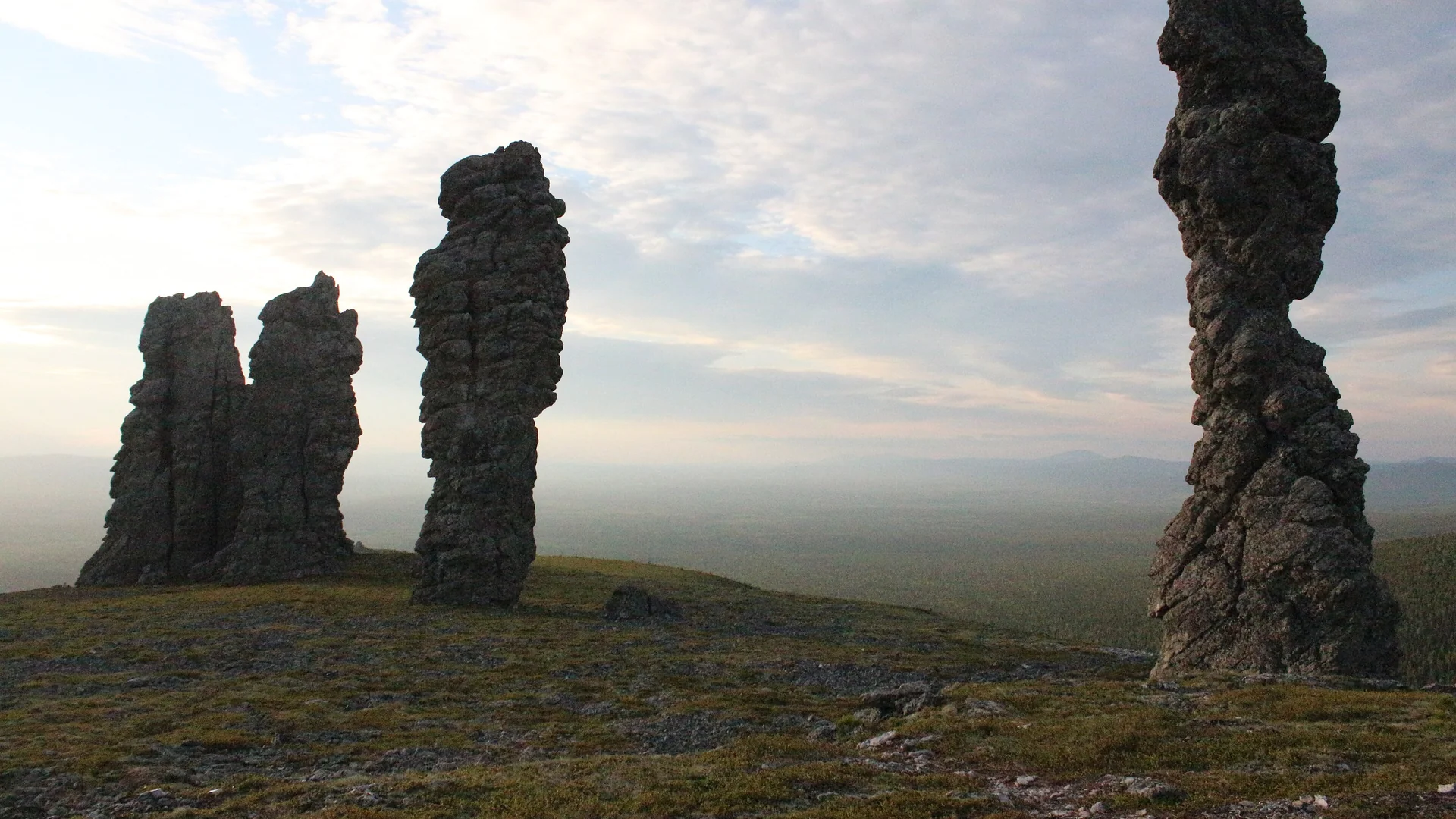
Seven enormous weathered rock pillars rising from the Ural plateau — the tallest reaching 42 meters — the remnant cores of ancient mountains eroded over 200 million years, sacred to the indigenous Mansi people who believed them to be giants turned to stone.
Two hundred million years ago, the Ural Mountains were as high as the Himalayas. The same geological forces that built them also sealed within them a different kind of rock — harder, more resistant to the weathering that would slowly dismantle the mountains around it. As the softer rock eroded over hundreds of millions of years, seven pillars of syenite and shale remained upright, standing where the mountain used to be.
The Mansi people, indigenous to the northern Urals, knew these formations as Bolvaniz — "idols of stone." Their oral tradition holds that the pillars are a party of Siberian giants who crossed the Urals to attack the Mansi people. A shaman turned them to stone before they could do harm, and they have stood there ever since, witnesses to everything that followed.
The tallest pillar is 42 meters high. The shapes are individually distinct — one resembles a boot, another an upturned face, a third a drum. They were shaped entirely by differential erosion: frost, water, and wind removing material at varying rates depending on the composition of each section of rock.
Manpupuner was voted one of the Seven Wonders of Russia in 2008. It remains extraordinarily difficult to reach — a minimum three-day trek through remote taiga and tundra from the nearest settlement, or a helicopter flight. The remoteness has preserved it entirely. There are no facilities, no crowds, no infrastructure. In winter, the plateau is covered in snow and the pillars stand in total silence.
At dawn, when the low Arctic sun strikes the pillars from the east and their shadows stretch across the plateau, the giants look exactly like what the Mansi said they were.