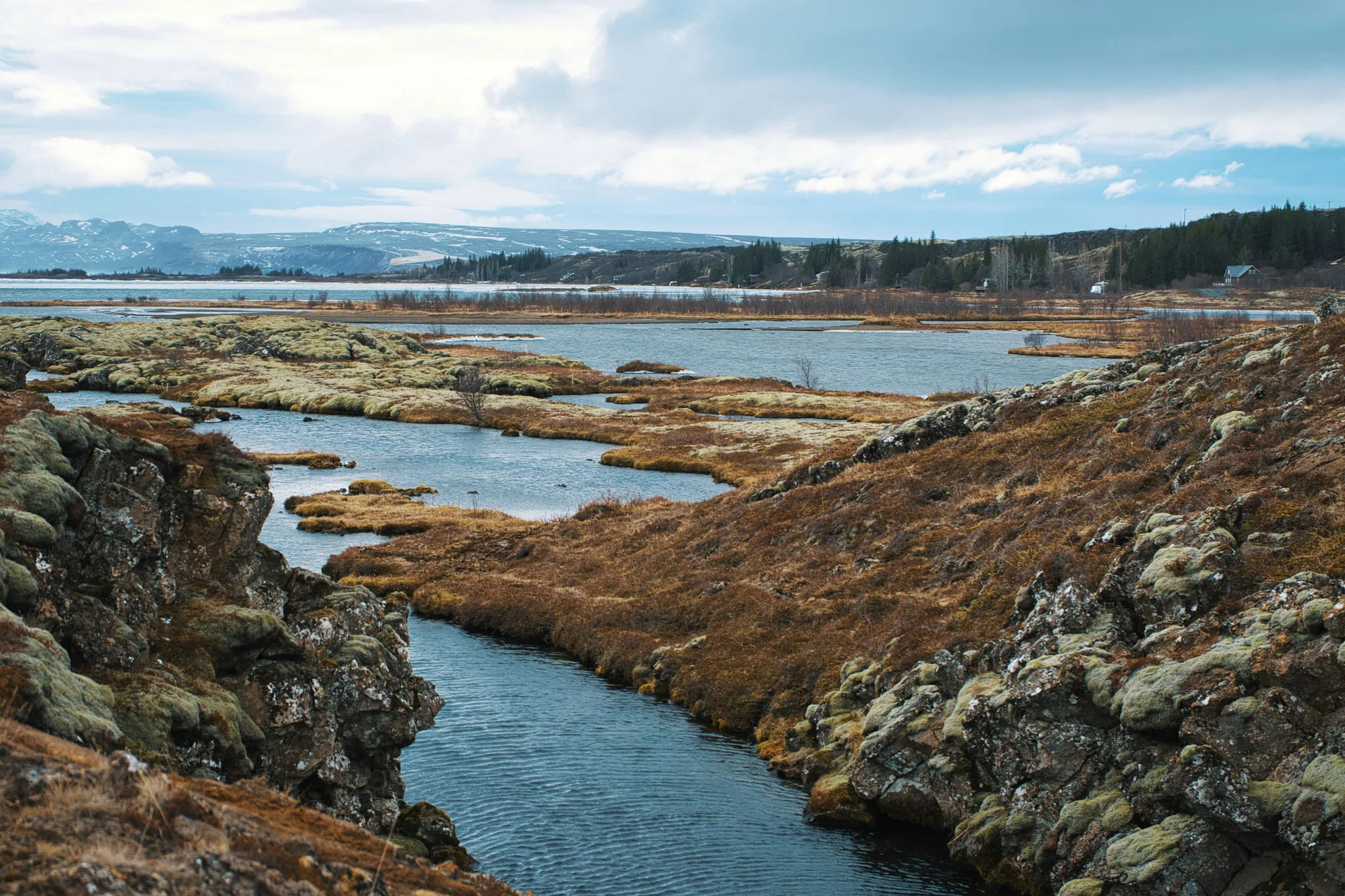
The only place on Earth where you can dive directly between two tectonic plates — the North American and Eurasian — in glacially filtered water of supernatural clarity, touching both continents with outstretched hands.
Silfra is the only place on Earth where certified divers can enter the gap between two tectonic plates and touch both simultaneously. The fissure runs through Þingvellir National Park in Iceland, where the North American and Eurasian plates pull apart at a rate of approximately 2 centimeters per year. The rift has been widening since the last Ice Age — 10,000 years of slow separation — and the accumulated crack is now 60–90 meters wide in places, filled with water of a clarity that has no equivalent in any other freshwater dive site on the planet.
The water filling Silfra is glacial meltwater from the Langjökull ice cap, filtered through the porous lava fields of the Þingvallahraun lava plain for between 30 and 100 years before emerging in Þingvallavatn lake and flowing into the fissure. The filtration process removes essentially all suspended particulates. Horizontal visibility in Silfra routinely reaches 80 to 100 meters. The water temperature is 2–4°C year-round, requiring dry suits. Colors are absorbed selectively at depth in most bodies of water, but Silfra is shallow enough — maximum 18 meters in the Cathedral section — that the full visible spectrum remains. The dominant color is a blue-green of unusual intensity, different from oceanic saltwater blue and different from most freshwater diving.
The dive runs through four sections. Silfra Big Crack is the entry — a narrow fissure between rock walls. Silfra Hall widens to 15 meters as the walls increase in height. Silfra Cathedral is the most affecting section: the fissure opens to 20–30 meters wide, the walls rising 20 meters on each side, visibility allowing the full geometry to be read simultaneously. Silfra Lagoon is a shallow, open basin at the exit where the rift meets the lake. In the Cathedral, the walls are volcanic basalt draped in green and purple algae — the primary life form that can survive in water this cold. Fish are present but sparse. The experience is one of clarity, scale, and deep quiet.
Þingvellir carries additional significance that amplifies the experience of being there. This was the site of the Alþing — the world's oldest surviving parliamentary assembly, established in 930 CE — where the Norse settlers of Iceland gathered annually to legislate, resolve disputes, and announce law. The landscape around Silfra is simultaneously a geological boundary between two continents and a historical foundation for a particular conception of democratic governance. The same rift that separates the plates runs through the field where that assembly met.
Access is by guided dive or snorkel only — the National Park requires certified operators for all in-water activity at Silfra. The site runs year-round; the above-water experience varies significantly between summer (long days, lupine-covered lava fields, midnight sun) and winter (ice on the lake margins, snow on the ridges, silence), but the water below the surface is the same temperature and the same clarity in every month. Silfra has been the same underwater for longer than the Alþing has been meeting above it.
Safety information
Safety information is not available yet.
Before visiting this place, check current safety guidance, access rules, local restrictions, and official updates on other trusted websites. Our editorial team does not have verified safety information for this location at the moment; it will appear here later.