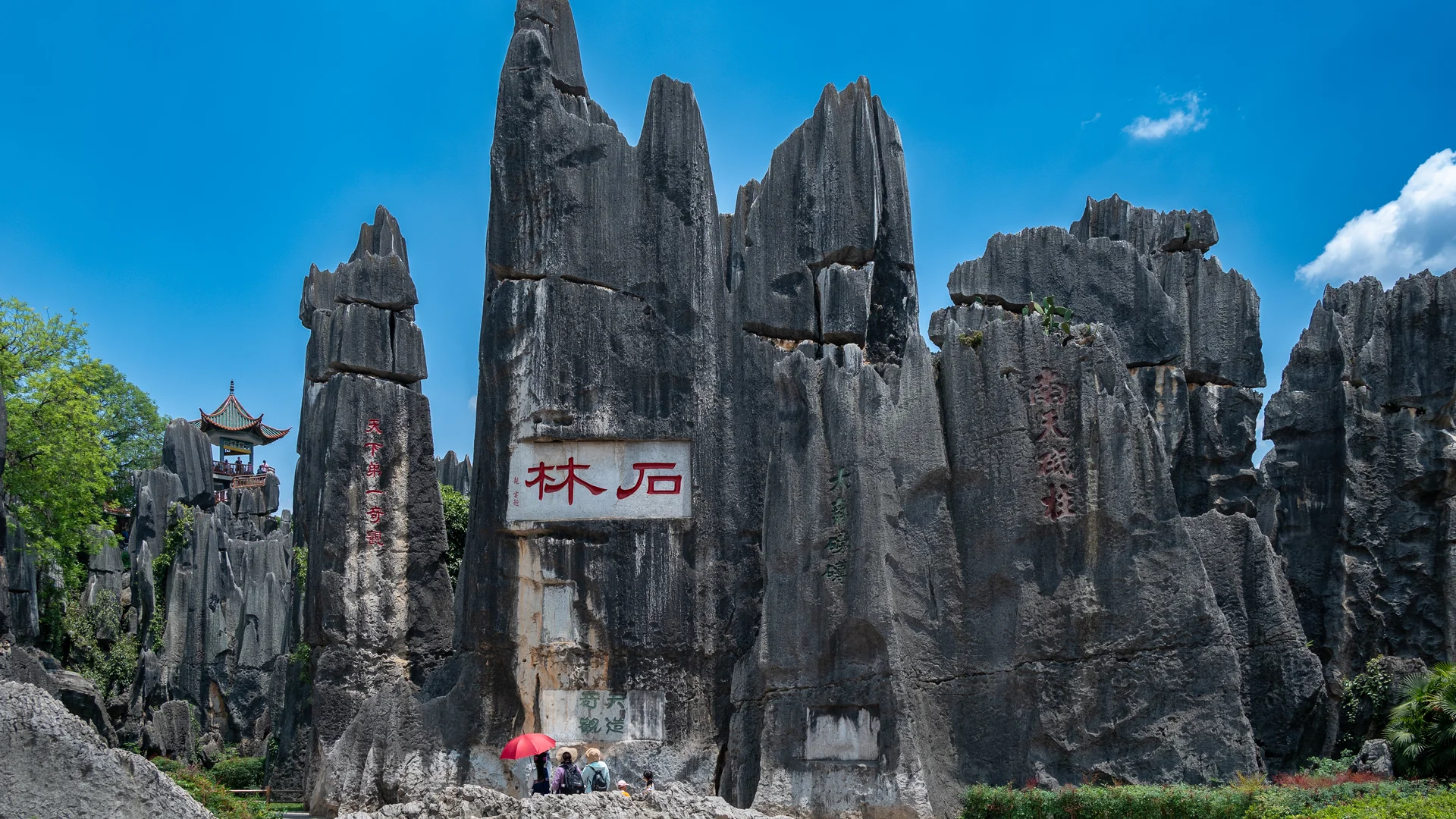
A 400 square kilometer landscape of sharp grey limestone pinnacles rising from the Yunnan plateau — karst formations eroded over 270 million years into shapes that resemble trees from a distance and something stranger up close, the result of an ancient shallow sea slowly carved by rain.
Two hundred and seventy million years ago, this part of Yunnan was the floor of a warm shallow sea. Marine organisms accumulated, died, and compacted into limestone over millions of years. Then the sea withdrew, the land rose, and rain began its work.
Rainwater is mildly acidic, and limestone dissolves in acid. Over hundreds of millions of years, water found the natural joints and cracks in the limestone, widened them, deepened them, and removed the material between them. What remained were the sections of rock that the water had not yet reached — vertical pinnacles and blades of grey limestone, ranging from a meter to 30 meters tall, separated by narrow passages that channel the wind.
From a distance, the landscape looks forested. The pinnacles suggest trees — vertical, closely spaced, varying in height. From within the formations, the analogy dissolves. The stone is grey and sharp, the passages between pinnacles narrow and labyrinthine, the light coming from above in the same way it comes through a forest canopy. But the material is wrong — cold and hard and immovable in a way that wood is not.
The Sani people, a branch of the Yi ethnic group indigenous to this area, have lived among the formations for centuries. Their folklore identifies specific formations by name and story. The Stone Forest is central to the legend of Ashima, a young Sani woman who was transformed into stone; a specific pinnacle in the park is identified as her image.
UNESCO inscribed the South China Karst, of which Shilin is a part, as a World Heritage Site in 2007. The formation is extensively developed for tourism and draws millions of visitors annually. Arrive before 8am to experience it without them.