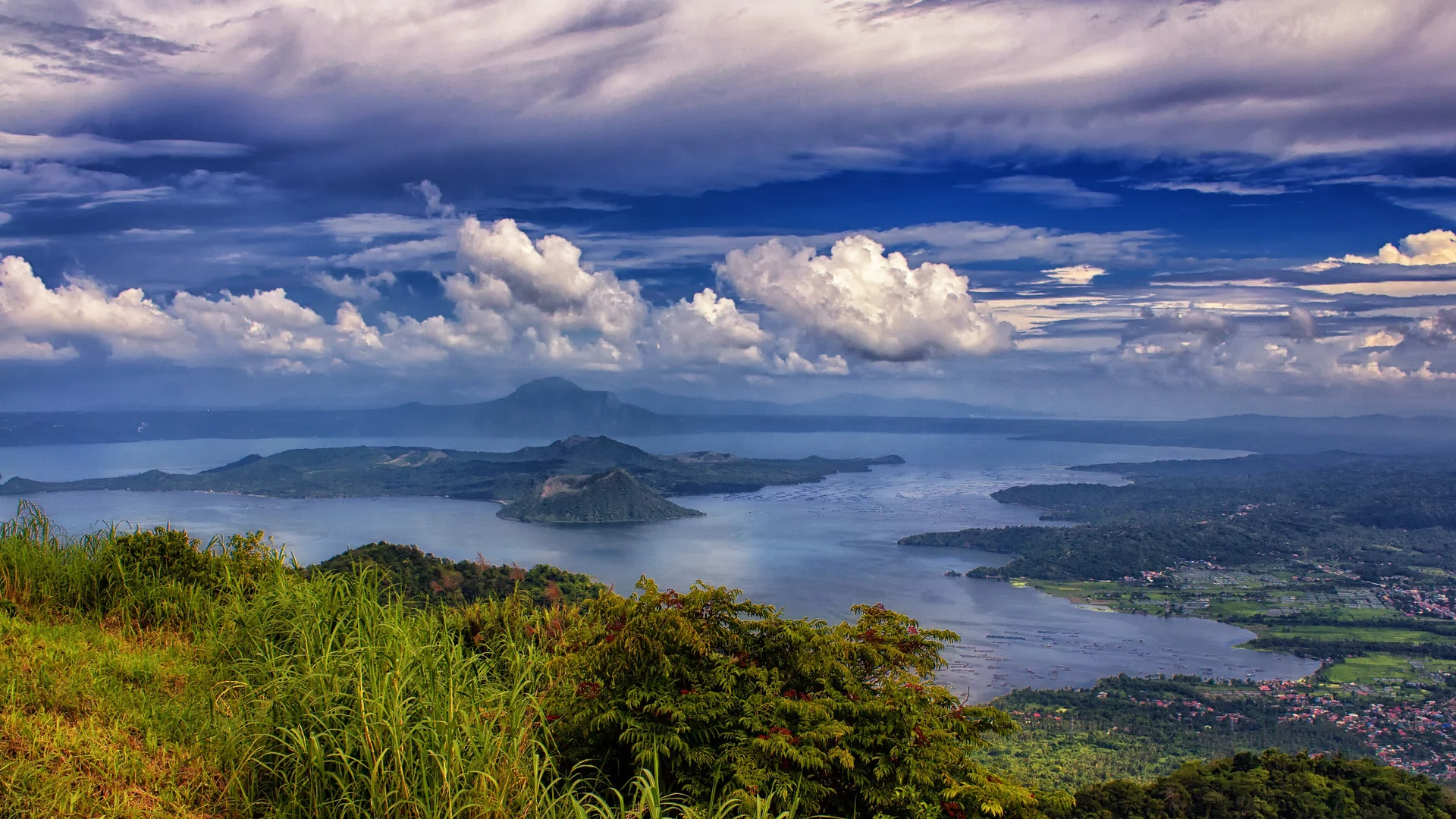
A small volcanic island inside a lake that fills the caldera of a larger volcano — one of the world's few lake-within-island-within-lake formations, and one of the most active volcanoes in the Philippines.
Taal is a volcano that contains a lake that contains an island that contains another lake. The logic is geological, but it reads like a riddle.
The outer Taal caldera is ancient — the remnant of catastrophic eruptions over the past 100,000 years that left a depression 25 kilometres across. Over time, this caldera filled with water, becoming Taal Lake. Within the lake, the volcano continued its activity, building up the cone that is now Taal Volcano island — a small, roughly circular island that sits in the middle of the lake. On top of the island, in the volcano''s summit crater, is another lake: the Main Crater Lake, whose water is sulfuric acid at concentrations dangerous to skin.
Seen from the surrounding hills — from Tagaytay ridge, which is the conventional viewpoint — the layers are all visible at once: the far shore of the outer lake, the dark volcanic island in the middle distance, the suggestion of the inner crater at the summit. The composition repeats: water, land, water, land. Each boundary is a different disaster.
Taal is one of the Philippines'' most active volcanoes and one of the world''s smallest. Its most violent historical eruption, in 1911, killed 1,335 people. In January 2020, it erupted again, sending ash 14 kilometres into the atmosphere and forcing the evacuation of the island''s permanent population. The people returned. The volcano has not finished.