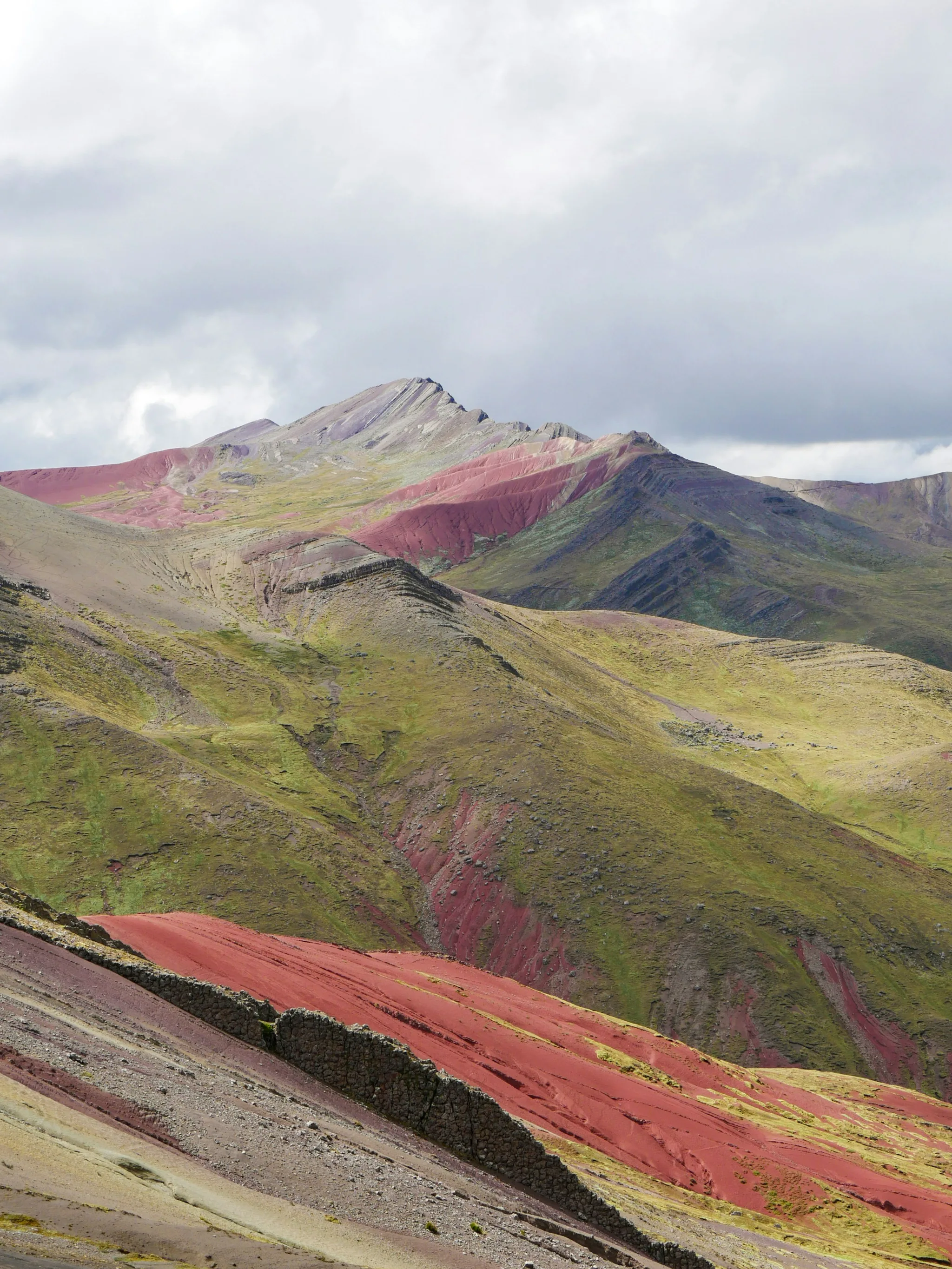
A Peruvian Andean summit whose striped mineral layers — burgundy, turquoise, gold, and lavender — were hidden under glacial ice for thousands of years until climate change stripped the cap away in the early 2000s.
For thousands of years, the mountain existed under a glacier. The Quechua communities who lived in the high valleys surrounding it knew it as Vinicunca — but they did not know its surface. The glacier covered everything. Then the climate warmed, and over the course of the early 21st century, the ice retreated. The mountain revealed itself: horizontal stripes of mineral color, vivid and precise, running across the summit zone in bands of burgundy red, sulphur yellow, turquoise green, pale lavender, and white. The glacier had hidden a geological painting for as long as anyone could remember. Climate change had removed the canvas.
The colors are mineral in origin. The red and burgundy bands come from iron oxide — the same chemistry that makes rust — in the weathered sedimentary layers. The yellow comes from sulphur and iron sulfide minerals. The turquoise-green color comes from copper chlorite, a mineral produced by hydrothermal alteration of the surrounding rock. The lavender color comes from manganese oxide and iron-bearing silts. The white comes from quartz and calcium carbonate. Each band represents a different sedimentary period, each with a different mineral composition deposited in a different geological environment, over the 60-million-year history of Andes mountain-building. The glacier that hid them formed perhaps 10,000 years ago. Geologically, the discovery is recent.
The mountain had no international profile before approximately 2013. Aerial photographs taken by geological survey teams first circulated outside Peru in the early 2010s; by 2015, Vinicunca had appeared on travel blogs and begun attracting guided tour traffic from Cusco. The growth was rapid — from a few hundred visitors per year in 2015 to an estimated 1,500 per day at peak season by 2019. The community of Cusipata, which manages access to the mountain under an agritourism framework, has benefited economically from this growth. The landscape has experienced some erosion along the primary trail from the volume of foot traffic.
The hike to the summit ridge where the colors are fully visible begins at approximately 4,300 meters elevation and climbs to 5,200 meters. The altitude presents the primary physical challenge: at 5,200 meters, the available oxygen is roughly 50% of sea-level concentration, and the ascent, while not technically demanding, requires manageable cardiovascular fitness and acclimatization. Most visitors spend at least two nights in Cusco (3,400 meters) before attempting the hike. The journey from Cusco takes approximately four hours by road to the trailhead, followed by two hours of hiking. The mountain itself appears over a final ridge without warning.
You come over the edge breathing hard, lungs working at altitude, and there it is — the striped summit, the colors impossibly saturated in the thin Andean air, real and implausible simultaneously. The glacier that hid it is still retreating. The bands of color that were hidden for 10,000 years are now visible, and the same warming that revealed them is also continuing to alter the landscape around them. Vinicunca is a new discovery and an ancient geology and a live geological process, all at once.
Safety information
Safety information is not available yet.
Before visiting this place, check current safety guidance, access rules, local restrictions, and official updates on other trusted websites. Our editorial team does not have verified safety information for this location at the moment; it will appear here later.