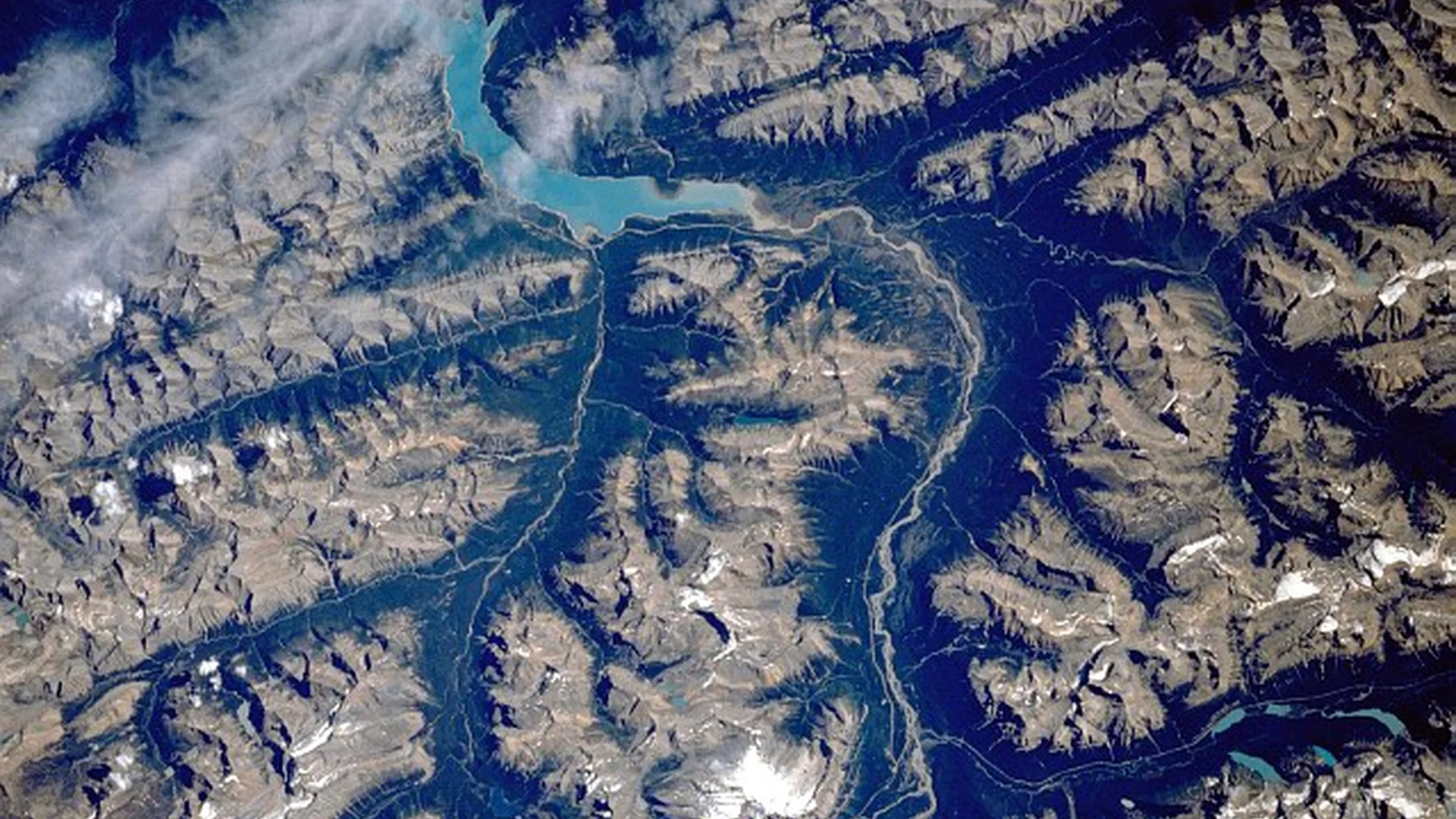
A man-made reservoir in the Canadian Rockies where methane released by decomposing plants freezes into stacked white discs under crystal-clear winter ice.
Abraham Lake did not exist before 1972. Engineers dammed the North Saskatchewan River in the Alberta foothills and a reservoir spread across the mountain valley. No one anticipated what would happen when winter arrived.
Beneath the lake floor, bacteria break down organic matter — drowned plants, soil, ancient wood — producing methane gas. As temperatures drop and the surface freezes, these bubbles rise through the water column and are captured by the ice, frozen in mid-ascent. Layer after layer of white discs and spheres accumulate, stacked like flattened pearls inside glass, some reaching the size of dinner plates.
The ice itself is extraordinary: crystalline, blue-grey, cracked into geometric plates by the cold. Stand above it and you can see metres down into the water below, bubbles suspended like a preserved moment in time. Beneath the surface, the Rockies' peaks reflect upward, doubling the mountains.
In late January, when temperatures plunge to -30°C and the ice reaches its full depth, the lake resembles no earthly image more than it does the surface of a frozen alien ocean — methane ice formations just like these exist on Saturn's moon Titan, billions of kilometres away.