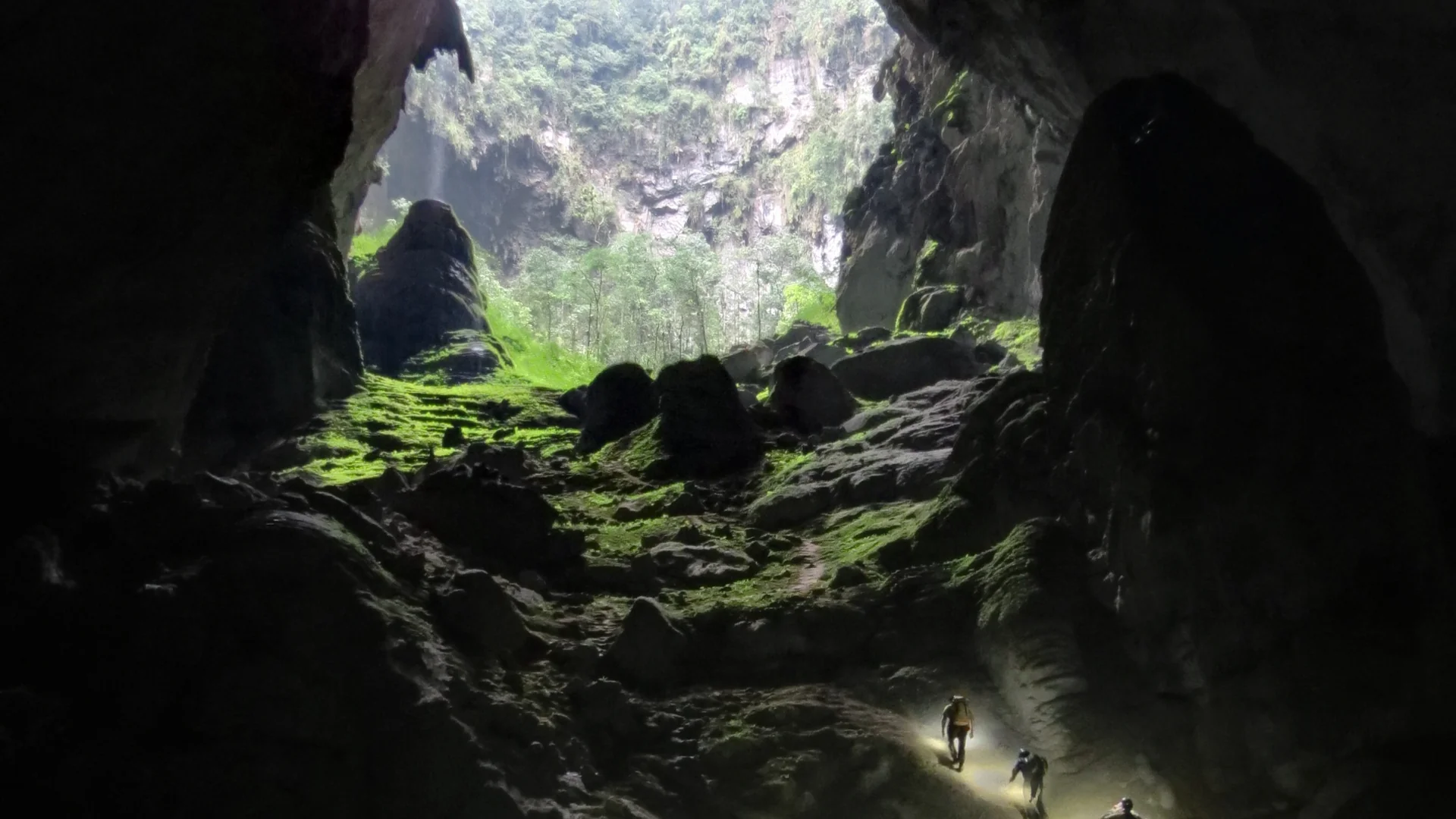
The largest cave on Earth contains its own jungle, clouds, and weather system deep inside a Vietnamese mountain.
In 1991, a local farmer named Hồ Khánh stumbled upon an opening in the jungle of Phong Nha-Kẻ Bàng and fled — the roar of underground wind and rushing river terrified him. He could not find it again. Nearly two decades later, British cavers followed his lead and descended into something that defied comprehension.
Hang Sơn Đoòng — Mountain River Cave — is not merely large. It is a separate world. Its main passage stretches five kilometres long, 200 metres wide, and 150 metres tall. A Boeing 747 could fly through it with room to spare. Forty-storey skyscrapers would stand inside and not reach the ceiling. Clouds form inside the cave when warm external air meets the cool subterranean atmosphere.
Where the ceiling has collapsed over millennia, sunlight pours through in cathedral shafts, nurturing dense jungle ecosystems below — entire forests growing underground, home to monkeys, flying foxes, and species found nowhere else on Earth. The cave river that terrified Hồ Khánh roars along its floor, turquoise and cold.
The first expedition to fully explore it did not occur until 2009. Today only 1,000 permits are issued per year, each costing thousands of dollars. Most of the cave has never been touched by human hands. Parts remain unmapped. No one knows what is deeper still.