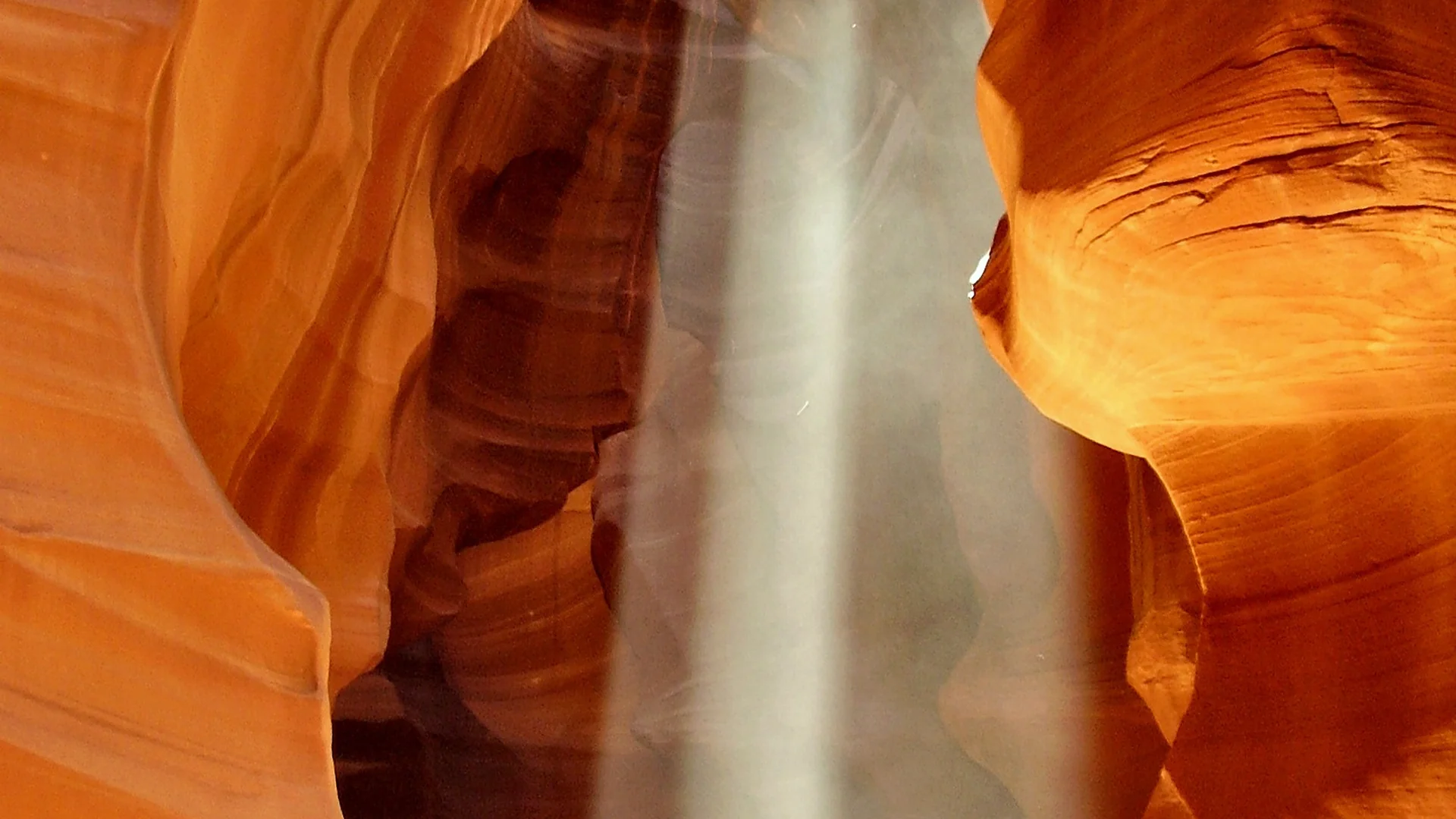
A Navajo slot canyon in Arizona where shafts of sunlight pierce narrow red sandstone corridors, creating beams of luminous gold visible only at certain hours.
The Navajo call it Tsé bighánílíní — the place where water runs through rocks. For centuries it was known only to the Navajo Nation, who recognized it as sacred. To the outside world it was invisible — a crack in the desert that opened into something incomprehensible.
Antelope Canyon is a slot canyon carved by flash floods over millions of years. Water pouring through sandstone during desert storms does not erode randomly; it spirals, sculpting the rock into flowing curved walls that resemble fabric, frozen waves, or the interior of a giant shell. The walls are sometimes only a metre apart. The stone is layered in shades from cream to deep rust to violet.
Between 11 AM and 1 PM on clear days between March and October, something extraordinary happens. Sunlight pours through the narrow openings above in discrete columns — visible beams of gold and white that descend to the sandy floor and appear almost solid. Photographers have waited years to capture them. The light moves, tilts, intensifies, then fades in minutes.
The canyon exists in two sections — Upper and Lower — with different personalities. Upper flows like a river of stone. Lower climbs through tight spiralling passages. Both sections were only opened to guided tours in the 1990s. Visitor numbers are now strictly limited. The Navajo Nation still controls access. The canyon is theirs.