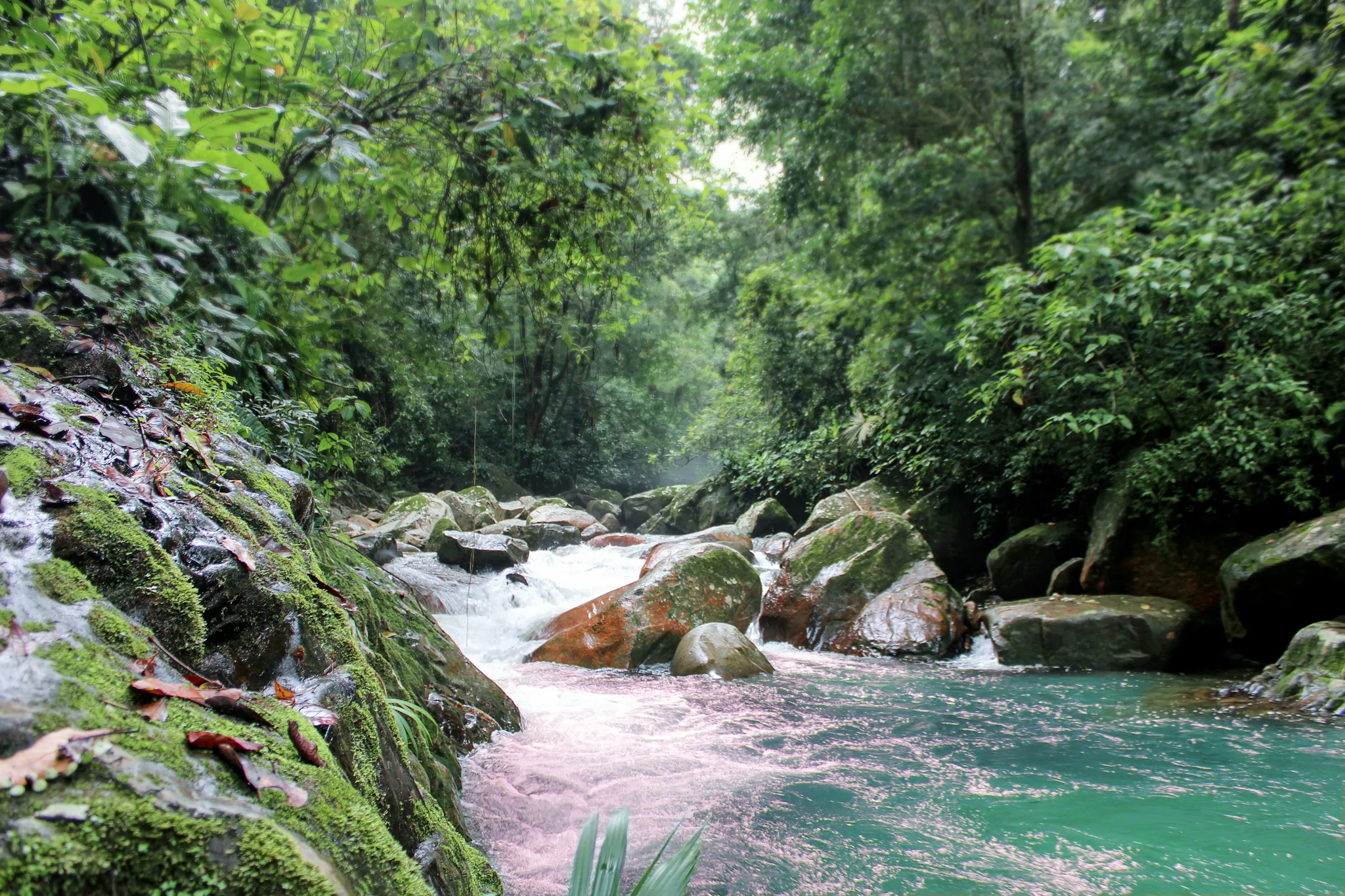
A remote Colombian river that flows simultaneously in yellow, blue, green, black, and vivid red for several weeks each year — caused by an endemic aquatic plant called Macarenia clavigera blooming on the riverbed.
For most of the year, Caño Cristales looks like any other river in the Colombian Amazon basin — clear water over grey rock, the color of rivers everywhere. Then, between approximately June and November, the riverbed turns red. The transition is not instantaneous. Over the course of a few weeks, a vivid red pigmentation spreads across the limestone riverbed until a 100-kilometer stretch of the Serranía de la Macarena river system reads as crimson, interrupted only by the silver of the water moving above it.
The cause is Macarenia clavigera — an aquatic plant endemic to this single river system, found nowhere else on Earth. The species colonizes the smooth rock surfaces of the Caño Cristales riverbed and exists in a state of photosynthetic equilibrium for most of the year, appearing as dark patches on the grey limestone. For the red bloom to occur, conditions must align precisely: enough water to keep the plants alive and submerged, but not so much that the water column prevents adequate sunlight from reaching the riverbed. This window — the brief transition between wet and dry seasons, when water levels are falling but haven't yet exposed the rocks to desiccation — is when Macarenia clavigera produces its pigment. The narrow conditions required explain why the display is limited to a few weeks per year, and why it can vary in intensity and timing.
The river does not run uniformly red. The underlying limestone is pale. Tannins from the surrounding tropical forest create golden and yellow tones in the water itself. Blue-green algae colonize sections where temperature and pH favor them. Aquatic mosses add dark green patches. The cumulative effect, over a single afternoon walk along a stretch of 100 meters, is to see all five colors present simultaneously — red, yellow, blue, black, and green — flowing together in the same water system. Colombians call it el río que escapó del paraíso — the river that escaped from paradise — and the name is earned.
The Serranía de la Macarena, where Caño Cristales flows, is a mesa formation whose geological isolation has produced a high degree of biological endemism. The tepui-type geology — ancient Precambrian sandstone elevated above the surrounding lowlands — shares characteristics with the isolated plateau ecosystems of the Venezuelan Guiana Highlands. Macarenia clavigera is the most dramatic example of this endemism, but the broader biological community of the Serranía includes numerous plant and animal species found only in this region.
Access was prohibited from the late 1980s through 2009 due to guerrilla activity in the region. The Macarena territory was controlled by FARC during this period and was inaccessible to civilians. Following peace negotiations, the site reopened to guided tourism in 2009. Visitor numbers are now regulated under an ecotourism management plan — daily entry is limited, overnight camping is prohibited, swimming is permitted only in designated areas. The flight is from Bogotá to La Macarena, a small town at the edge of the national park, followed by boat and hiking access to the river. The logistical effort required is proportionate to what is there.
Safety information
Safety information is not available yet.
Before visiting this place, check current safety guidance, access rules, local restrictions, and official updates on other trusted websites. Our editorial team does not have verified safety information for this location at the moment; it will appear here later.