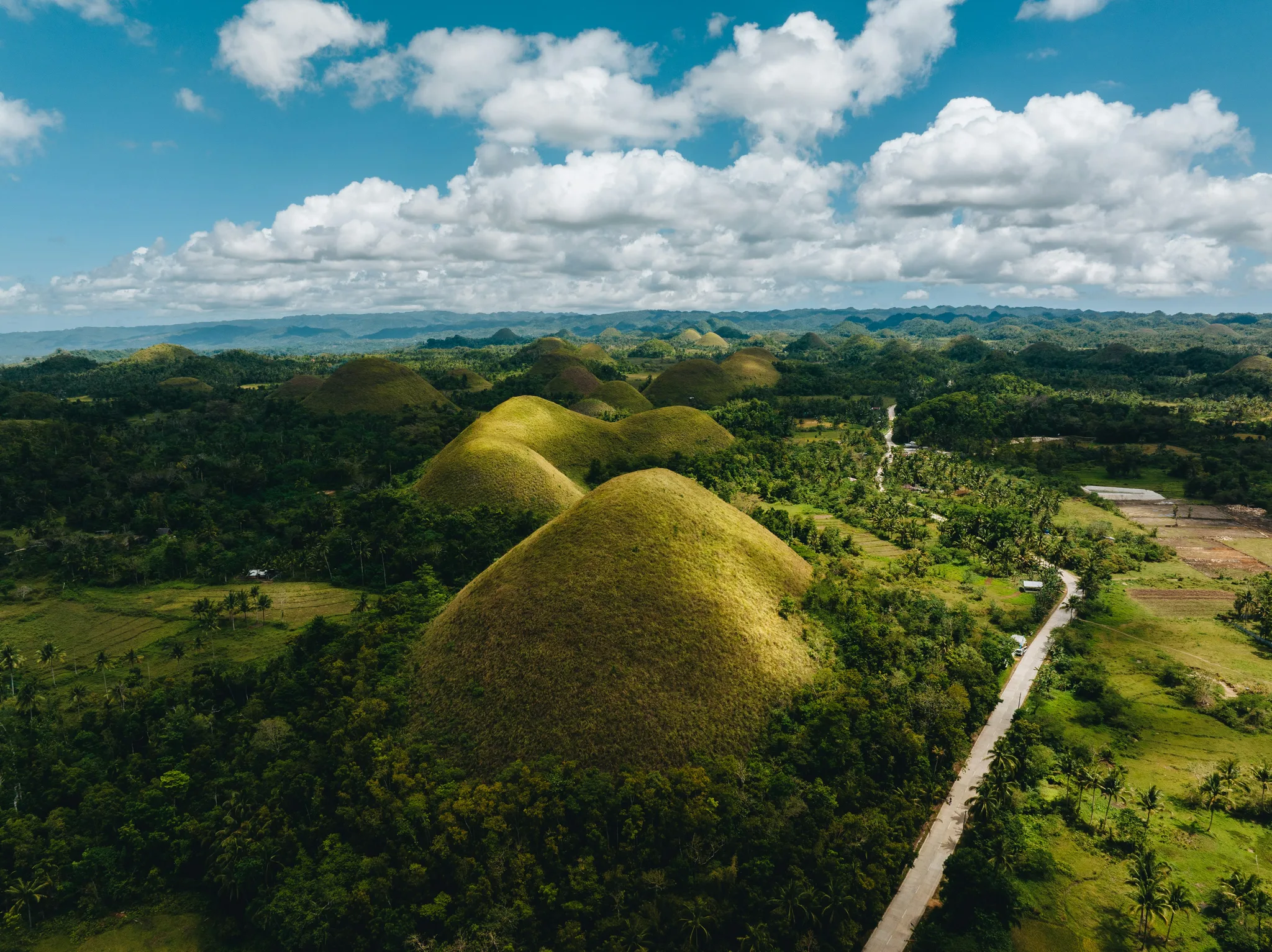
More than 1,200 almost perfectly cone-shaped grass-covered limestone hills spread across 50 km² of Bohol Island, turning chocolate brown in the dry season — their unusual geometric uniformity has no fully accepted geological explanation.
Bohol Province officially claims 1,268. Others have counted higher. What no one disputes is the shape: each hill is nearly identical, nearly symmetrical — a rounded cone rising from a flat valley floor, 30 to 50 meters tall, covered in coarse grass that turns brown in the dry season. From above, the landscape is almost hallucinatory. Hundreds of identical forms stretching to every horizon, each casting an identical shadow. The formation is karst — limestone dissolved and sculpted by rainwater over millions of years. The Bohol limestone was once a coral reef, lifted above sea level by tectonic forces. Water slowly dissolved the rock, leaving harder mounds where dissolution was slowest. This is the best current theory. It does not quite explain the near-identical size and spacing. Local legend is more satisfying: two fighting giants threw sand and stones at each other for days. What they left behind became the hills.