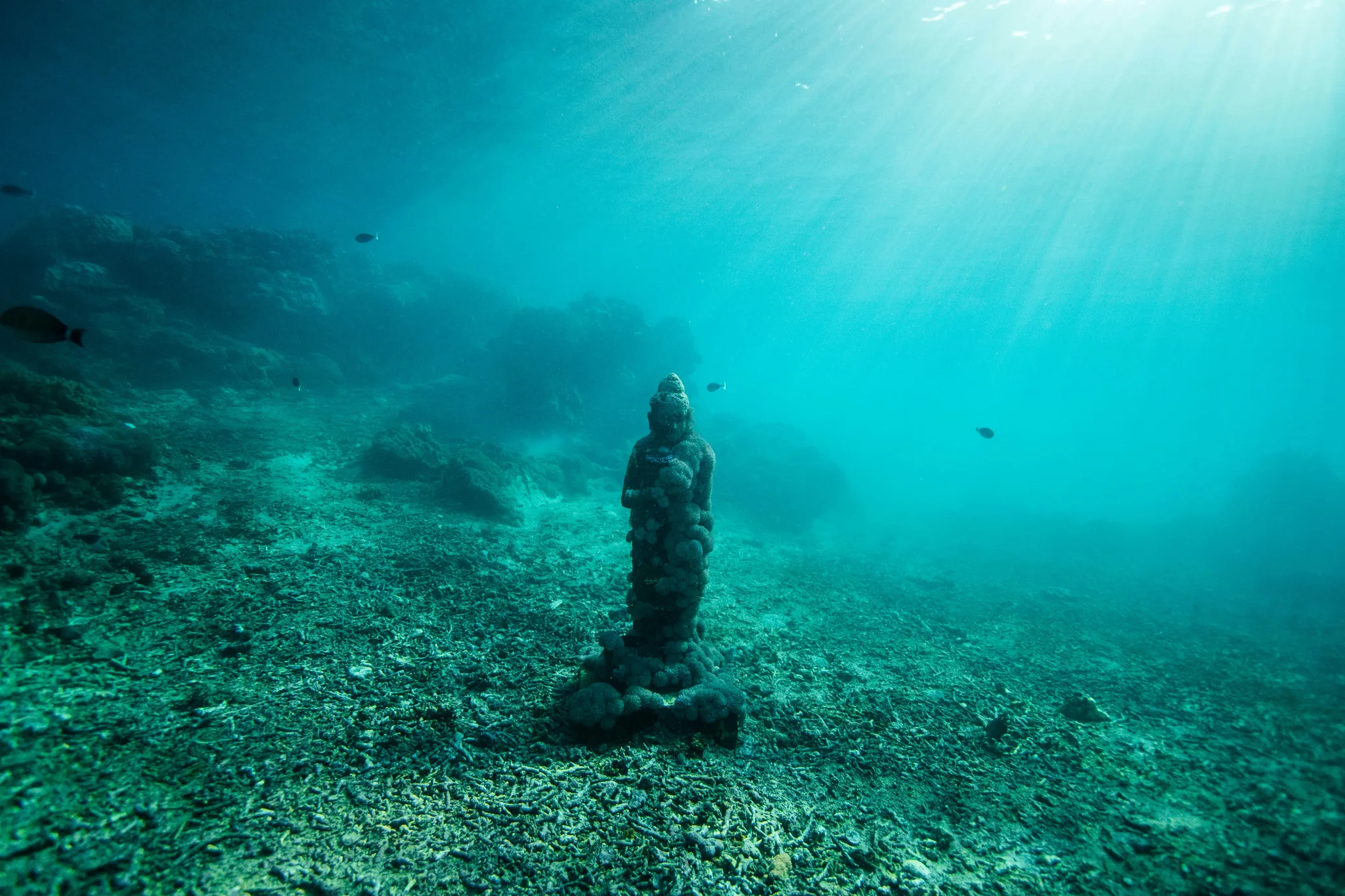
A bronze statue of Christ submerged 17 meters below the Ligurian Sea near Portofino, arms raised skyward through shafts of filtered light — silently blessing the depths in an eternal gesture visible only to those who descend.
On August 22, 1954, a 2.5-metric-ton bronze statue was lowered to the seafloor of the Ligurian Sea near the headland of Portofino in northwestern Italy, and placed 17 meters below the surface at a site called San Fruttuoso. The statue depicts Christ in the posture of benediction — arms raised, face angled upward, palms open toward the surface. It was designed by sculptor Guido Galletti and commissioned by diving pioneer Duilio Marcante as a memorial to Dario Gonzatti, the first Italian to die while using an aqualung. The combination of form, material, and placement produced one of the most affecting underwater artworks in the world.
The location was chosen deliberately for its diving conditions. San Fruttuoso Bay, sheltered by the Portofino promontory, maintains exceptional visibility — regularly exceeding 15 meters in calm weather. The depth of 17 meters places the statue well within recreational diving range, accessible without technical equipment to any certified diver. The site is protected within a marine reserve that prohibits anchoring, which has preserved the surrounding reef from anchor damage over the seven decades since the statue was placed.
Approaching the statue from the surface, it comes into resolution gradually through the water column. The bronze has oxidized over decades to a blue-green patina that reads differently than its original cast color. Shafts of filtered Mediterranean light cross the water from varying angles depending on time of day and season. At certain times — typically mid-morning in summer, when the sun is high enough to penetrate the surface clearly — the light arrives at the statue's upturned face and extended arms with a quality that is difficult to describe without recourse to words that sound overworked. The sculpture was designed for exactly this interaction with light diffused through water.
The original statue required restoration in the 1990s after salt corrosion and biological accumulation caused structural damage. A cast replica was placed while the original was removed for restoration in Genoa; the restored original was returned to its position in 2003. Two other casts of the Galletti mould exist: one at John Pennekamp Coral Reef State Park in Florida, placed in 1966, and one at a museum in France. The San Fruttuoso original remains the most visited of the three.
San Fruttuoso Bay is accessible only by foot — a 2-hour hike from Camogli through the Portofino Natural Park — or by seasonal ferry from Camogli, Santa Margherita Ligure, or Portofino. No road leads to the bay. The monastery, the beach, the medieval Doria family mausoleum, and the dive site share the space in a configuration that has remained largely unchanged for centuries. The isolation has kept development away from a place that has every reason to be overbuilt. Diving at the statue is organized through local operators. Finding it underwater requires no navigation — it is the most visible thing in the bay at that depth.
Interesting facts
What damage forced the statue's restoration in the early 2000s?
One of its hands had been snapped off by a boat anchor despite the bay's no-anchoring rule. A diver later located the detached hand, and it was reattached when the bronze was brought to the surface for cleaning and repair.
Did the Florida replica go straight into the ocean?
No — it was first unveiled indoors, in the ballroom of Chicago's Palmer House Hotel at a 1962 diving convention, and wasn't actually lowered into the water off Key Largo until three years later, in 1965.
Why was a copy placed in a mountain lake instead of the sea?
In 1972 a cast was lowered into Lake Palù, a reservoir high in Lombardy's Val Malenco, largely to draw public attention to the lake's seasonal water depletion rather than for diving tourism.
Why is there a copy of this statue in the Caribbean?
The Grenada cast was a gift from the Genoa-based Costa shipping family to the people of Grenada, in gratitude for their rescue of the passengers and crew of the Italian liner MV Bianca C., which caught fire and sank in Grenada's harbour in 1961.
How many casts of this statue exist around the world?
At least five: the original off San Fruttuoso, an underwater copy off Key Largo in Florida, another off St. George's in Grenada, one submerged in an alpine reservoir in the Italian Alps, and the onshore copy in the San Fruttuoso church.
Is there a way to see the statue without diving?
Yes — a bronze copy stands inside the abbey church at San Fruttuoso itself, just above the bay, so visitors who never go underwater can still see the same face and raised hands up close.
Does the original clay model still exist?
Yes. The full-size clay positive used to cast the bronze was rediscovered in a foundry in 1993 missing its arms; they were later found, though the hands had to be remade. The reassembled clay original is now on display at the National Museum of Underwater Activities in Ravenna.
What is the statue actually cast from?
The bronze was melted down from commemorative medals, ship's bells, and scrapped naval parts, including submarine propellers donated by the U.S. Navy specifically for the casting.
Safety information
Safety information is not available yet.
Before visiting this place, check current safety guidance, access rules, local restrictions, and official updates on other trusted websites. Our editorial team does not have verified safety information for this location at the moment; it will appear here later.