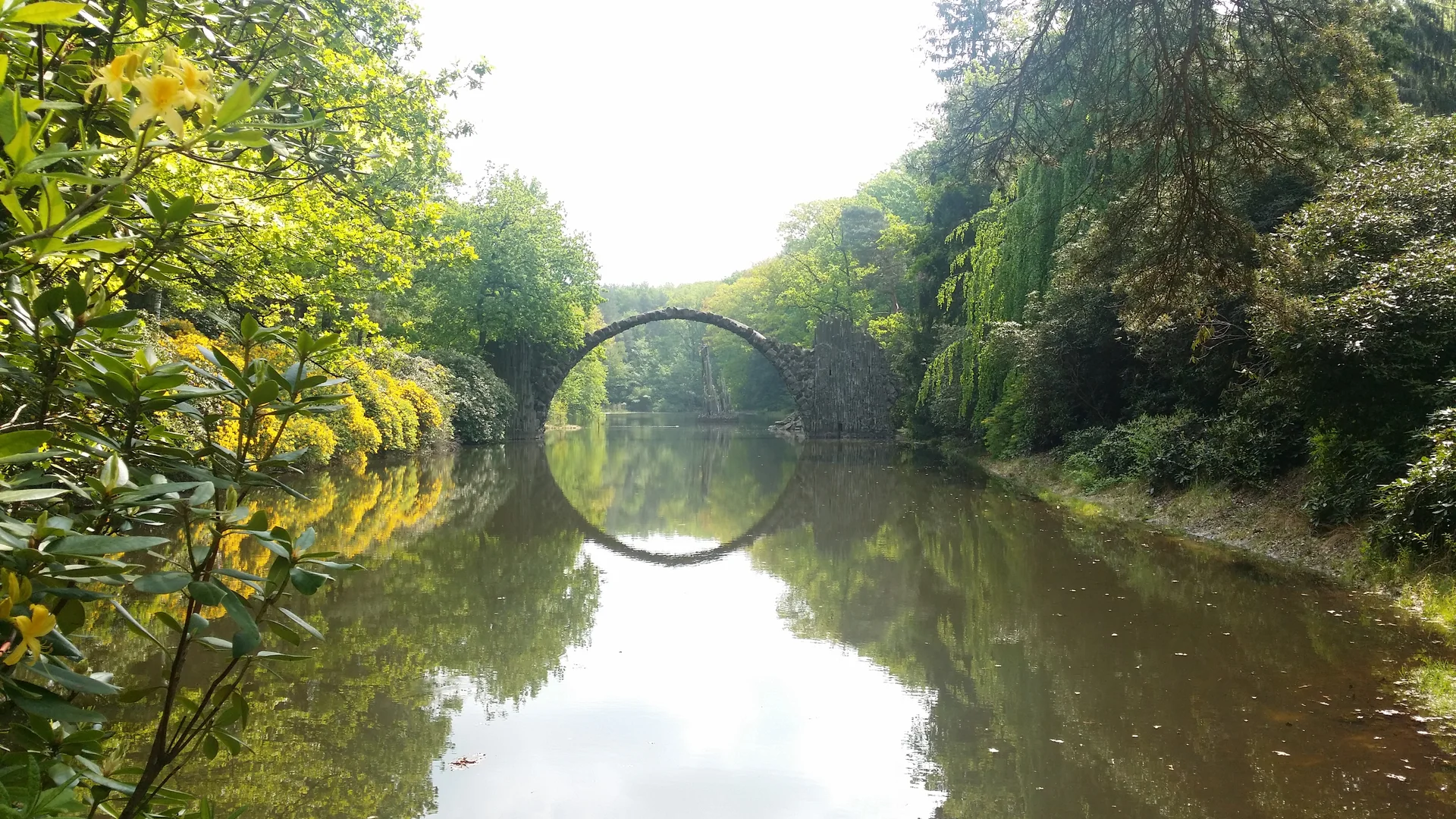
A 19th-century devil's bridge in Saxony's Kromlau Park, so perfectly arched it forms a flawless circle with its reflection — a stone portal between worlds built by human hands to look like it appeared by magic.
The bridge was built in 1860 by the German landowner Friedrich Hermann Rötschke on his estate in Saxony — and it was built specifically to form a perfect circle with its own reflection. Every design decision was oriented toward this single optical effect: the arch is a precise semicircle, the span is narrow enough to read cleanly from a distance, and it is positioned over a section of the Rakotzsee lake wide enough to contain the full reflection without visual interruption. When the water is still, the stone arch and its mirror image complete each other into an unbroken ring of stone floating on the surface.
Rakotzbrücke is one of several so-called Teufelsbrücken — devil's bridges — built across central Europe in the 18th and 19th centuries. The name comes from a folk tradition: a structure so precisely made, so apparently beyond ordinary human craft, could only have been built with supernatural assistance. The 1860 construction date makes Rakotzbrücke relatively modern by European standards, but its ambition — to create not a functional crossing but an object of sustained illusion — gives it a quality that most architecture of that era does not possess.
The park surrounding it, Rhododendronpark Kromlau, was laid out as an English garden in the Romantic tradition — designed to look like nature organized by accident rather than intention. Kromlau sits in the Lausitz region of eastern Saxony, close to the Polish border. The park's approximately 200 hectares include artificial rock formations, lake islands, and a second, smaller bridge — all designed to produce specific emotional effects on visitors walking through them. The Rakotzbrücke is the centerpiece: its reflection visible from several points along the western bank, each offering a slightly different angle on the circle.
The best conditions for the circle effect are a windless morning in late spring before the rhododendrons peak, or in autumn after the leaves have mostly fallen from the surrounding trees. During the May flowering season, the surrounding color is spectacular but the lake surface is often disturbed by wind and foot traffic, breaking the reflection. In autumn, the reflection is sharpest and the visitor numbers are lower. The particular quality of the image — a perfect stone ring floating in still dark water, surrounded by bare trees — has made Rakotzbrücke one of the most widely circulated photographs in European landscape photography.
The bridge cannot be walked across. A fence at its entrance prevents foot traffic, a practical restriction given the age of the stone. Rakotzbrücke exists to be looked at, not crossed. From the correct angle and in the right light, it makes good on the promise of its designer: an object that appears not to have been constructed at all, but to have been found here, already complete, as if the water had decided one morning that it wanted a stone ring, and arranged it.
Safety information
Safety information is not available yet.
Before visiting this place, check current safety guidance, access rules, local restrictions, and official updates on other trusted websites. Our editorial team does not have verified safety information for this location at the moment; it will appear here later.