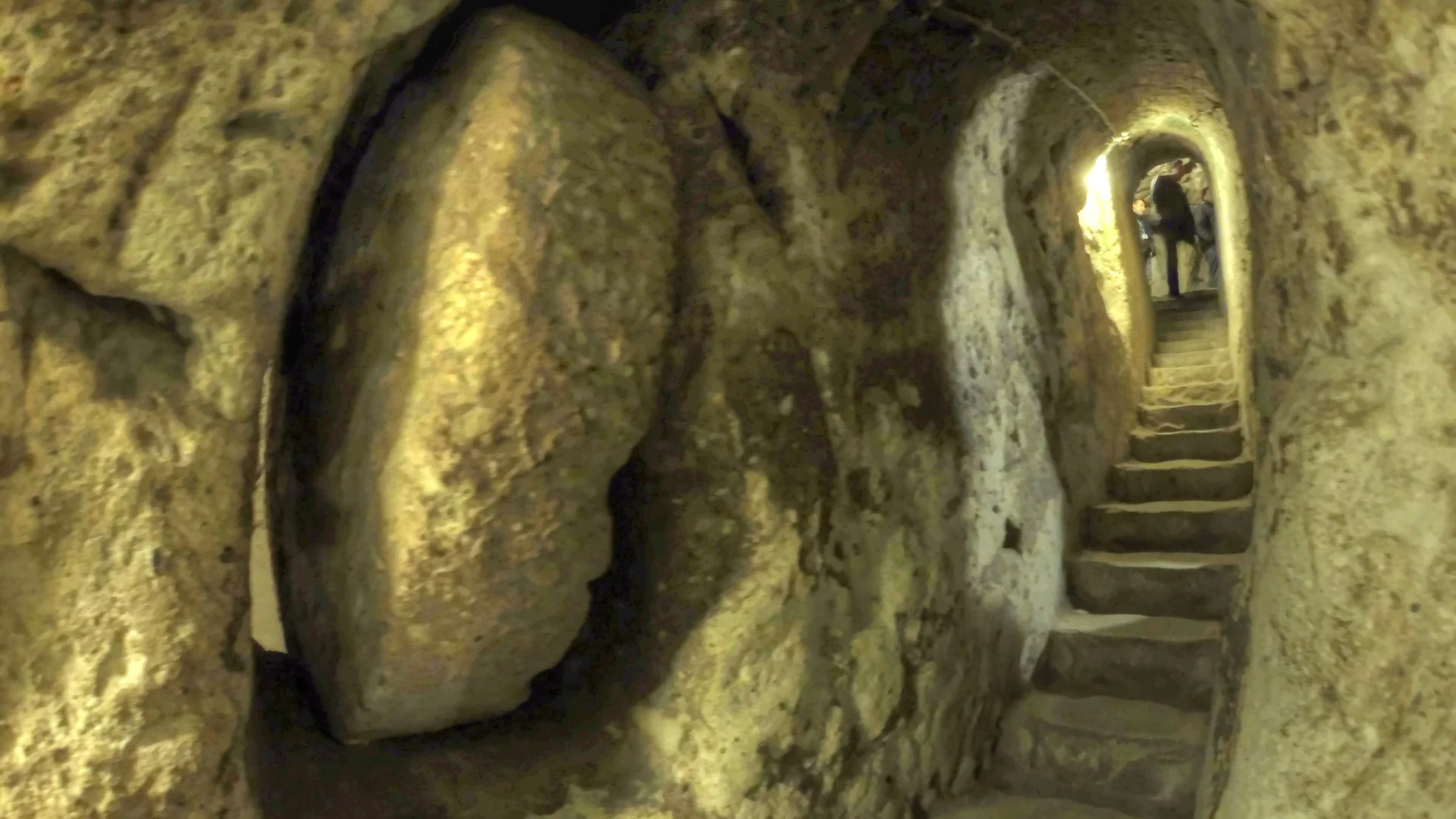
An ancient underground city carved 18 floors deep into Cappadocian volcanic rock, capable of sheltering 20,000 people — with stables, chapels, wineries, and wells — for months at a time.
In 1963, a man in the Cappadocian town of Derinkuyu demolished a wall in his basement and found another room behind it. And another room beyond that. And passages leading down. The rediscovery of a city that had been hidden under an ordinary Turkish town for over a thousand years began with a man wondering where his wall went.
The underground city descends 18 storeys — approximately 85 metres — into the soft volcanic tuff that underlies the entire Cappadocian plateau. It was carved by hand, likely between 800 BCE and the Byzantine period, expanded repeatedly by different civilizations seeking refuge from invasion. At its maximum capacity, it could accommodate an estimated 20,000 people, along with their livestock, food stores, and everything needed to outlast a prolonged siege.
The engineering is extraordinary in its completeness. Ventilation shafts descend the full 85 metres, bringing fresh air to every level. Channels connect to deep wells that tapped underground water. Wine presses, oil presses, stables with stone ties for horses, school rooms, communal halls, and at least one large church are carved from the rock. Rolling millstone doors — weighing hundreds of kilograms — could be sealed from the inside at each level, isolating sections of the city from whatever threatened above.
Derinkuyu connects to other underground cities via kilometres of tunnels. The full extent of the subterranean network beneath Cappadocia remains unmapped. Turkish authorities have opened eight of the 18 levels to visitors. They are not certain what remains below the eighth.