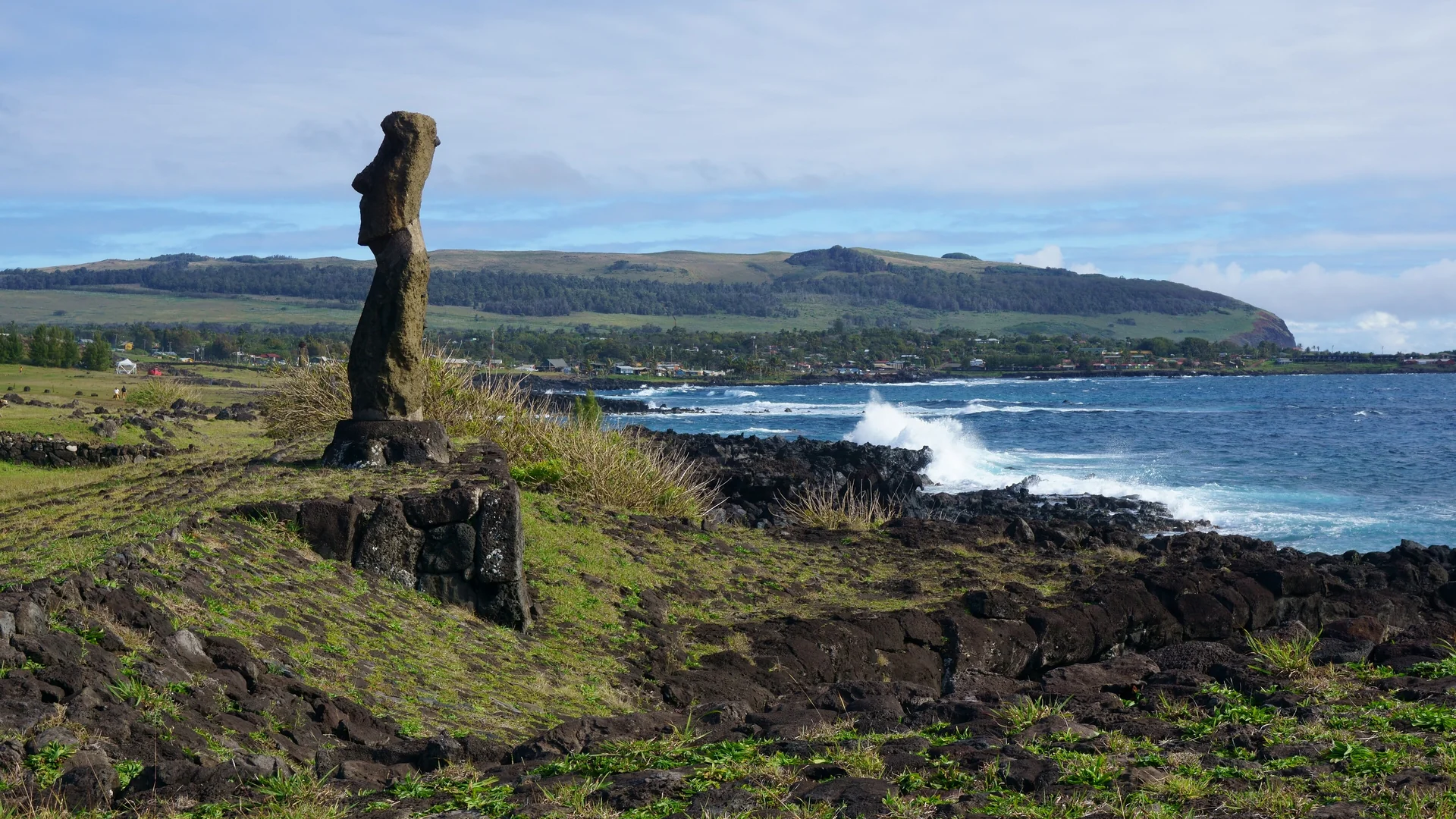
A remote volcanic island in the southeastern Pacific, home to 900 monolithic stone statues called moai — carved by the Rapa Nui people between 1250 and 1500 CE, some weighing 80 tonnes — and the site of one of the most debated collapses of a human civilization.
Rapa Nui sits at the southeastern corner of the Polynesian Triangle, 3,700 kilometers from the coast of Chile, 2,000 kilometers from the nearest inhabited island. It is one of the most isolated permanently inhabited places on Earth. The Polynesian people who arrived here around 1200 CE found a volcanic island covered in subtropical forest and built one of the most remarkable material cultures in human history.
The moai are the product of approximately 300 years of continuous carving, between 1250 and 1500 CE. They were carved from the volcanic tuff of Rano Raraku crater, transported across the island using methods still debated, and erected on stone platforms called ahu, facing inland toward the villages they were meant to protect. The largest erected moai is 10 meters tall and weighs 74 tonnes. An unfinished statue in the quarry would have been 21 meters tall and weighed approximately 270 tonnes.
The question of how they were moved — across terrain with no draft animals, no wheels, and limited timber — has produced competing theories for decades. The most supported current hypothesis involves rocking the statues upright on their flat bases, using ropes and coordinated teams to walk them forward in a waddling motion. Oral tradition says the statues walked.
The civilization that built them collapsed before European contact, probably due to a combination of deforestation, soil erosion, internecine conflict, and the disruption of the rat population introduced by the original settlers. By the time Europeans arrived in 1722, the forests were gone, the population had fallen dramatically, and the moai were being toppled.
The island now has a human population of about 7,700 people, a Chilean naval presence, an airstrip, and two million tourists per year. The moai stand on their platforms, facing the interior, watching over a landscape entirely different from the one they were built to protect.