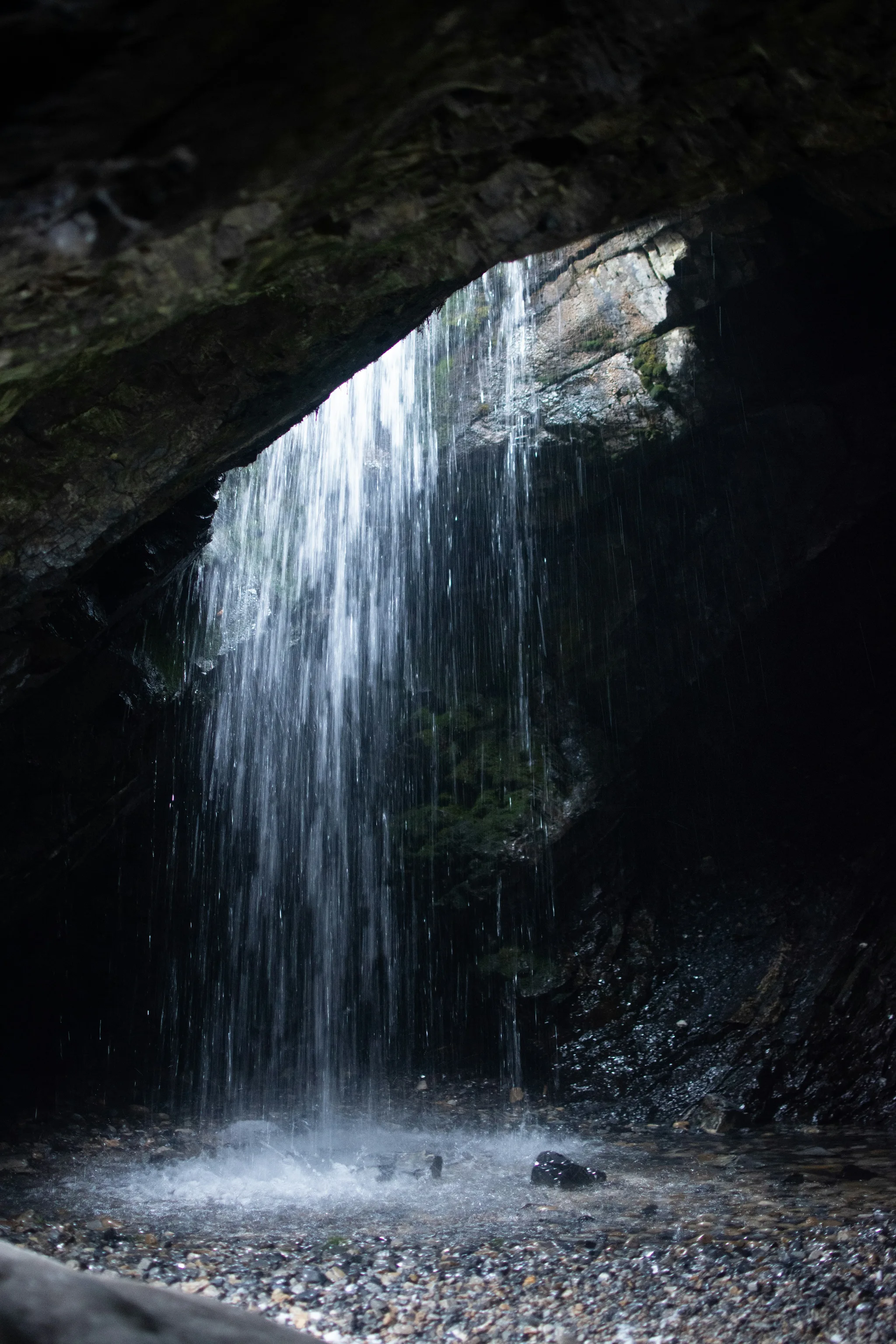
Deep in Chestnut Ridge Park, New York, a natural gas vent keeps a small flame burning perpetually behind a waterfall — fire and water coexisting in impossible harmony inside a mossy Devonian grotto.
In a forest in western New York, a small cascade falls over moss-covered Devonian shale into a shallow pool — and burning inside the grotto behind it is a natural flame, fed continuously by gas seeping through cracks in 350-million-year-old rock. Fire and water in the same enclosed space. The combination feels wrong in a way that takes a moment to articulate, because fire and water are supposed to cancel each other out. Here they have coexisted, in this same grotto, for longer than the town of Chestnut Ridge has existed.
The Eternal Flame Falls are located in Chestnut Ridge Park in Erie County, in the Alleghenies foothills of upstate New York. The waterfall drops approximately nine meters over an upper and lower cascade. The natural gas flame burns in an alcove carved into the shale at the base, sheltered from direct water flow by the geometry of the rock. It stands roughly 15–20 centimeters high in calm conditions. Heavy rainfall and high water flow extinguish it temporarily, but the flame relights easily from a match and re-ignites without human intervention after most weather events, as the gas seepage is continuous.
The gas is primarily methane and ethane, drawn from organic matter trapped in the Devonian bedrock and exposed by millions of years of geological uplift and erosion. What distinguishes this seep from most natural gas vents is the persistence of the geological setup: the source rock is ancient enough, the seep consistent enough, and the sheltering alcove protected enough that the flame has maintained itself across timescales that make human history look brief. The term "eternal" is a projection, but not an unreasonable one.
Geologists classify this type of feature as a seep-supported flame. Similar gas vents support persistent fires in Turkey, Azerbaijan, and Iraq — the eternal fires of Baku were burning when Marco Polo passed through in the 13th century. The difference at Chestnut Ridge is the context. A seep in a desert is one thing. A flame burning inside an actively flowing waterfall, in a deciduous forest in a New York state park, surrounded by beech and maple trees dropping leaves in autumn, is something else. It exists outside the categories that make nature legible.
The hike to the falls takes roughly 30 minutes on an unmarked trail from the park road. There is no signage at the trailhead, no guardrail at the falls. The flame is not guaranteed to be burning on arrival — hikers carry lighters as a matter of habit. Standing in the grotto with the mist from the falls on one side and the heat from the flame on the other, both simultaneously, is an experience that very few natural sites anywhere in the world can offer.