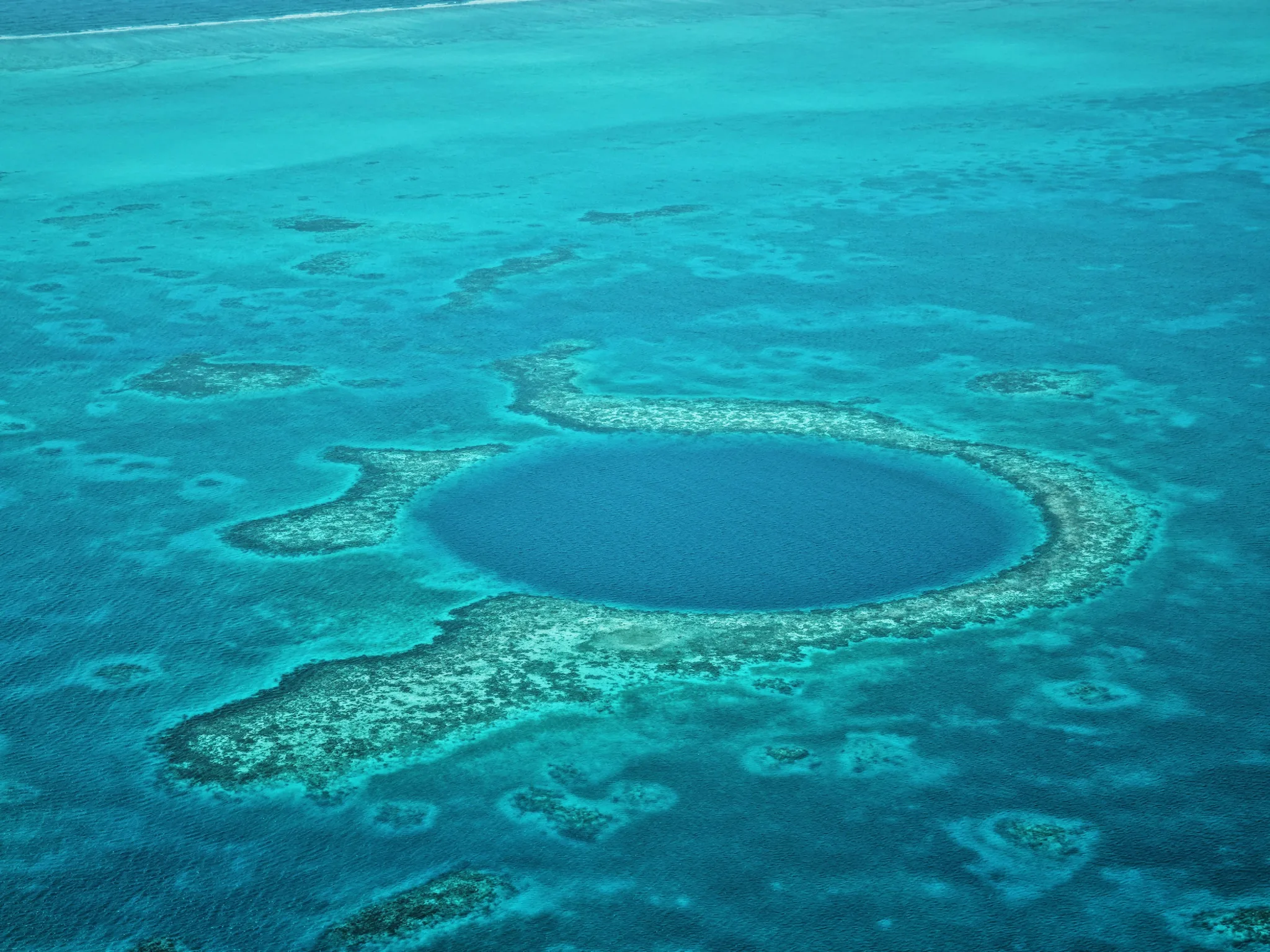
A 300-meter-wide, 125-meter-deep submarine sinkhole off the coast of Belize — a flawless ultramarine circle suspended in turquoise shallows, formed when rising seas drowned an ice-age cave system and left a window to the abyss.
The Great Blue Hole of Belize appears from the air as a circle of deep ultramarine punched through the surrounding turquoise shallows of the Lighthouse Reef Atoll — 300 meters wide, 125 meters deep, its color so distinct from the adjacent reef water that early aircraft pilots used it as an aerial landmark visible without looking for it. Jacques Cousteau declared it one of the top dive sites on Earth after leading an expedition to map its interior in 1971. The footage was broadcast on American television and introduced the Great Blue Hole to international dive audiences. It has been on every serious diver's list since.
The hole is a submerged sinkhole — a surface expression of a collapsed cave chamber. During the last Ice Age, when sea levels were 100–120 meters lower than today, the Lighthouse Reef was dry land and the limestone beneath it was being carved by rainwater into an extensive cave system. Approximately 10,000 to 15,000 years ago, as glaciers melted and sea levels rose following the end of the last glacial maximum, the cave system flooded. At some point during or after this flooding, a large cave chamber roof collapsed, leaving the circular sinkhole we can see today. The atoll reef then grew around the collapsed opening over subsequent millennia, framing it in coral.
The evidence of the cave's above-water history is preserved inside the hole at depth. Between 40 and 60 meters, divers encounter stalactites — calcium carbonate formations that grow only in air, requiring both the absence of water and the presence of carbon dioxide. The stalactites in the Great Blue Hole, some reaching 12 meters in length, grew when the cave system was above sea level and have been suspended at depth since the chamber flooded. Their presence provides geological documentation of the site's timeline and makes the deeper sections of the hole among the most significant cave dive destinations in the world.
The dive itself is organized in most cases as a day trip from Belize City or Caye Caulker — a three-hour boat journey or 15-minute seaplane flight. The recreational portion of the dive (to 30–35 meters) is technically straightforward in the hole's clear, current-free interior. The stalactite zone requires advanced certification and decompression dive planning. Visibility inside the hole regularly exceeds 30 meters; the transition from the bright blue surface water to the darker interior, with the circular rim of the opening visible above, is the defining visual experience of the site. The surrounding Lighthouse Reef is a UNESCO World Heritage Site and one of the most species-rich reef systems in the Caribbean, making the day trip worthwhile even for non-divers who can snorkel the atoll rim.
Safety information
Safety information is not available yet.
Before visiting this place, check current safety guidance, access rules, local restrictions, and official updates on other trusted websites. Our editorial team does not have verified safety information for this location at the moment; it will appear here later.