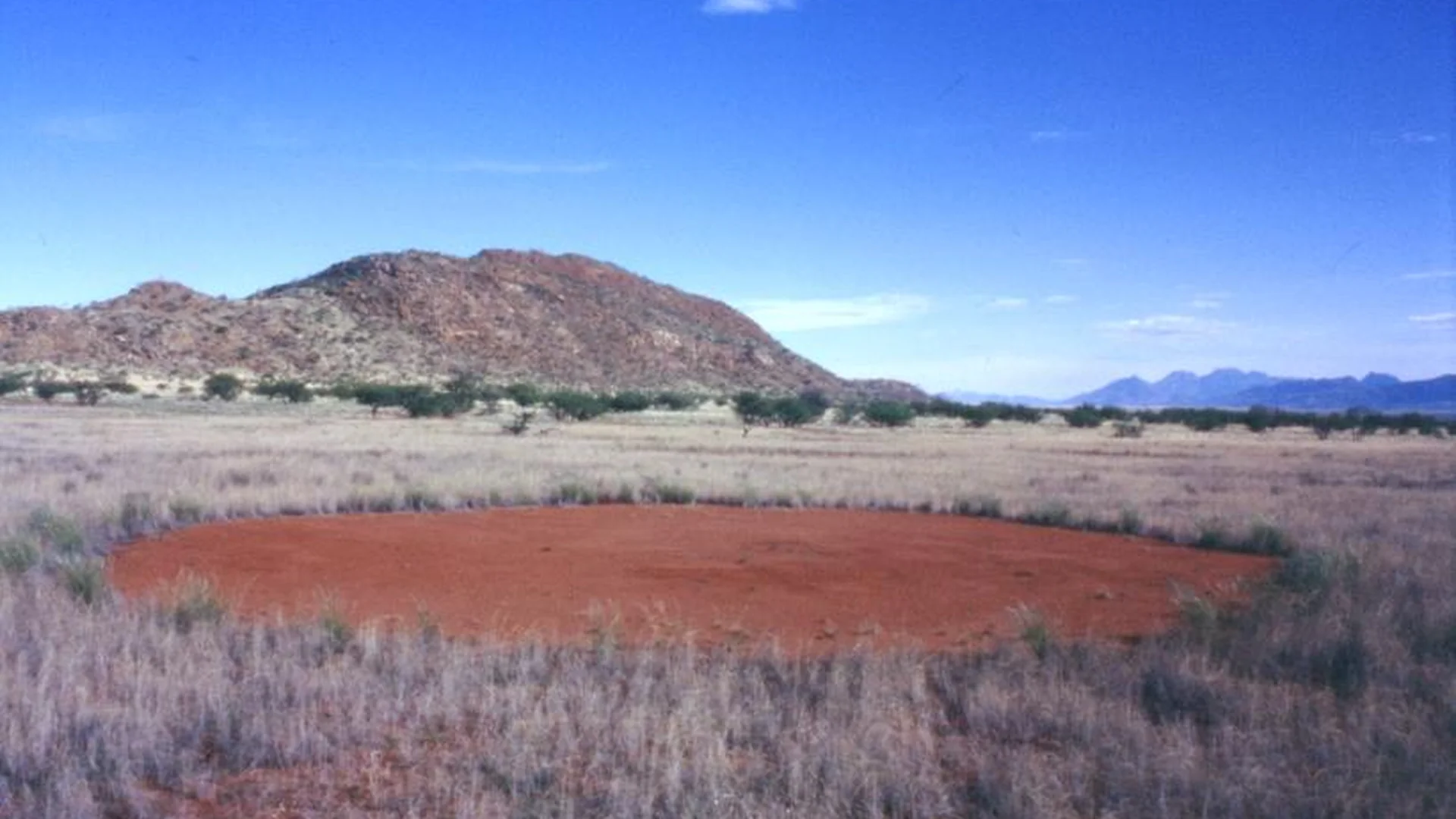
A landscape in the Namib Desert covered by millions of bare circular patches of earth, uniformly spaced, each surrounded by a ring of taller grass, extending for hundreds of kilometres with no single accepted scientific explanation.
They appear at the edge of the Namib Desert, where the arid grassland meets the older rock, and they extend for hundreds of kilometres in every direction — circular bare patches in the grass, each ringed by a border of taller, darker vegetation. From the ground they look like bald spots. From the air they look like a pattern laid by a mathematical hand. From a light aircraft at altitude, they look like the skin of something vast and alive.
The circles range from two to fifteen metres in diameter. They are spaced with a regularity that statisticians have measured and found to be non-random — the spacing is more uniform than chance would produce. They exist for a decade or two, then vanish, replaced by grass, and new ones form elsewhere in the landscape. The zone where they occur is in the Namib-Naukluft region of Namibia, and only here.
Scientists have been arguing about their cause for decades. Termite theories have been proposed and contested. Soil toxicity. Competition between grass plants for water, creating self-organizing patterns. Radioactivity. The San people, who have lived in this landscape for tens of thousands of years, have known about them much longer than science and call them the footprints of the gods.
No single explanation has won. The circles appear and disappear. The regularity persists. The pattern holds. Whatever made them is still at work.