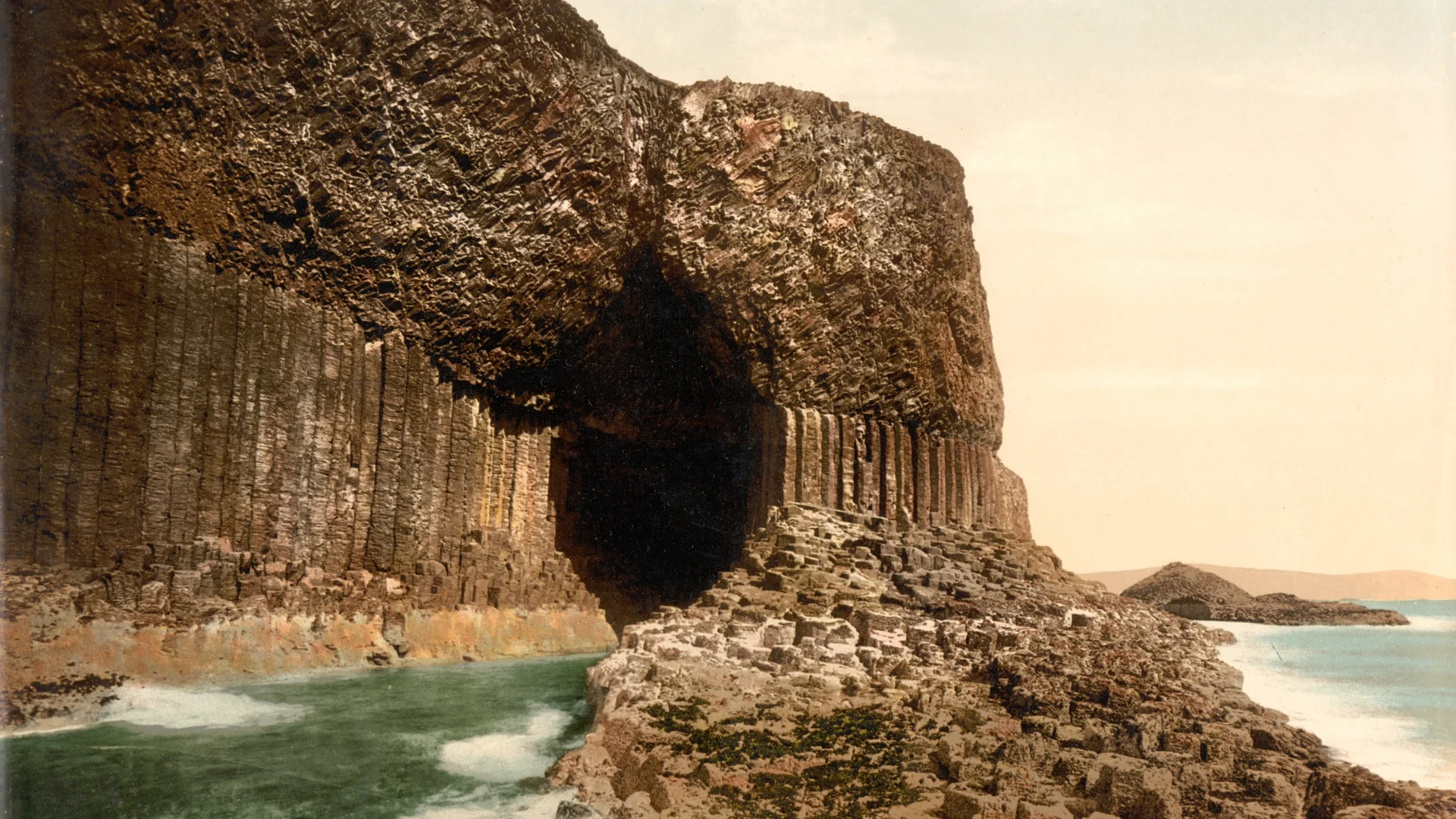
A sea cave on the uninhabited Scottish island of Staffa, its interior formed entirely by interlocking hexagonal basalt columns from the same 60-million-year-old volcanic eruption that created the Giant''s Causeway — the resonant acoustics inspired Felix Mendelssohn''s Hebrides Overture.
The island of Staffa has no permanent residents, no harbor, and no roads. It rises from the North Atlantic 10 kilometers from the nearest Scottish island — a basalt stack 70 meters high, its flanks made entirely of hexagonal columns that step down to the sea like the remnants of a vast natural architecture.
Fingal''s Cave opens in the southern face of the island, accessible only by sea. The entrance is 20 meters high. Inside, the walls and ceiling are formed by the same interlocking hexagonal basalt columns that make up the island''s exterior — the product of a 60-million-year-old lava flow that cooled with such exceptional regularity that it fractured into hexagons, the same geometry found at the Giant''s Causeway in Northern Ireland, 200 kilometers to the south.
The cave is 85 meters deep. Its floor is below sea level — the only way to enter at high tide is by boat; at low tide, a narrow ledge of columnar basalt allows passage on foot. The acoustics are the reason for the name. Atlantic swells enter the cave, compress against the far wall, and return, creating sounds described variously as moaning, organ-like, and vertiginous.
Felix Mendelssohn visited Staffa in 1829 at age 20. He was seasick on the way there. He stayed long enough to write the opening bars of what would become the Hebrides Overture in a letter to his sister before leaving. The piece captures something of the cave''s particular quality — the repetition, the swell, the sense of something enormous working on something enclosed.
The Gaelic name Uamh Binn means "melodious cave." The Norse name from which Staffa derives means "pillar island." Both are accurate. Together they describe something for which English only has "extraordinary."