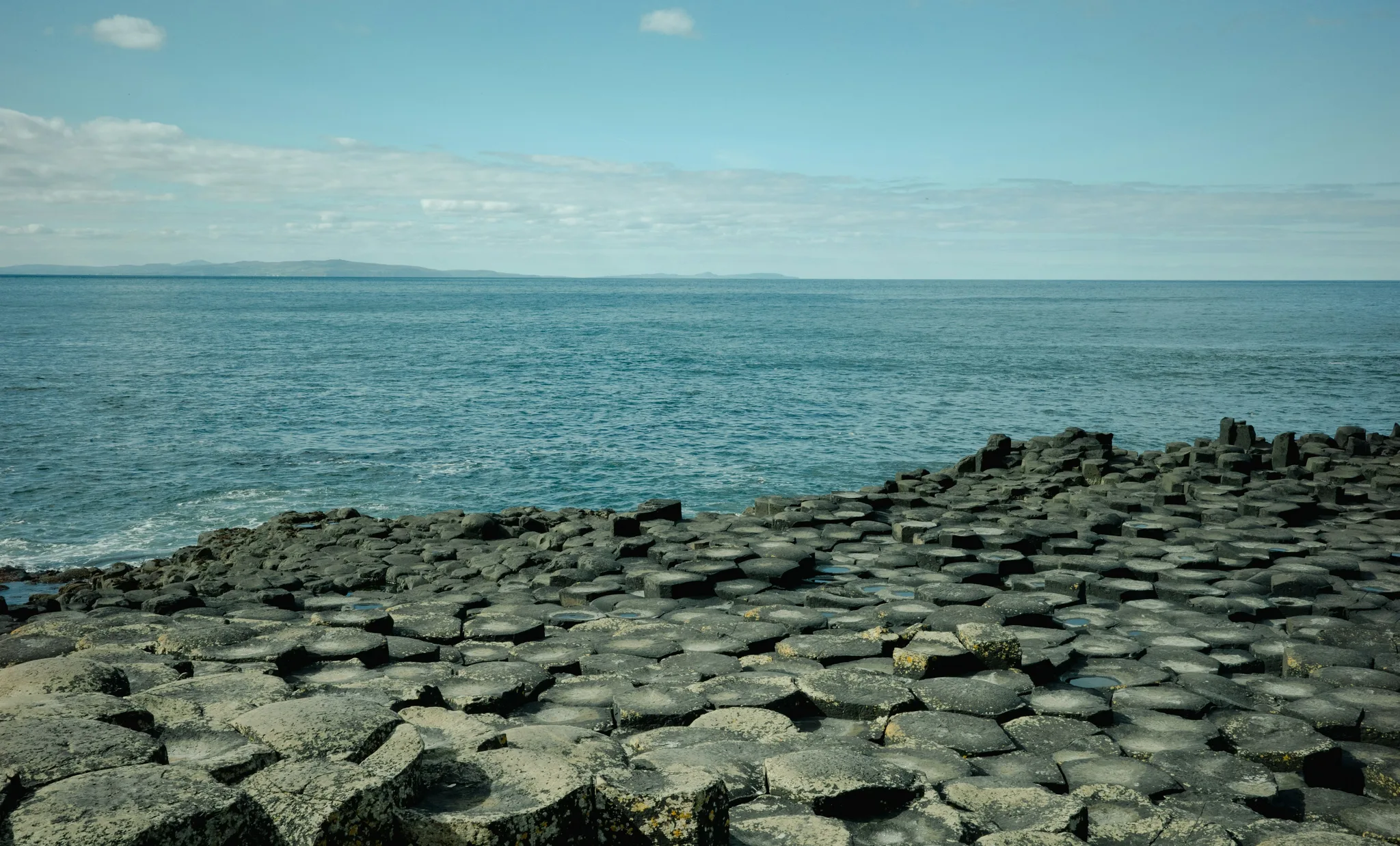
Around 40,000 interlocking basalt columns formed by a volcanic fissure eruption 60 million years ago, their hexagonal geometry so perfect that medieval people were convinced giants had built a causeway to Scotland.
Sixty million years ago, a volcanic fissure eruption flooded the surface of what is now northern Ireland with basalt lava flows up to 90 meters deep. As the lava cooled uniformly from the surface downward, it contracted. When a flat, homogeneous material contracts from a flat surface, it fractures in the most geometrically efficient pattern available — a hexagonal network, the same pattern that appears in drying mud, in the cells of a beehive, and in the columnar jointing of basalt cooling on flat ground worldwide. At Giant's Causeway, this process produced approximately 40,000 basalt columns, the majority hexagonal in cross-section, stacked in descending steps from the base of the coastal cliff to the North Atlantic.
The medieval and early modern inhabitants of this coastline had no access to volcanology. What they saw was a causeway — clearly constructed, clearly regular — built by something with the engineering capacity for thousands of precisely fitted stone columns. The giant Finn MacCool, hero of the Ulster Cycle, was the builder in Irish tradition: he constructed the causeway to cross to Scotland and fight his rival Benandonner, then tore it down on his return to prevent pursuit. The myth has the quality of a story built from observation: it starts from the genuine strangeness of the columns and works backward to find a cause proportionate to the effect.
The geological confirmation of the myth's spatial logic is visible in Scotland. Fingal's Cave on the island of Staffa in the Inner Hebrides shows identical hexagonal basalt columns emerging from the sea 200 kilometers northeast of the Causeway. Both formations are surface expressions of the same volcanic event — the same eruption, the same cooling process, the same hexagonal fracture pattern, separated by the opening of the North Channel as ice melted and sea levels rose. The causeway does go to Scotland, not through water but through the geological record. The myth was right about the connection.
The Causeway Coast is a UNESCO World Heritage Site and one of Northern Ireland's primary visitor destinations, attracting approximately 1.2 million visitors per year to the Giant's Causeway formation itself. The National Trust manages the site; a visitor center at the top of the cliff provides context and manages the pedestrian flow down to the columns. The path from the visitor center to the water's edge takes approximately 20 minutes on foot. Shuttle buses are available for those who cannot walk the gradient.
The best experience of Giant's Causeway is available in the early morning on any weekday outside July and August, when the overnight visitors who have stayed in the Causeway area arrive before the buses. At the base of the cliff, standing where the columns meet the sea, the hexagonal pattern is visible in every direction simultaneously — underfoot, in the cliff face beside you, in the columns disappearing into the water in front. The geological explanation is entirely clear and completely satisfying. It also loosens its grip entirely when the Atlantic comes in at the base of the columns and the spray covers the geometric stone and the sky is doing what the Irish sky does in the early morning. The myth comes back, not as belief, but as the correct emotional register for a landscape this extraordinary.