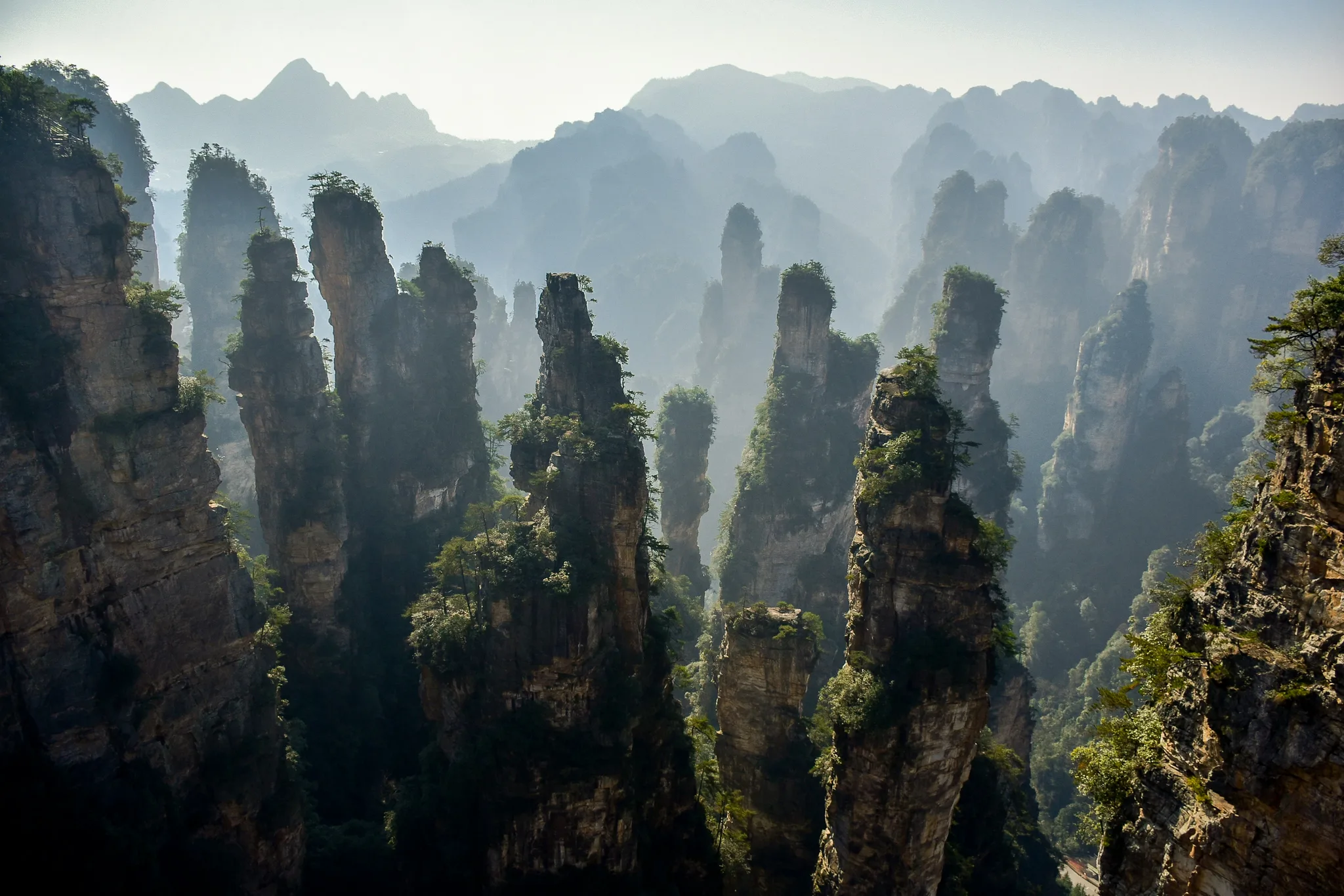
A forest of slender quartzite sandstone pillars cloaked in subtropical mist and vegetation — one of the most dramatic vertical landscapes on Earth, and the direct visual reference for the floating Hallelujah Mountains in Avatar.
The name means Son of Heaven Mountains. They rise from the subtropical valley like columns left by some vanished architecture — slender, vertical, hundreds of meters tall, draped in hanging vegetation and moss, half-submerged in cloud for much of the year. What produced them is geology, not mythology, but the geology requires time spans that make mythology seem rapid by comparison. 380 million years ago, quartz sandstone sediment accumulated in a shallow sea that covered this part of Hunan Province. 30 million years ago, tectonic forces lifted the plateau. Then erosion worked the rock for tens of millions of years, removing everything soft and leaving the hardest sandstone standing as near-vertical columns. The current landscape is what remains when most of a plateau has been taken away.
Tianzi Mountain is the highest point in the Wulingyuan Scenic Area, reaching 1,262 meters. The broader area, which includes Zhangjiajie National Forest Park, covers approximately 264 square kilometers of pillar and peak landscape inscribed as a UNESCO World Heritage Site in 1992. The Tianzi formation takes its name from a local legend of a Tujia leader who staged a revolt in the 14th century, claiming this mountain as his base — tian means heaven, zi means son. The combination creates a designation that accurately describes what standing on the summit in cloud feels like: suspended between earth and something larger.
James Cameron's production designers visited the Wulingyuan area in 2008, specifically including Tianzi Mountain and the adjacent Zhangjiajie formations, during the development of Avatar. The floating Hallelujah Mountains of Pandora are not a loose approximation. They are a translation: the same proportions, the same near-impossible verticality, the same relationship between stone surfaces and cloud, the same visual logic of massive forms appearing to float when their bases are obscured by mist. Cameron acknowledged the direct reference publicly after the film's release and a prominent pillar in the area was subsequently renamed Avatar Hallelujah Mountain.
The mist that fills the valleys between pillars on most mornings is not atmospheric effect or photographic enhancement. It is produced by the evapotranspiration of the dense subtropical forest in the valleys combined with the temperature difference between the valley floors and the exposed peaks. On a still morning with light wind, the cloud fills to a level that covers the bases of most pillars and leaves their summits projecting above — and the visual effect is exactly what the photographs show. The stone appears to float. The forest has disappeared. What remains looks designed, like the ruins of a civilization that built at a scale and in a material no civilization has ever used.
The Tianzi Mountain cable car runs from the valley floor to the summit ridge, making the high viewpoints accessible without the 3–4 hour hike. The summit area has viewing platforms, a small hotel, and restaurant facilities — infrastructure that is visible in the landscape from below but becomes irrelevant when cloud fills the valleys and the platforms sit above it. For the floating effect, the timing is October through March, early morning, after a clear night when mist has had time to develop in the still air. What you see from the platform in those conditions is either the best available confirmation of the Avatar production design team's judgment, or evidence that the film was simply the first to translate to a mass audience what the Tujia people have known for centuries.