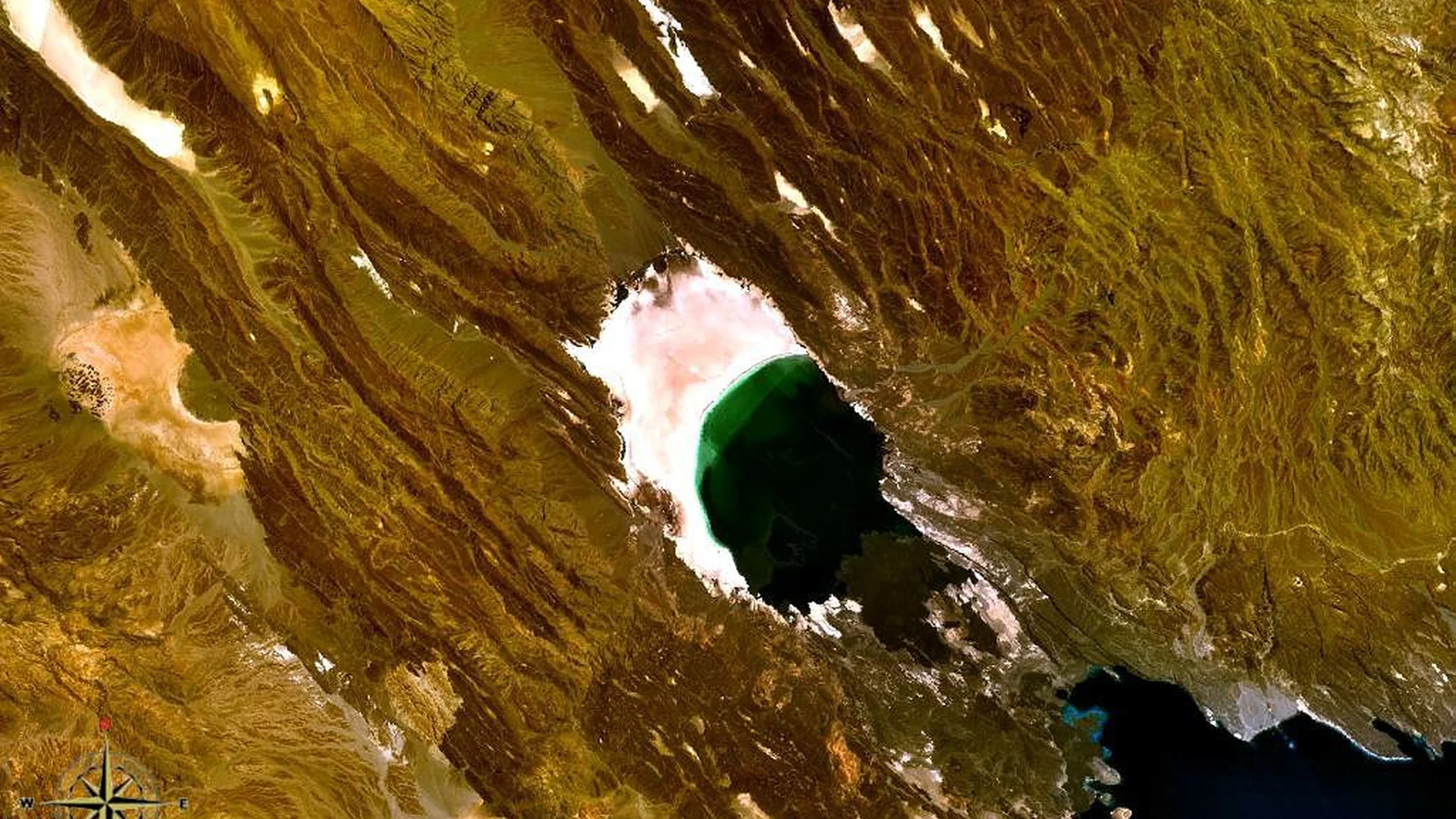
155 metres below sea level in one of the hottest places on Earth, Lake Assal is ten times saltier than the ocean — a white salt crust surrounds cobalt water that nothing can live in.
Lake Assal sits at the lowest point in Africa and the third lowest on Earth — 155 metres below sea level, in the Afar Triangle, where the African, Arabian, and Somali tectonic plates are pulling apart simultaneously. The lake occupies a volcanic crater surrounded by fields of black lava and white salt, in one of the most geologically active and climatically extreme places on Earth. Summer air temperatures regularly exceed 50°C.
The water is extraordinary. With a salinity of approximately 34.8% — ten times saltier than the ocean and three times saltier than the Dead Sea — it is one of the most saline bodies of water on Earth. Nothing lives in it. The salt concentration is too extreme for any organism to metabolize. The water is cobalt blue in the centre, shading to white at the edges where salt has crystallized out of the supersaturated solution.
These salt deposits are the lake''s economic significance. For centuries, Afar nomads have harvested the salt and traded it inland — camel caravans still carry salt blocks along routes that have not changed in a thousand years. The caravans cross 100 kilometres of desert in temperatures that approach the lethal limit for human physiology.
The geology around the lake is stark and theatrical. Black basalt lava fields from recent eruptions contrast with the white salt crust. Fumaroles steam from fractures in the rock. The ground is visibly moving — geologists measure the spreading rate of the African Rift here at approximately 16 millimetres per year. In 200 million years, Djibouti will be an island in a new ocean.