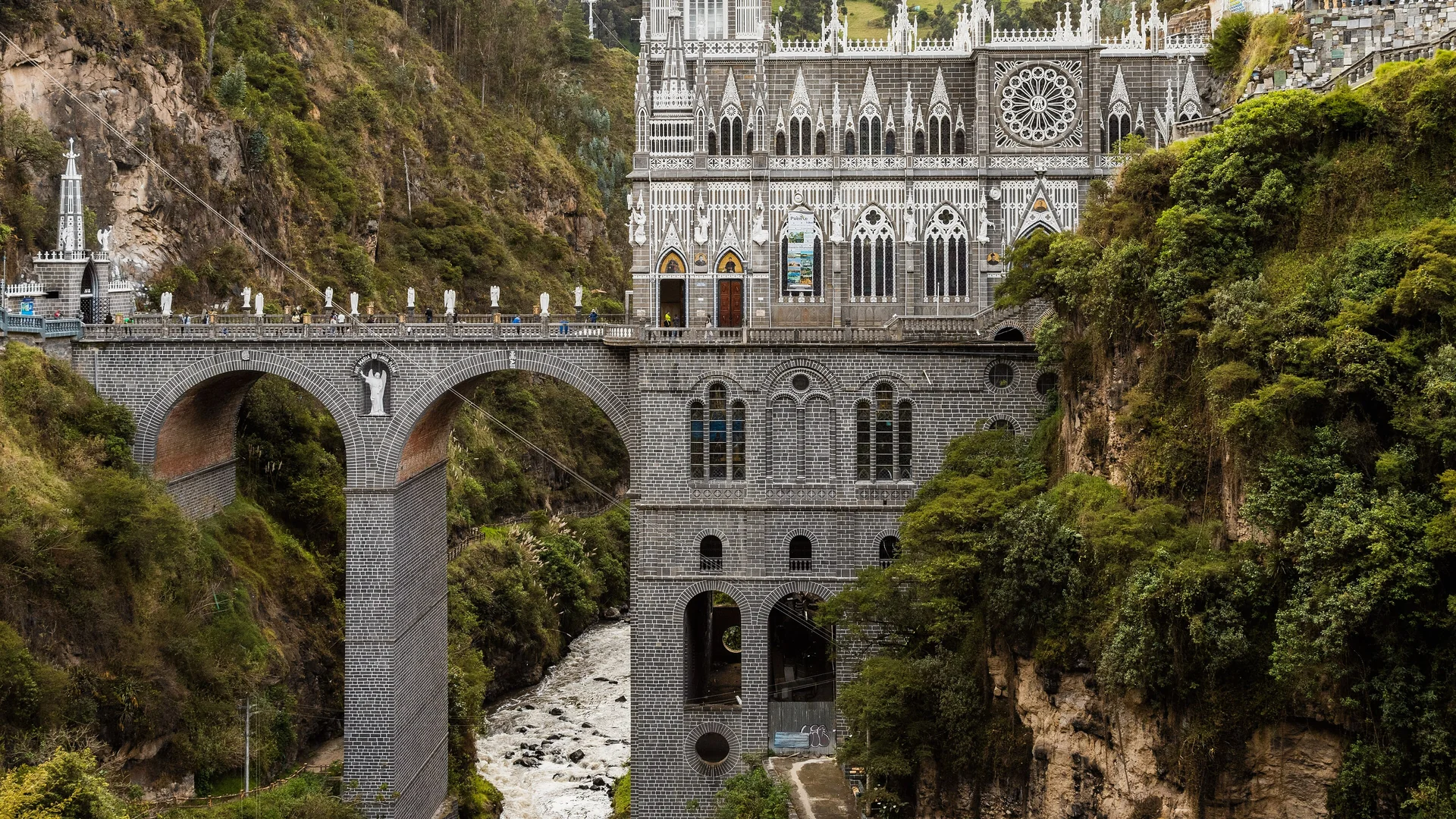
A neo-Gothic church built into the walls of a deep river gorge in southern Colombia, its towers rising 45 metres from a bridge over the Guáitara River to meet the cliff face above.
The apparition was seen in 1754. An indigenous woman named María Mueses de Quiñones and her deaf-mute daughter were crossing the Guáitara gorge when the daughter suddenly spoke, saying she could see the Virgin Mary on the rockface inside a cave in the canyon wall. María looked and saw the same. The Catholic Church investigated. Other miracles followed. The cave became a shrine.
Over the next two centuries, that shrine became one of the most architecturally improbable churches on Earth. The current structure — built between 1916 and 1948 in neo-Gothic style — spans the gorge on a bridge, its foundations anchored to the canyon walls on both sides, its towers rising 45 metres to bring the roof level with the cliff tops. The façade faces the river. The interior extends into the rock face itself, where the cave of the original apparition still exists.
The structure has no proper ground to stand on. It stands on a bridge. The canyon walls are its walls. The river runs 30 metres below the nave floor, audible through the stone.
The path to the sanctuary descends into the gorge along canyon walls lined with plaques — ex-votos, offerings of gratitude for miracles attributed to Las Lajas. There are thousands of them, covering the rock in layered testimony. People have been attaching their thanks to these walls for 270 years.