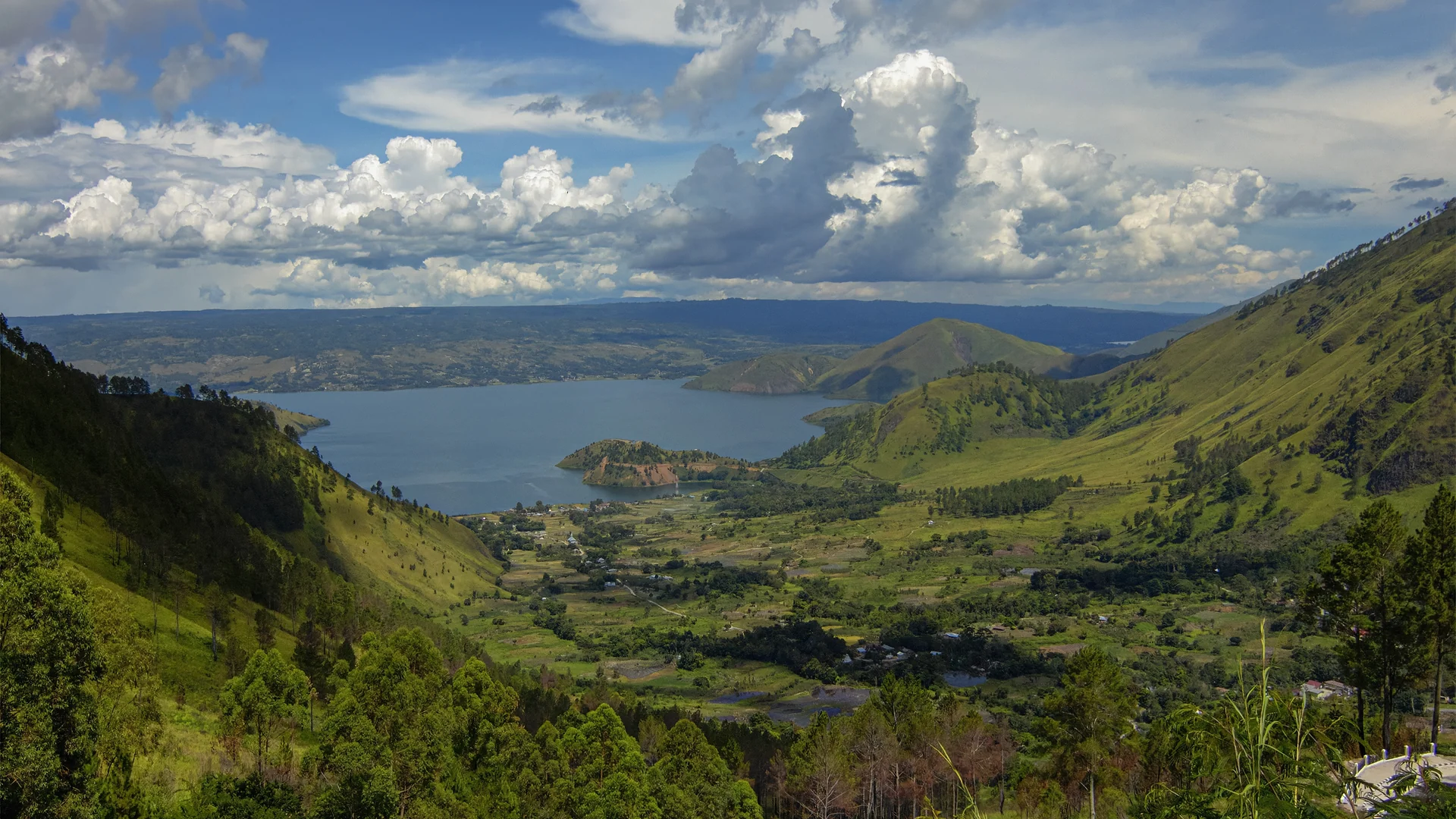
The world's largest volcanic lake, occupying a supervolcanic caldera whose eruption 74,000 years ago may have reduced the entire human population to a few thousand individuals.
Lake Toba is 100 kilometres long, 30 kilometres wide, and 505 metres deep. It sits inside a caldera — a volcanic depression formed by the collapse of an emptied magma chamber — and the caldera is the result of an eruption 74,000 years ago that was the largest volcanic event in the last 2 million years.
The Toba eruption released an estimated 2,800 cubic kilometres of material. Ash fell across South Asia to a depth of 6 metres. Sulphur dioxide injection into the atmosphere triggered a volcanic winter that lasted years, possibly a decade. Global temperatures dropped by an estimated 3 to 5 degrees Celsius. The human population at that time was already small — anatomically modern humans had only recently spread out of Africa. Genetic evidence suggests that the global human population was reduced to as few as 3,000 to 10,000 individuals. We nearly did not survive.
The lake that now fills the caldera is impossibly tranquil by comparison. The water is clear. A large island — Samosir Island, itself the size of Singapore — rises from the lake''s centre, formed by the slow uplift of magma below pushing the ground back up after the eruption emptied it. Batak villages cluster on its shores, their traditional houses with their curved roofs reflected in the water.
The geology beneath the lake is not dormant. It is quiescent. The distinction matters.