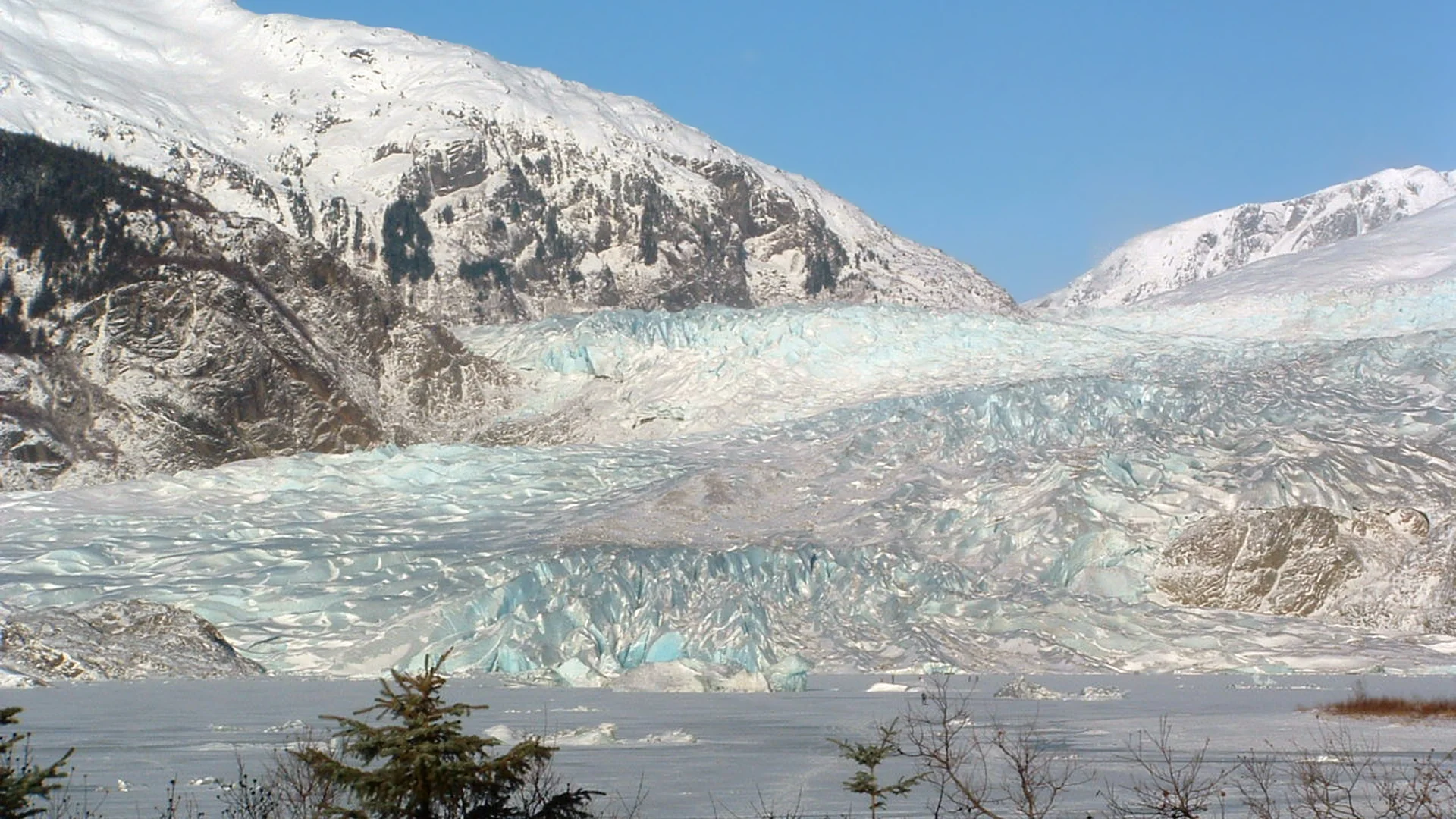
Ephemeral caves within the Mendenhall Glacier near Juneau — their ice walls glow an otherworldly blue as compressed glacial ice absorbs all wavelengths of light except blue, and they are retreating as the glacier melts at accelerating speed.
The blue is physics. Ancient snow compresses into glacial ice over centuries, expelling air and increasing crystal density. Dense ice absorbs wavelengths of light at the red end of the spectrum more readily than at the blue end. The deeper and older the ice, the more red is absorbed; the more blue passes through. The ice glows.
In the meltwater caves that form beneath and within the Mendenhall Glacier — carved by streams of meltwater that flow through and under the ice each summer — this blue light is total. The walls, ceiling, and floor are ice that ranges from translucent white to deep cobalt. Water streams across the floor. The glacier groans above. The cold is absolute.
Mendenhall Glacier descends from the Juneau Icefield, one of the largest icefields in North America, and terminates in Mendenhall Lake, just 19 kilometers from downtown Juneau. The glacier has been retreating since the 1940s and is doing so with increasing speed. The lake it calves into did not exist a century ago.
The ice caves are temporary in two senses: they change shape from year to year as the meltwater cuts new channels, and they exist within a glacier that is itself disappearing. Access requires kayaking across the glacier lake, then climbing ice — an approach that has become more hazardous as ice conditions change. Some years, certain caves are inaccessible. Other years, new ones open.
Visiting Mendenhall's ice caves is an encounter with geological time running out in real time. The blue light is extraordinary. The reason for its impermanence is not.