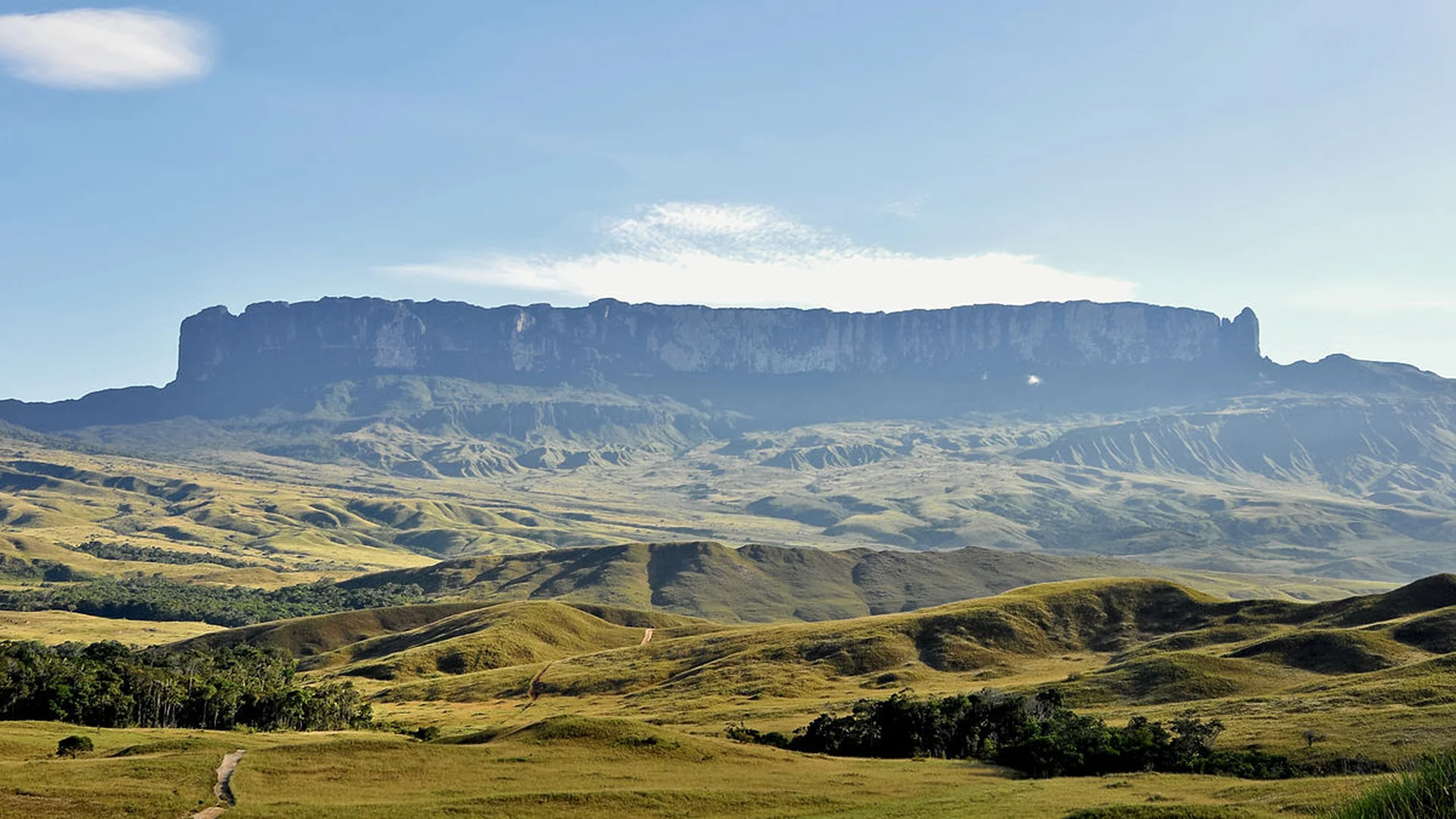
The highest tepui in the Guiana Highlands — a flat-topped sandstone mesa with vertical 400-meter cliff walls shrouded in permanent cloud, its isolated summit hosting endemic species found nowhere else on Earth, and the probable inspiration for Arthur Conan Doyle''s The Lost World.
The Precambrian sandstone of Mount Roraima is among the oldest exposed rock on Earth — approximately 1.8 billion years old, formed when the continents themselves were still assembling. The Guiana Shield, of which Roraima is part, is one of the ancient cores around which the South American continent accreted over hundreds of millions of years.
For most of geological time, Roraima was part of a vast sandstone plateau that once covered much of the region. Erosion removed the surrounding material. What remains are the tepuis — flat-topped table mountains with vertical walls, rising above the Venezuelan grasslands. Roraima is the highest, at 2,810 meters, and its summit is shared between three countries: Venezuela, Brazil, and Guyana.
The summit plateau is roughly 30 square kilometers of alien landscape — flat sandstone carved by rain and wind into a labyrinth of dark rock formations, black pools, pink sand, and endemic plants. Because the summit has been isolated by its cliff walls for millions of years, its biology diverged from everything below. Of the plant species on Roraima''s summit, approximately 35% exist nowhere else on Earth. The same is true of many of its insects and amphibians.
Arthur Conan Doyle published The Lost World in 1912, imagining a plateau in South America where prehistoric life had survived in isolation from the rest of evolution. He based it partly on reports of Roraima from explorers. He was right about the isolation. The evolution that happened here — the pink sand, the carnivorous plants, the unique frogs — is strange enough without dinosaurs.
The standard approach requires a four-day trek from the Venezuelan town of Paraitepui. The final ascent follows the only natural ramp in Roraima''s vertical walls — a route that feels like entering somewhere that was not meant to be entered.