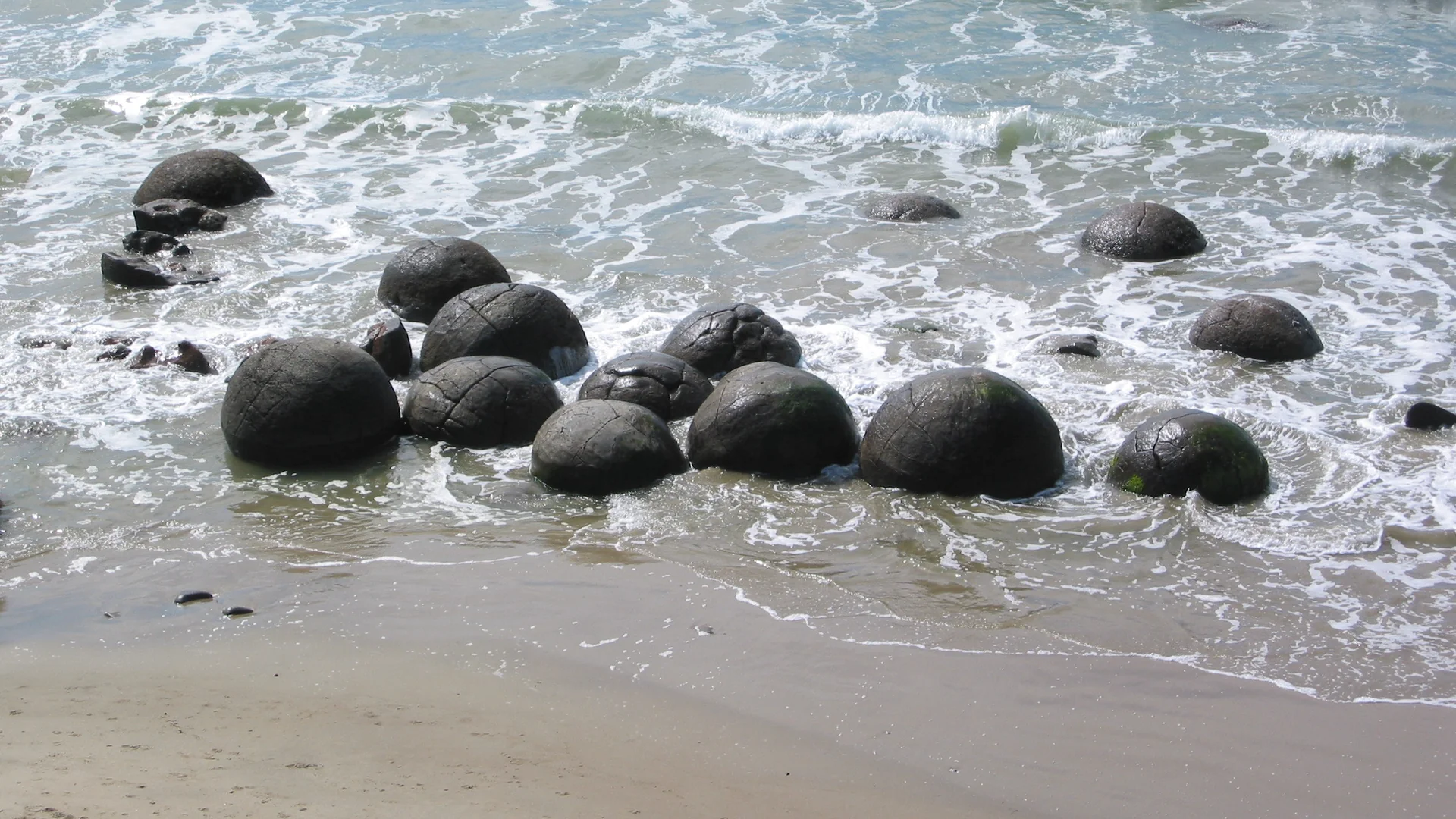
Dozens of enormous spherical boulders emerging from the eroding cliffs of Koekohe Beach — some up to 2 meters in diameter — septarian concretions formed on the ancient seafloor 60 million years ago and slowly revealed as the mudstone cliffs retreat.
They look placed. That is the first response, and it is wrong but understandable. Dozens of enormous stone spheres, most measuring between 0.5 and 2 meters in diameter, scattered across a stretch of New Zealand beach — some clustered, some isolated, some fractured and revealing their hollow interiors, some half-buried in sand, some perched on rock ledges at the tide line. They look as if someone arranged them.
They were not arranged. They are septarian concretions — a geological process in which minerals accumulate around a central nucleus in concentric layers, forming a sphere. The process takes millions of years. These formed on the ancient seafloor approximately 60 million years ago, when this part of New Zealand was under a shallow sea. The material is calcite and clay minerals, cemented around a nucleus that might be a piece of shell, a shark tooth, or simply a concentration of organic matter.
The mudstone cliffs that hold them have been eroding for millennia. As the cliff face retreats, it releases the boulders it has held. They roll down to the beach, where wave action removes the surrounding softer matrix and leaves them exposed. Some have been on the beach for centuries; others have emerged recently. There will be more.
Māori tradition has a different explanation. The boulders are eel baskets, pumpkins, and kumara that washed ashore from a great canoe called Āraiteuru that was wrecked on the coast, along with its cargo. The sea preserved what the crew could not save.
At low tide, standing among the boulders as the Pacific comes in around them, the geological explanation and the traditional one both seem like attempts to account for the same fundamental feeling: that you have come upon something that was already here, and that has been waiting.