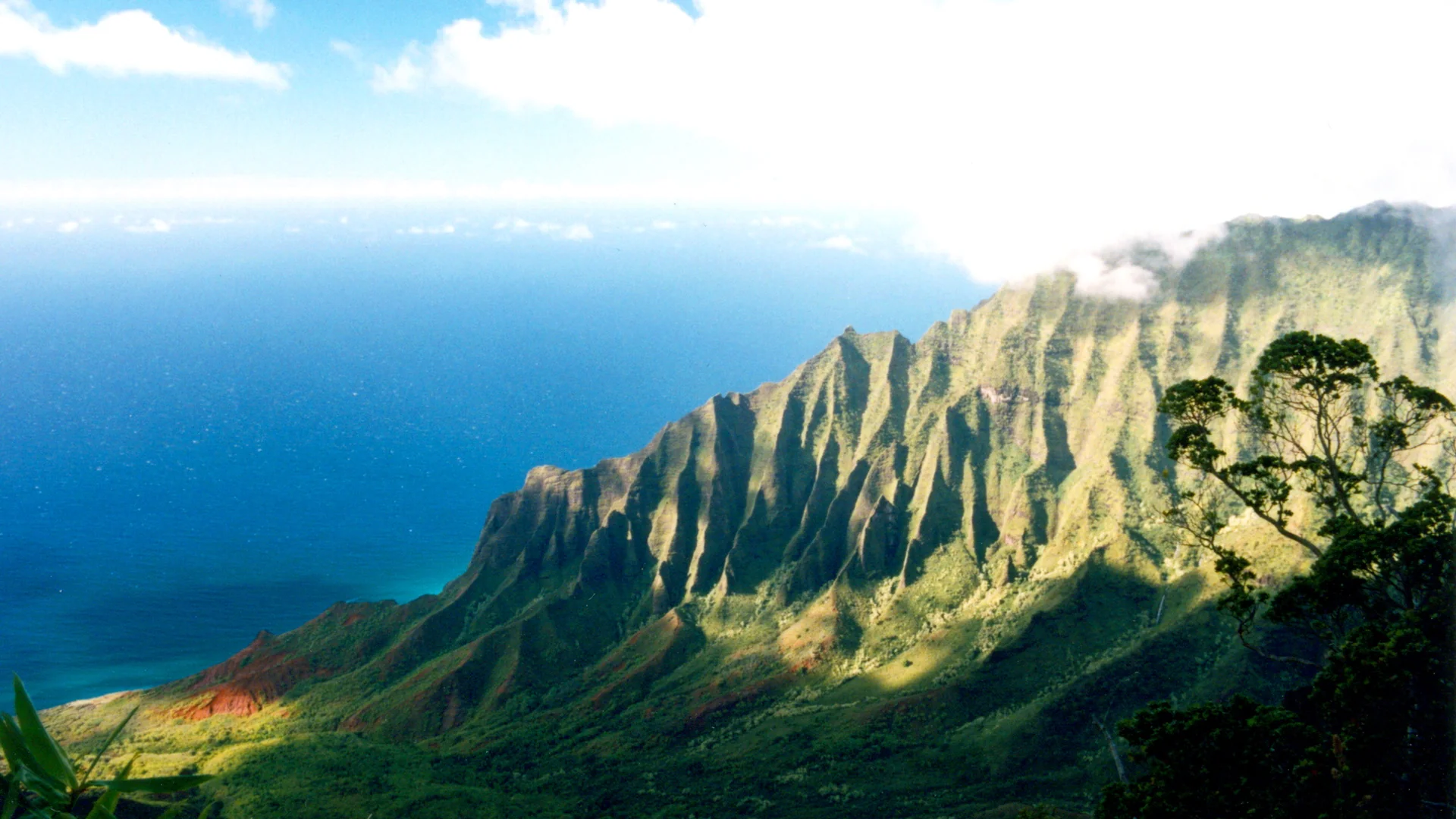
The northwest coast of Kauai where erosion has carved 27 kilometres of fluted green sea cliffs rising 1,200 metres directly from the Pacific — accessible only by sea, by air, or by one of the most gruelling day hikes in the United States.
The Hawaiian word nā pali means the cliffs. The name is accurate but insufficient. These are not cliffs in the way that word typically functions — a vertical face below a plateau, a geological interruption in an otherwise horizontal landscape. The Nā Pali Coast is 27 kilometres where the mountains of Kauai meet the Pacific without transition: the ridge peaks at over 1,200 metres and falls directly into the water, the cliffs fluted by five million years of rainfall into a series of vertical columns and buttresses, their faces green with vegetation to a point and then bare wet rock above that.
Kauai receives the highest rainfall of any island on Earth on its central plateau — Mount Waialeale averages over 11,000 millimetres per year, among the highest recorded. The rivers that flow from this plateau have been cutting the valleys for five million years. On the Nā Pali coast, the valleys have been separated by the sea from the rest of the island, accessible only from the water, their floors occupied by tiny beaches visible from above as strips of white between the cliff bases.
There are three ways to see this coastline. By sea, on a boat or kayak that hugs the base of the cliffs, the scale becomes measurable: the cliffs go up and up, the sound of the swells against the base echoes differently under the overhangs. By air, in a helicopter, the perspective reverses: the ridgelines, the valleys, the white beaches visible below. By foot, on the Kalalau Trail — 18 kilometres of switchbacks cut into the cliff face — the access is earned step by step, and the coast reveals itself gradually, each headland rounding to a new view of the next impossible cliff face.
The Kalalau Valley, reachable only by the trail or by sea, was continuously inhabited by Native Hawaiians for over a thousand years. It was abandoned in 1919 when the territory government required residents to leave. The valley has been mostly uninhabited since.