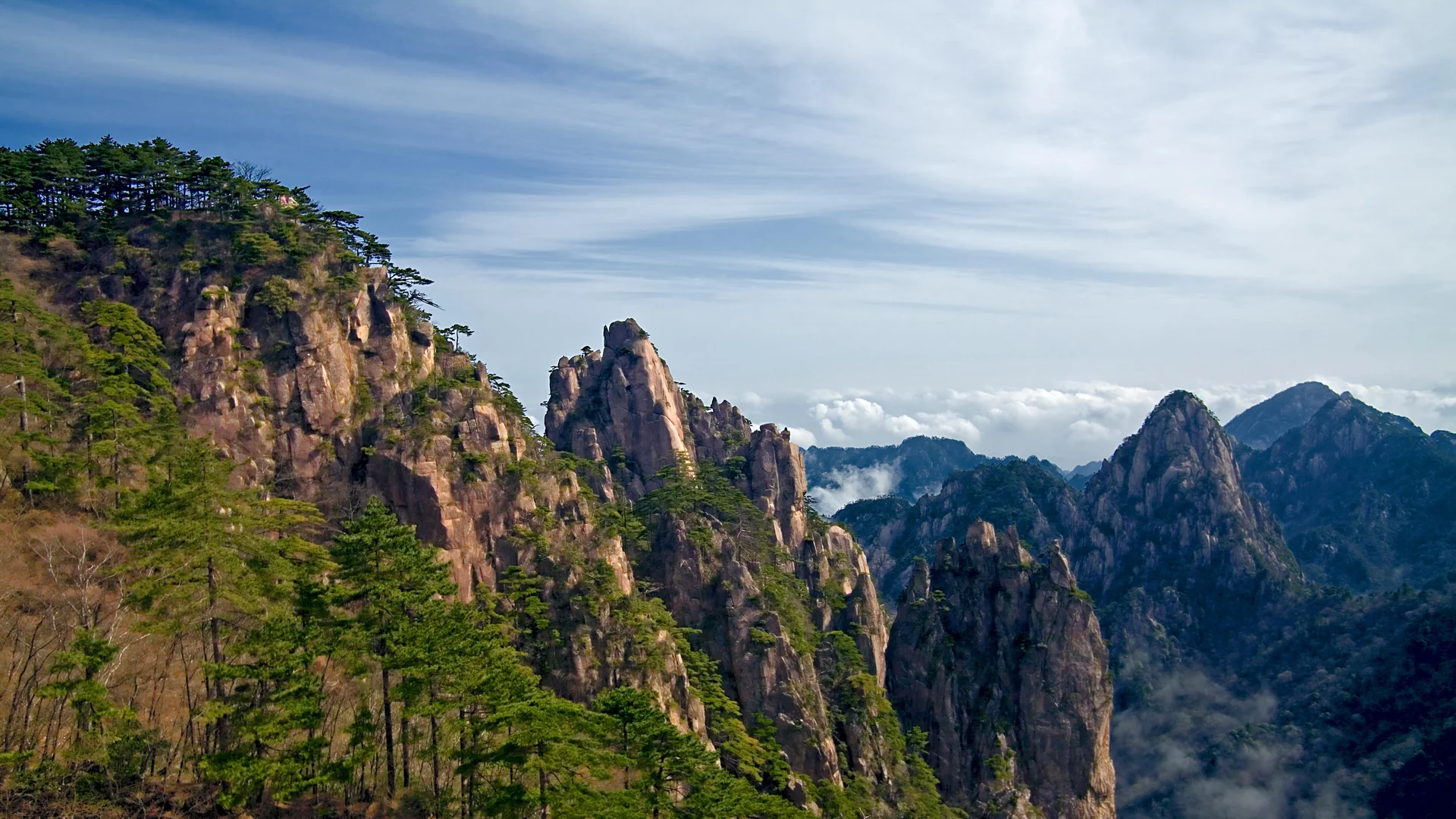
A mountain range in Anhui Province where 77 peaks rise above 1,000 metres, their granite summits draped with gnarled pines and often completely submerged in a sea of clouds — the landscape that defined Chinese painting for a thousand years.
Chinese landscape painting — the tradition that stretches back a thousand years, the silk scrolls and ink washes that hang in every major museum — was not imaginary. The painters were depicting a real place. They were depicting Huangshan.
The mountains are granite, pushed up through the earth''s surface 65 million years ago and then eroded into their current form by glacial action during the ice ages. The result is 77 peaks above 1,000 metres, each one sheer-sided, connected by narrow ridges, their summits bearing yellow pines that grow in rock crevices, their roots finding purchase in the stone itself. The trees are old enough and gnarled enough to have individual names and personalities attributed to them.
The effect that defines the mountain — the image reproduced on every scroll and every screen saver — is the cloud sea. When temperature inversion traps clouds in the valleys below the peaks, Huangshan becomes an archipelago: the grey-granite peaks emerge from a white sea of cloud, with the dark green of the pines as accent. At sunrise, the cloud sea turns pink and gold.
The mountain receives 1.5 million visitors per year, most of them Chinese. Cable cars make the peaks accessible to people who would not otherwise manage the 7.5-kilometre hike up 80,000 stone steps. The steps were laid by hand, carved from granite, ascending paths that have been here for over 1,000 years. The landscape they ascend to was old before they were built.