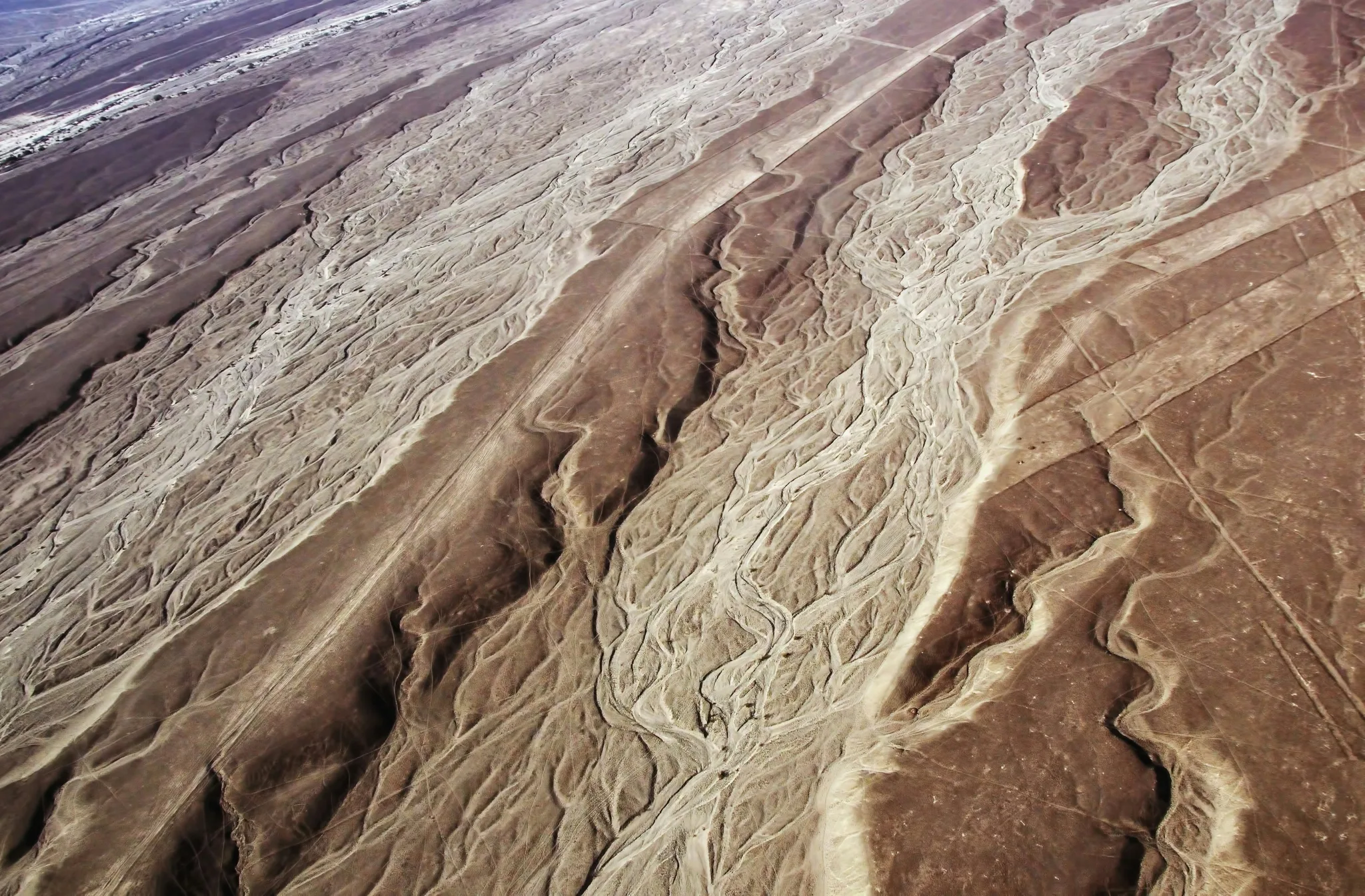
Enormous geoglyphs — some spanning over 370 meters — etched into the Peruvian desert floor by the Nazca culture between 500 BCE and 500 CE, visible in their true form only from the air and undisturbed for two millennia.
Between 500 BCE and 500 CE, the Nazca people of southern Peru scraped the desert surface and created something that would not be fully understood for another 1,400 years. The technique was deceptively simple: remove the iron oxide-coated pebbles from the surface to expose the pale yellowish ground beneath. The removed pebbles were piled at the margins of the cleared lines. The stability of the Nazca desert — one of the driest and most wind-free environments on Earth, where the surface has been undisturbed for millennia — meant that these cleared lines would remain visible indefinitely. They have.
From the air, the cleared lines resolve into figures. A hummingbird with a 93-meter wingspan. A condor stretching 135 meters. A spider 46 meters long. A monkey with a spiraling tail more than 100 meters long. A whale. A pelican. A man in a characteristic pointing pose that has been called "the astronaut" by writers who see modern meaning in ancient iconography. There are also thousands of straight lines, some extending 30 kilometers across the pampa with geometric precision that modern surveyors, working with GPS and laser tools, find technically challenging to replicate using the instruments available to the Nazca.
The question of why has occupied researchers, archaeologists, and enthusiastic amateurs for a century without a definitive answer. The leading academic theories interpret the lines as ritual pathways, as astronomical alignments, or as features connected to the veneration of water sources in a severely arid landscape. The Nazca region receives minimal rainfall and is hydrologically dependent on seasonal water from the Andes; several of the figures can be interpreted as pointing toward distant water sources or seasonal solar positions relevant to agricultural planning. None of the scientific explanations are fully satisfying to everyone, which is part of why the more dramatic interpretations — ancient aliens, lost technology, archaeological fraud — continue to circulate outside academic contexts.
The pampa that contains the figures is part of the Nazca and Palpa Lines UNESCO World Heritage Site, protected since 1994. Access to the pampa floor is restricted to researchers with permits. Visitors observe the figures from a metal observation tower (limited visibility, showing two figures), from commercial flights from the Nazca airport in small Cessna aircraft (the standard and most rewarding approach), or from the hillside mirador at the northern edge of the site. The flight experience — banking over the pampa in a five-passenger aircraft, the figures rotating beneath you — is the one that aligns with the geometry of the lines. They were made to be seen from above, and most tourists arrive by aircraft anyway.
The monkey was one of the last figures discovered, in the 1950s. Its spiraling tail covers an area no individual could see in its entirety from the ground. The people who made it had no aerial perspective, no way to see what they were creating at the scale at which it exists. Whatever internal geometry they carried — whatever system of counting, pacing, and marking allowed them to produce this shape at this scale with this accuracy — was sufficient to the task. The knowledge that created the Nazca Lines died with the culture that built them. What remains is the work, visible and measurable and still not fully explained.