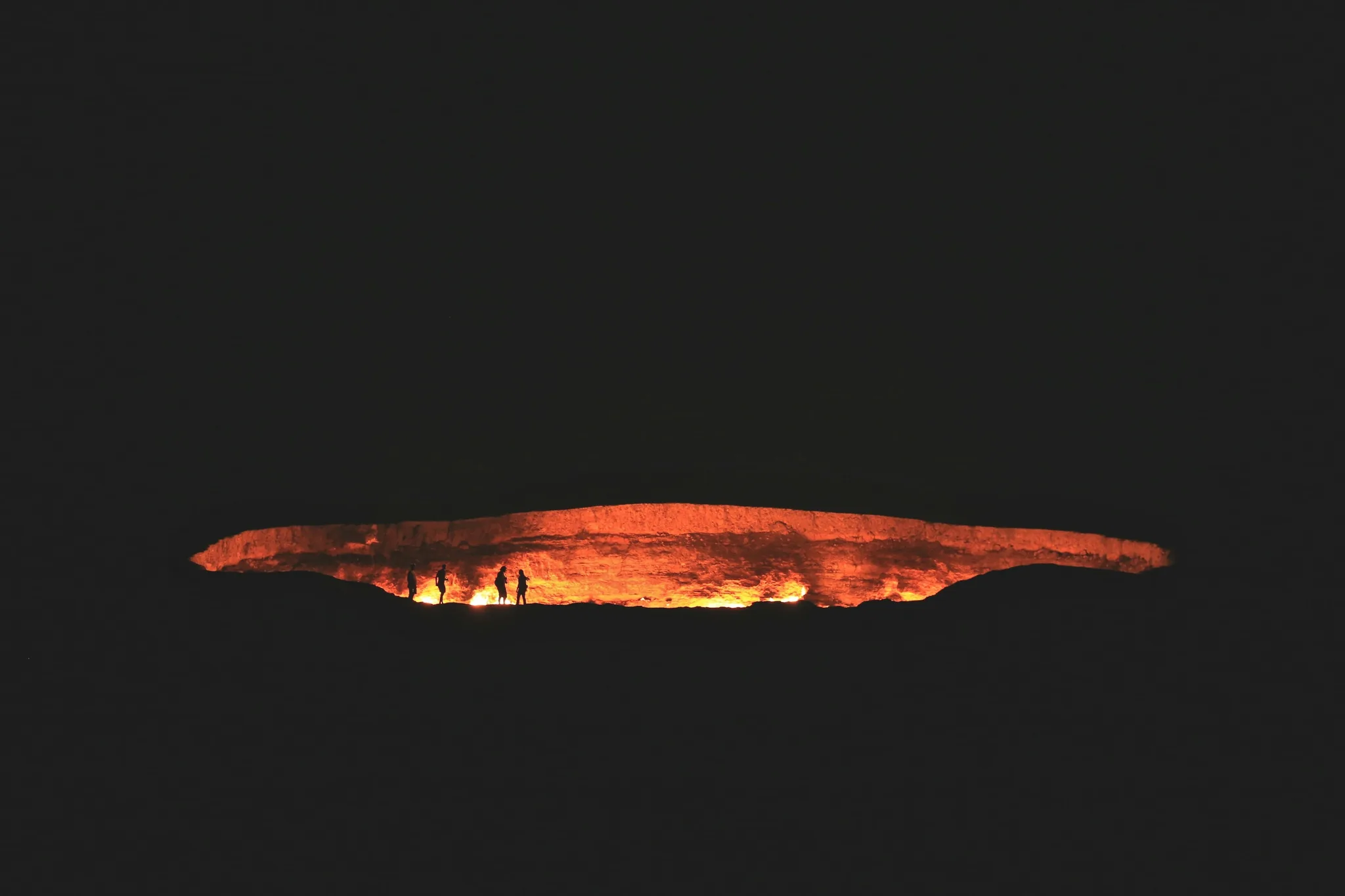
A 70-meter wide crater of burning natural gas in the Karakum Desert — set alight by Soviet geologists in 1971 who expected the fire to burn out in days. More than 50 years later, it is still burning.
In 1971, Soviet geologists working in the Karakum Desert of Turkmenistan drilled an exploratory well into a natural gas deposit and struck a pocket of pressurized methane. The ground beneath the drilling rig collapsed, swallowing the equipment and leaving a crater approximately 70 meters wide and 30 meters deep. Concerned about the continuous outflow of methane into the desert air, the geologists set the gas alight. Their expectation was that the methane would burn off within a few weeks at most. The Darvaza Crater has been burning continuously ever since — more than 50 years of uninterrupted combustion in the middle of a desert with no towns within 200 kilometers.
The crater is called the Gates of Hell by the people of the Karakum, and the name is not whimsical. At night, from the distance of its approach across the open desert, the crater is visible as an orange glow on the horizon before anything else becomes identifiable. Standing at the rim — which requires no guard rail, no official barrier, no formal caution beyond common sense — hundreds of individual flames burn continuously at the base and walls of the pit, the largest reaching several meters in height. The heat at the rim is intense enough to feel on the face and hands from 30 meters away. The sound is a constant, low, total roar that occupies the entire auditory field and makes conversation difficult. The smell is not sulfur — the gas burning here is methane, which burns cleanly — but the heat produces its own atmospheric distortion, and the air above the crater shimmers visibly at midday.
Methane is a greenhouse gas significantly more potent than carbon dioxide over short timescales. The decision in 2022 by the Turkmenistani government to attempt to extinguish the crater — announced but not yet executed as of 2024 — was driven by environmental concerns about the uncontrolled methane release that was happening before ignition, and which would resume if the fire were extinguished without also sealing the source. Previous attempts to cap similar gas vents in the region have had mixed results. The crater represents a significant ongoing methane release regardless of whether the surface expression is flame or invisible seepage.
Getting to Darvaza requires driving approximately 260 kilometers north from Ashgabat across a desert that has no paved road to the crater site. The route is navigable in a 4WD vehicle using GPS and desert driving experience, or with a Turkmen guide. Most visitors camp at the crater rim for at least one night — the daylight view is striking, but the night view, when the flames are the only light source for many kilometers in every direction, is the experience that people travel from across the world to have. The desert sky above the Karakum is dark enough for the Milky Way to be clearly visible; the flames of the crater below it; the contrast between the two is not something that photographs manage well.
Turkmenistan maintains strict visa requirements and requires all visitors to travel with an official government-approved guide. Independent travel is not permitted. This limits visitor numbers and has kept the Darvaza Crater from the infrastructure development that most significant natural sites of this visibility attract. The crater sits in the open desert, accessible and unenclosed, as it has since 1971. The fire burns at whatever rate the methane supply dictates, indifferent to the number of people watching.
Safety information
Safety information is not available yet.
Before visiting this place, check current safety guidance, access rules, local restrictions, and official updates on other trusted websites. Our editorial team does not have verified safety information for this location at the moment; it will appear here later.