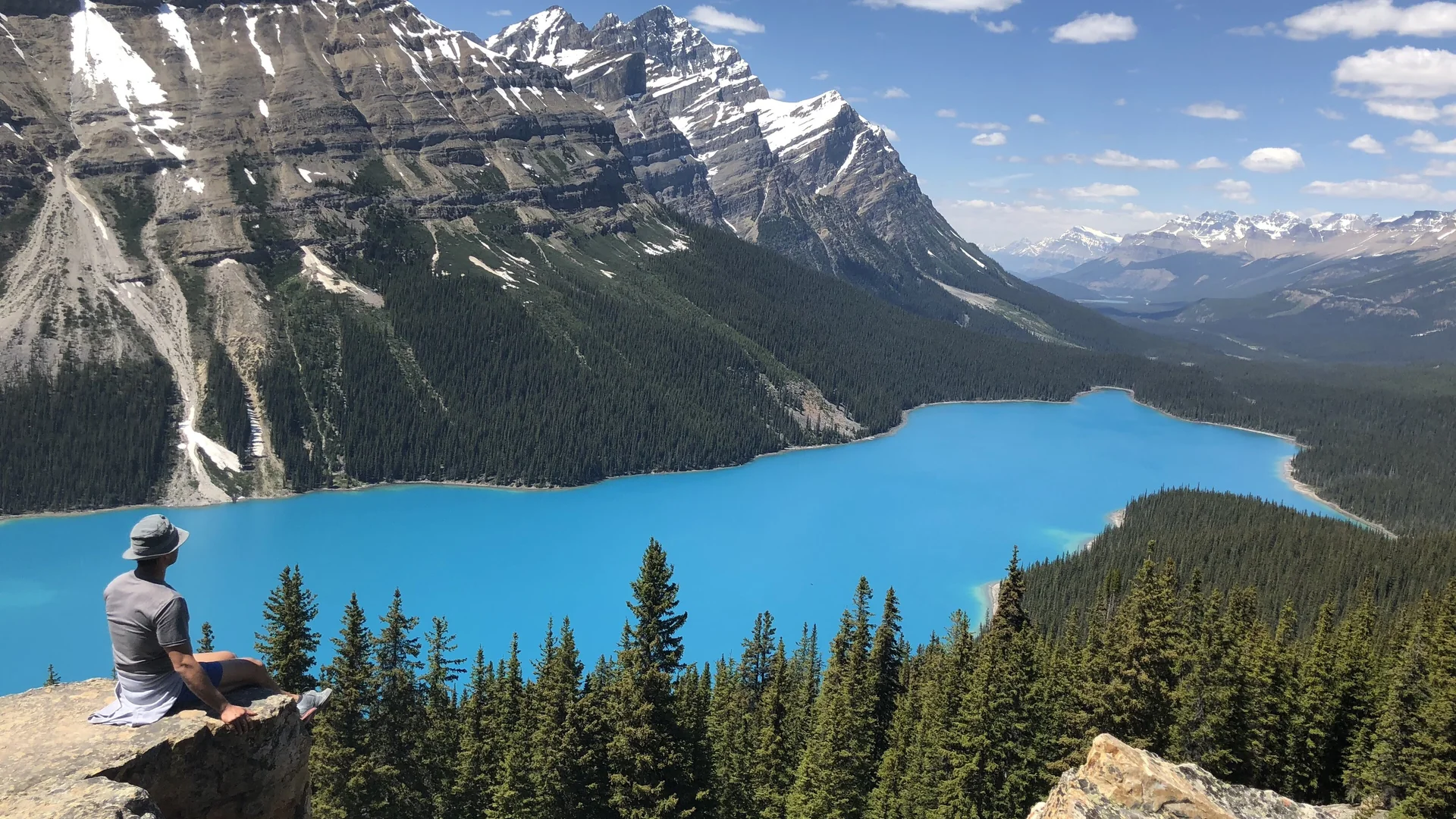
A glacier-fed lake in Banff National Park whose water is an impossible bright turquoise produced by rock flour suspended in the melt — a colour that intensifies through summer as glacial melt increases.
Peyto Lake is turquoise. Not the pale turquoise of a swimming pool, not the greenish blue of tropical shallows. It is a turquoise of almost painful intensity — a colour that the brain registers as artificial, as chemically produced, as something that should not occur in a natural body of water in the Canadian Rockies.
The cause is rock flour. The Peyto Glacier feeds the lake from above, and as the glacier moves over the rock beneath it, it grinds the rock into particles of sub-micron size — glacier flour — which are carried into the lake by meltwater. These particles are too small to sink quickly and remain suspended in the water column, and they scatter and reflect the incoming light in the blue-green spectrum. The same physical process that makes the sky blue makes Peyto Lake the colour it is.
The colour is not constant. In early summer, when snowmelt dominates the input, the lake is a more conventional grey-blue. As summer progresses and glacial melt increases, the flour concentration rises and the colour intensifies. It peaks in July and August. By September it has faded somewhat. Next year it will return.
The most famous view is from the Bow Summit viewpoint above the lake — a short walk from the Icefields Parkway — where the lake is visible in its entirety, surrounded by spruce forest and the peaks of the Continental Divide. The viewpoint is crowded from June to September. The crowd does not diminish what is at the bottom of it: a lake of such impossible blue that seeing it in person still seems slightly implausible even while standing in front of it.