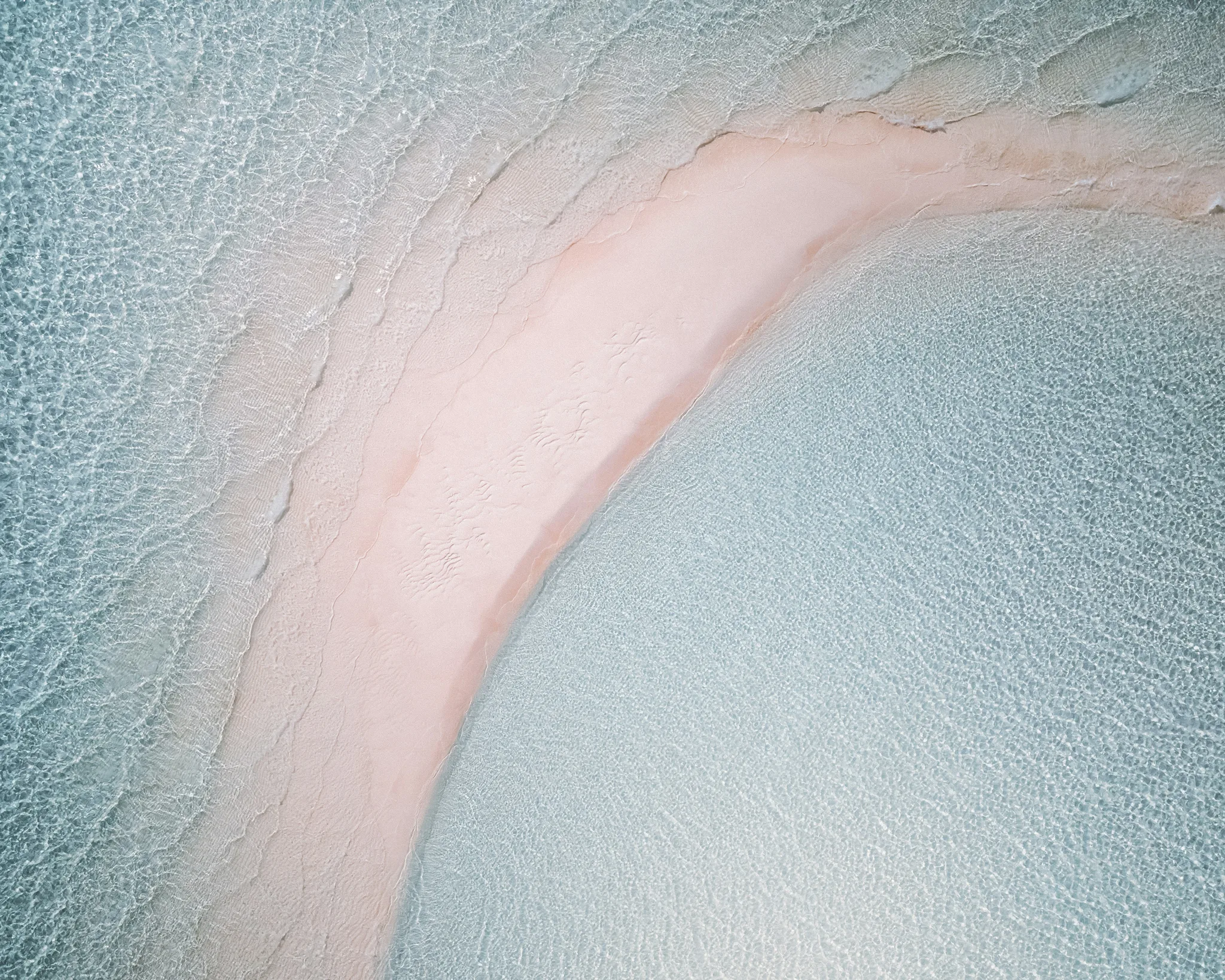
A 3-mile stretch on Harbour Island in the Bahamas where crushed coral and pink foram shells create a rose-tinted shoreline — one of only a handful of pink beaches on Earth, set against water of impossible turquoise.
The sand on Harbour Island in the Bahamas is pink. Not faintly pink, not pinkish-beige in certain light — genuinely, unmistakably pink, consistent across the full three-mile stretch of the island's eastern shore, and consistent at any hour of the day. It is the color of a faded rose petal or a particular kind of Italian marble, and it contrasts with the turquoise of the Atlantic with an intensity that photographs consistently fail to reproduce accurately. Every image looks oversaturated. The place is what the image is trying to show.
The color comes from Homotrema rubrum — a foraminifera, a single-celled marine organism encased in a calcium carbonate shell, which in this species is deep red. Homotrema rubrum colonizes coral reefs and hard limestone substrates throughout the Caribbean; when the organisms die, their red shells are broken down by wave action and mixed into the accumulating beach sediment. At Harbour Island, the offshore reef system is productive enough, and the current patterns concentrated enough, that these red foram shells accumulate in sufficient quantity to tint the sand a consistent rose. The effect does not wash away, because the reef continues to produce the shells and the waves continue to deposit them.
Harbour Island — known locally as Briland — is a small island approximately six miles long and two miles wide, positioned off the northeastern coast of Eleuthera in the northern Bahamas. The permanent population is roughly 1,700 people. Access is by a 10-minute water taxi from the North Eleuthera ferry terminal or airport. The island has been continuously settled since the 18th century, one of the first significant European communities in the Bahamas, and today it operates largely as a luxury tourism destination on the strength of the beach.
The beach faces east, receiving the full energy of the Atlantic from the sunrise direction and the shelter of the island from the afternoon west. The water is shallow for a long distance offshore — the limestone platform underlying the Bahamas filters groundwater to near-perfect clarity, and the protected orientation keeps the surface calm enough to read its color clearly. At the far southern end, near the less-developed margins of the island, the sand is typically the most deeply colored and the least occupied.
Pink sand beaches exist in a small number of locations worldwide — certain shorelines in Greece, Indonesia, and the Philippines show similar coloration from equivalent geological processes. Harbour Island is distinguished not by being uniquely pink, but by the consistency and accessibility of the effect, and by the specific contrast that its east-facing orientation, shallow turquoise water, and morning light combine to produce. The sand is also softer underfoot than most Caribbean beaches — the foram shells are ground to a fine powder by decades of wave action. You feel the color before you see it properly.
Safety information
Safety information is not available yet.
Before visiting this place, check current safety guidance, access rules, local restrictions, and official updates on other trusted websites. Our editorial team does not have verified safety information for this location at the moment; it will appear here later.