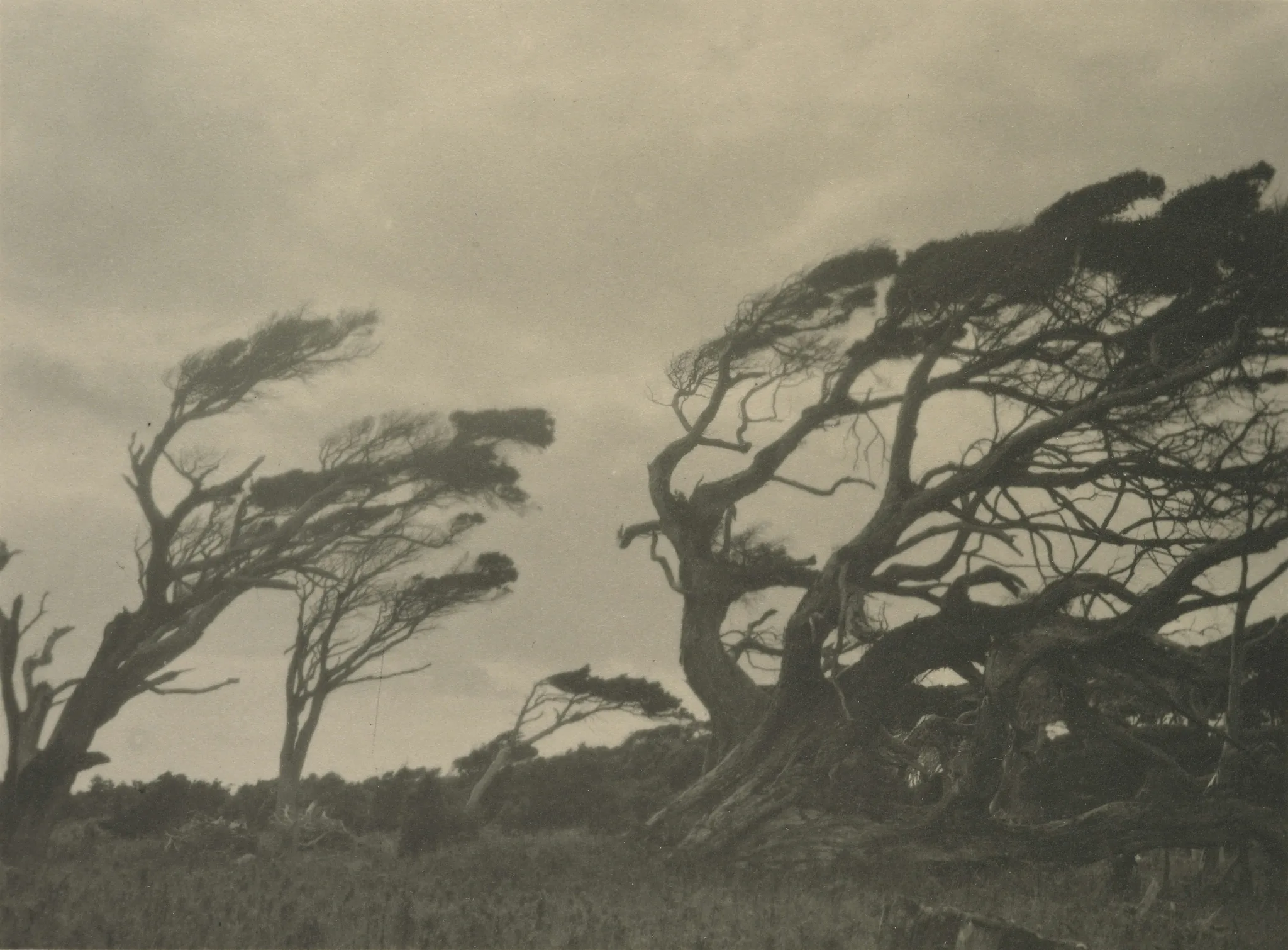
A grove of ~400 pine trees near Gryfino, Poland, all bent 90 degrees at their base and curving northward before growing straight — planted in the 1930s and shaped by a force that left no record, no name, and no explanation.
Near the small town of Gryfino in northwestern Poland, a grove of approximately 400 pine trees grows in a way that no one has definitively explained. Each tree begins its growth normally, then at a height of roughly 25 to 50 centimeters, the trunk bends 90 degrees to the north, runs horizontally for 1 to 2 meters, and then curves back upward to grow vertically for the rest of the tree's life. The result is a hook or J-shape at the base of every tree — all curving in the same direction, all from the same planting generation, all from the early 1930s.
The grove sits within a larger ordinary forest on the edge of Gryfino, accessible in a short walk from the town center. The trees are now approximately 80 to 90 years old, the trunks thick and the canopy dense. From a distance the forest looks unremarkable — a patch of Pinus sylvestris, the common Scots pine of northern European lowlands. Up close, the distortion becomes legible at the base of each trunk: a smooth, gentle curve, all in the same direction, in the lower two meters, then a straight shaft rising 10 to 15 meters into the canopy above. The regularity is what disorients. One bent tree is an incident. Four hundred identically bent trees, all from the same planting, is a question.
The leading hypothesis among foresters and dendrochronologists is that the trees were subjected to sustained mechanical manipulation during their first few years of growth — bent deliberately by human hands. Curved timber had multiple uses in pre-industrial European construction: the shaped ribs of wooden boats, the curved members of furniture frames, the structural arches of wooden buildings. Cultivating a grove of deliberately formed trees for eventual timber harvest was an established practice in parts of Scandinavia and Germany in the early 20th century. The grove at Gryfino may have been such a project.
What ended it is unknown. The trees were planted around 1930. The region of Gryfino was German territory at that time — it is in the former eastern Germany that became part of Poland after World War II, and it was heavily depopulated and physically destroyed during the war's final months. Whatever knowledge the planters held about the grove's purpose may have been lost with the discontinuity between the German community that planted it and the Polish community that inherited it. The trees were left to complete their growth in peace, and the shape they were given in their first two years has remained visible in every subsequent decade.
The Crooked Forest gained significant international attention in the 2010s through social media and travel writing. Visitor numbers have increased substantially. The municipality of Gryfino has installed interpretive panels near the grove that acknowledge the mystery honestly, without resolving it. The most prosaic explanation — that someone bent these trees on purpose, for ordinary reasons, and the war interrupted their plans — is also the one that requires the least revision of how the world works. It circulates less widely than the alternatives, which may tell us something about what kind of stories we prefer for a forest that looks impossible.