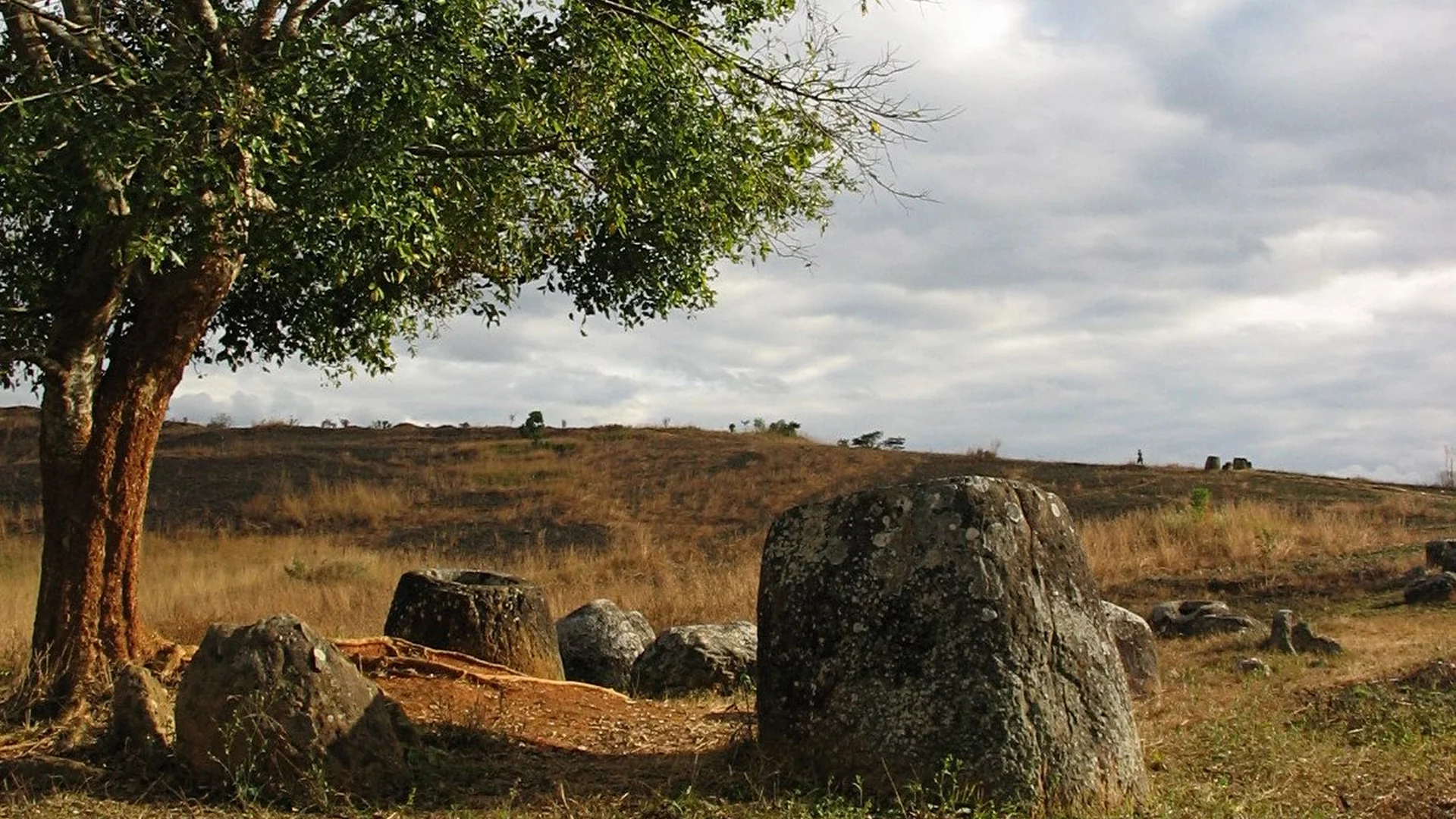
Thousands of massive stone jars — some three metres tall and weighing 30 tonnes — are scattered across a plateau in central Laos. Their makers, purpose, and age remain disputed.
No one knows who made them. No one knows why. No one knows, with any certainty, what was kept inside them or when the makers disappeared. The jars have simply been there, on the plateau of Xieng Khouang, for longer than recorded Laotian history.
There are thousands of them — some estimates suggest over 3,000 jars at more than 90 sites across the plateau. They range from a few hundred kilograms to 30 tonnes. Some are a metre tall. Some reach three metres. They are carved from sandstone, granite, conglomerate, and a material called calcified coral that has no source deposit within 100 kilometres. Some were carved locally. Some were brought from somewhere that cannot be identified.
The dominant theory: they are funerary urns. Bodies were placed inside to decompose over a monsoon season, then the bones removed and buried elsewhere, with the jars left as markers. Archaeological evidence — burned bone fragments, burial goods in the soil nearby — supports this. But the scale of production, the variety of stone sources, and the sheer size of the largest jars suggest something more significant: an entire civilization that processed its dead this way for centuries before vanishing.
The plateau was carpet-bombed during the Vietnam War. Unexploded ordnance still saturates the soil. Archaeologists excavate with metal detectors before every trowel. The jars that survived the bombs stand as they always have, patient and mute, waiting for a question no one has yet learned to ask.