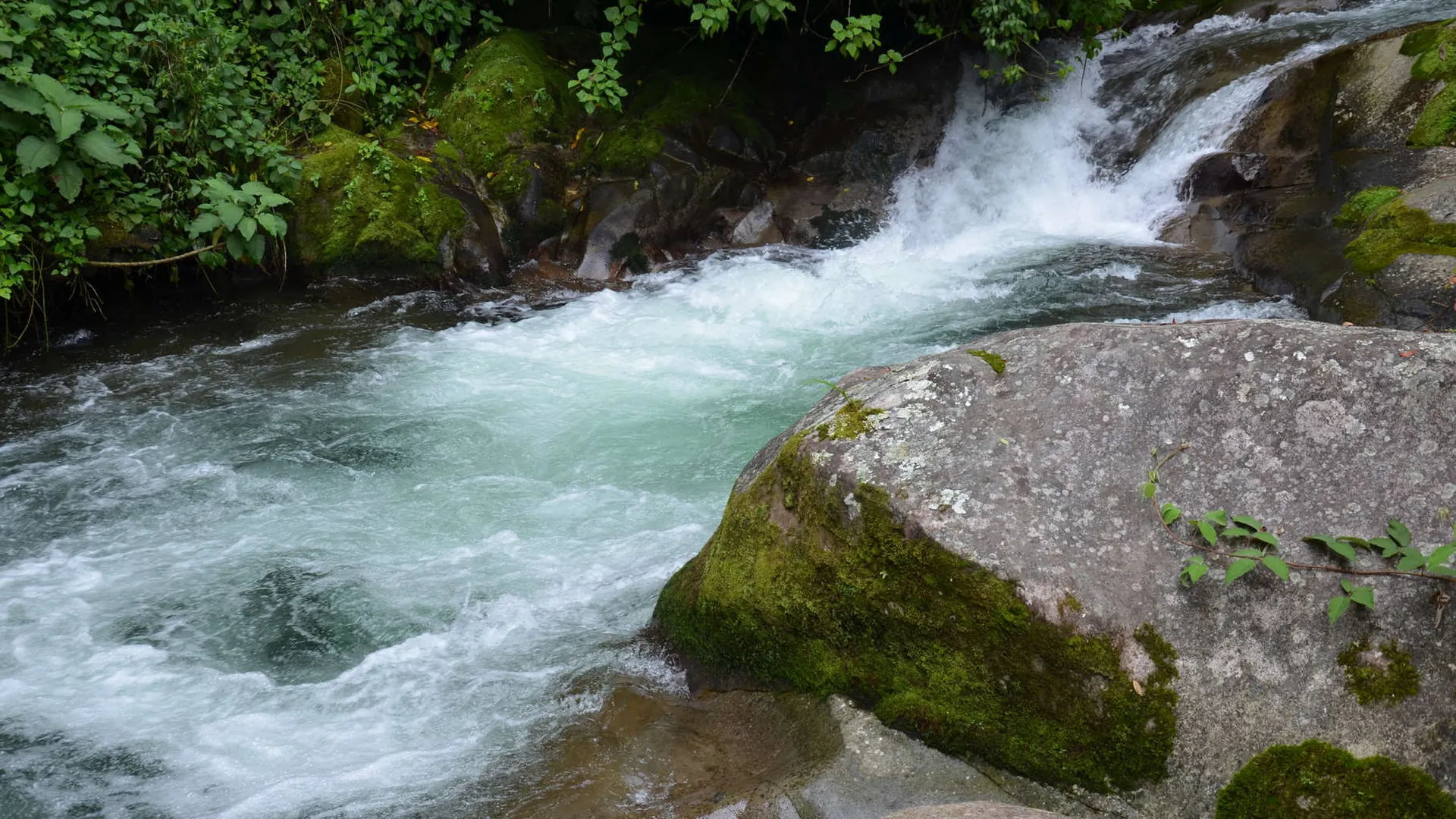
At a precise point inside a Costa Rican volcano's rainforest, two chemically colourless rivers converge and instantly become an impossible turquoise blue — a natural optical illusion.
Follow the trail into Tenorio Volcano National Park long enough and the forest changes colour around you. The air smells faintly of sulfur. The vegetation along the riverbank fades to pale from the mineral-rich water nearby. Then the river appears.
It is the blue of a swimming pool, the blue of a Mediterranean bay, the blue of things that are not supposed to exist in a jungle. Walk upstream along its banks and eventually you reach a point — the Teñidero — where two rivers merge. Above the confluence: two rivers, both essentially colourless. Below it: one river, impossibly blue.
The chemistry is precise and counterintuitive. Both rivers carry aluminosilicate nanoparticles suspended in solution. When the two flows mix, their differing pH levels cause the particles to flocculate — clumping together into sizes that scatter blue light preferentially, in exactly the same way that the atmosphere scatters blue wavelengths to make the sky blue. It is not dye. It is not reflection. It is physics happening in real time at a point in the forest that you can stand beside.
Local legend explains it differently: God was painting the sky, washed his brush in the river, and left. The scientists'' version and God''s version arrive at the same blue.
Safety information
Safety information is not available yet.
Before visiting this place, check current safety guidance, access rules, local restrictions, and official updates on other trusted websites. Our editorial team does not have verified safety information for this location at the moment; it will appear here later.