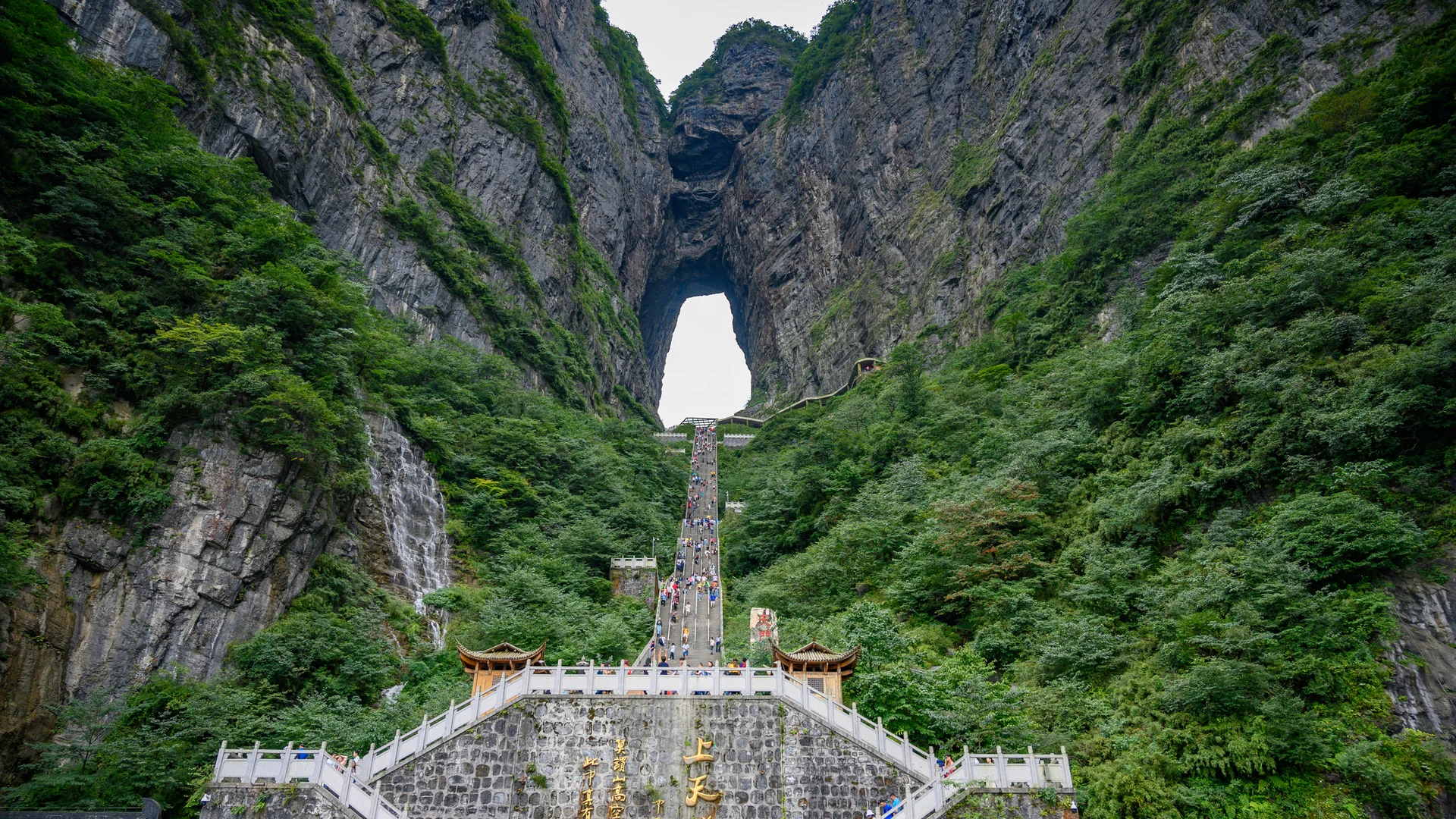
A natural limestone arch 60 metres high opens in the summit of a sacred Chinese mountain reached by the world's longest cable car — a portal the ancients called the Door of Heaven.
In 263 CE, the cliff face of this mountain simply opened. A section of rock gave way and fell, leaving behind a perfectly elliptical arch 60 metres high and 57 metres wide, punched through the summit like a window cut by an impossible craftsman. The ancients decided only heaven could be responsible. They called it Tianmen — the Heaven Gate — and the mountain took its name.
The arch still stands. Looking through it from below, it frames a circle of sky that seems to glow independently of the rest of the heavens. Mist drifts through it most mornings. Stunt pilots have flown aircraft through it. From the peak on clear days, the view drops vertically into the Zhangjiajie valleys below, a thousand metres of exposed air between stone and forest.
To reach it, visitors board the Tianmen Mountain cable car — 7.5 kilometres long, the longest aerial cableway in the world — which climbs nearly 1,400 metres in altitude, passing over ravines and through clouds. At the summit, a glass walkway clings to the cliff face, extending over nothing at 1,430 metres above sea level. The glass panels are 25mm thick. They creak faintly underfoot.
The 999 steps that lead up to the arch itself — chosen for the Chinese symbolism of longevity — are carved directly from the cliff. They are as steep as a staircase. The arch waits at the top, exactly as it has for 1,700 years.