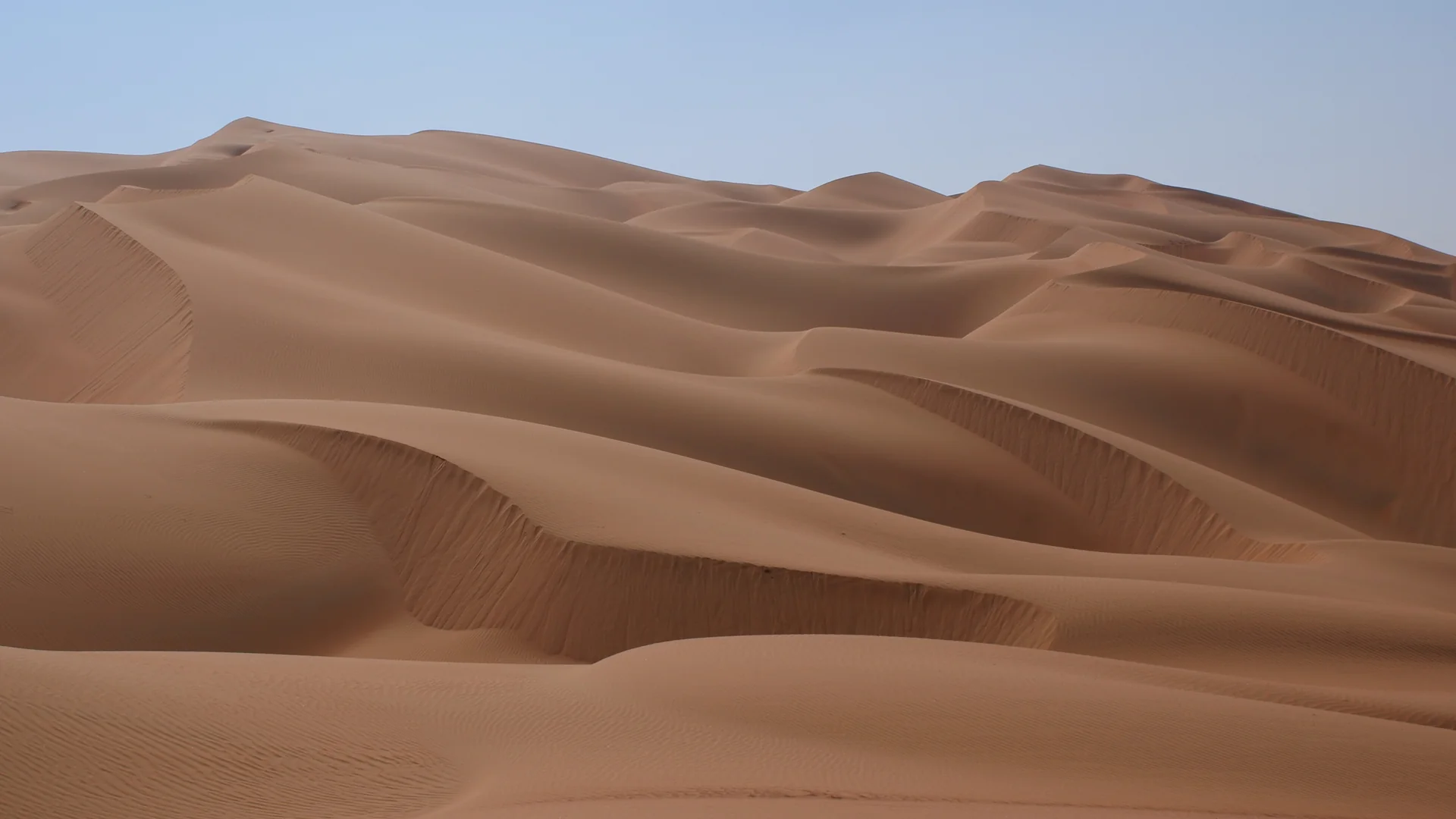
A desert the size of France, Belgium, and the Netherlands combined — 650,000 square kilometres of unbroken sand dunes rising to 250 metres, with no permanent water, no roads, and no inhabitants.
Rub'' al Khali means the Empty Quarter. It is not merely a poetic name. The desert that covers most of the southern Arabian Peninsula — 650,000 square kilometres — is, in practical terms, empty. There are no permanent settlements. No roads. No rivers, no oases accessible to ordinary travel. Summer temperatures reach 56°C. The dunes, which rise to 250 metres in the central regions, shift with winds that carry no moisture.
It is the largest continuous sand desert on Earth. The Sahara is larger in total area, but it contains mountains, rock plateaus, oases, and paved roads. The Rub'' al Khali is sand, only sand, across an area roughly the size of France. It is the most unbroken expanse of dunes on the planet.
Beneath this emptiness is one of the world''s great oil reserves — estimated at 100 billion barrels, deposited by an ancient sea that covered this region hundreds of millions of years ago. The desert sits above an ocean of oil it knows nothing about.
Bedouin tribes have crossed portions of the Empty Quarter for centuries, using routes that relied on knowledge passed between generations — which dunes to avoid, where the sands were deep enough to swallow a camel, how to navigate by stars. The British explorer Wilfred Thesiger made the first documented crossing by a Westerner in 1946-1947, accompanied by Bedouin guides. He wrote that the desert''s beauty was beyond anything he had encountered, but also that it was a beauty that wanted to kill you.