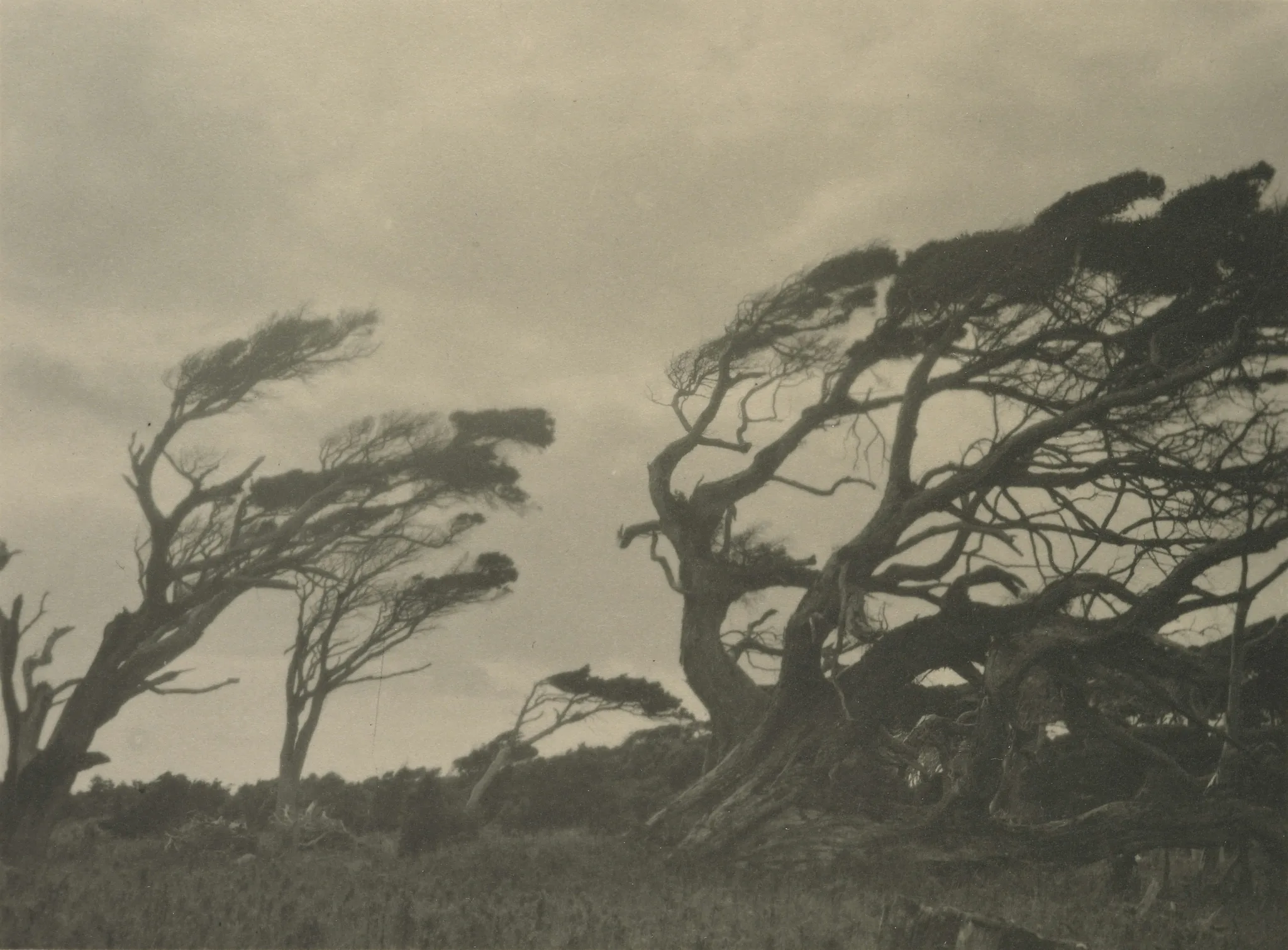
The southernmost tip of New Zealand's South Island, where relentless Antarctic winds sculpt trees into living sculptures permanently bent northward — frozen in gestures of longing at the edge of the habitable world.
Slope Point is not a destination in any conventional sense. There is no township nearby, no visitor center, no café. The southernmost tip of New Zealand's South Island — the point where land ends before the ocean runs uninterrupted to Antarctica — is reached by a 20-minute walk across private farmland through a landscape of wind-burned grass, lichen-covered stone, and the particular quality of coastal light that belongs to the southern latitudes. Most people who make the effort describe feeling the isolation before they notice anything visually remarkable.
What they eventually find is the trees. In a grove at the cliff edge above the sea, a cluster of macrocarpa cypress have grown at an angle so extreme they appear to be permanently bowing to the north. Every branch, every leader, every twig extends in the same direction — northward and inland, away from the coast. Not one tree grows vertically. Each trunk carries the same smooth curve at its base, produced over decades by a wind that never changes direction.
The wind at Slope Point arrives from the southwest, crossing the Southern Ocean with no significant landmass to interrupt it between Patagonia and this cliff — approximately 10,000 kilometers of open water in which the wind builds without obstruction. The latitude, 46.7°S, places Slope Point in the Roaring Forties, the belt of persistent westerly winds that drove sailing ships around Cape Horn and made the southern ocean the most feared body of water on Earth for centuries of navigation. The macrocarpa trees at the cliff edge have been growing in this wind for somewhere between 30 and 100 years. Every year of that growth is recorded in the direction they lean.
The coastal cliffs at Slope Point are limestone and mudstone, carved by the same ocean that shapes the wind. Below the cliff, where accessible, beaches of grey shingle are interrupted by wave-cut rock platforms. The sea changes color from green-grey to deep blue depending on weather and depth, and the light at southern latitudes arrives from a lower angle even in midsummer — flatter and more horizontal than anything experienced further north, reaching under cloud and across water in a way that is specific to this hemisphere and this latitude.
The access track crosses sheep-farming land. The gates must be closed behind you. There are no interpretive signs along the route. From the gate to the cliff, across a landscape of grass and salt air and wind, the scale of the empty southern ocean becomes gradually available. The bent trees at the end are the confirmation — not the thing itself, but the mark the thing has left on everything that tried to grow here.