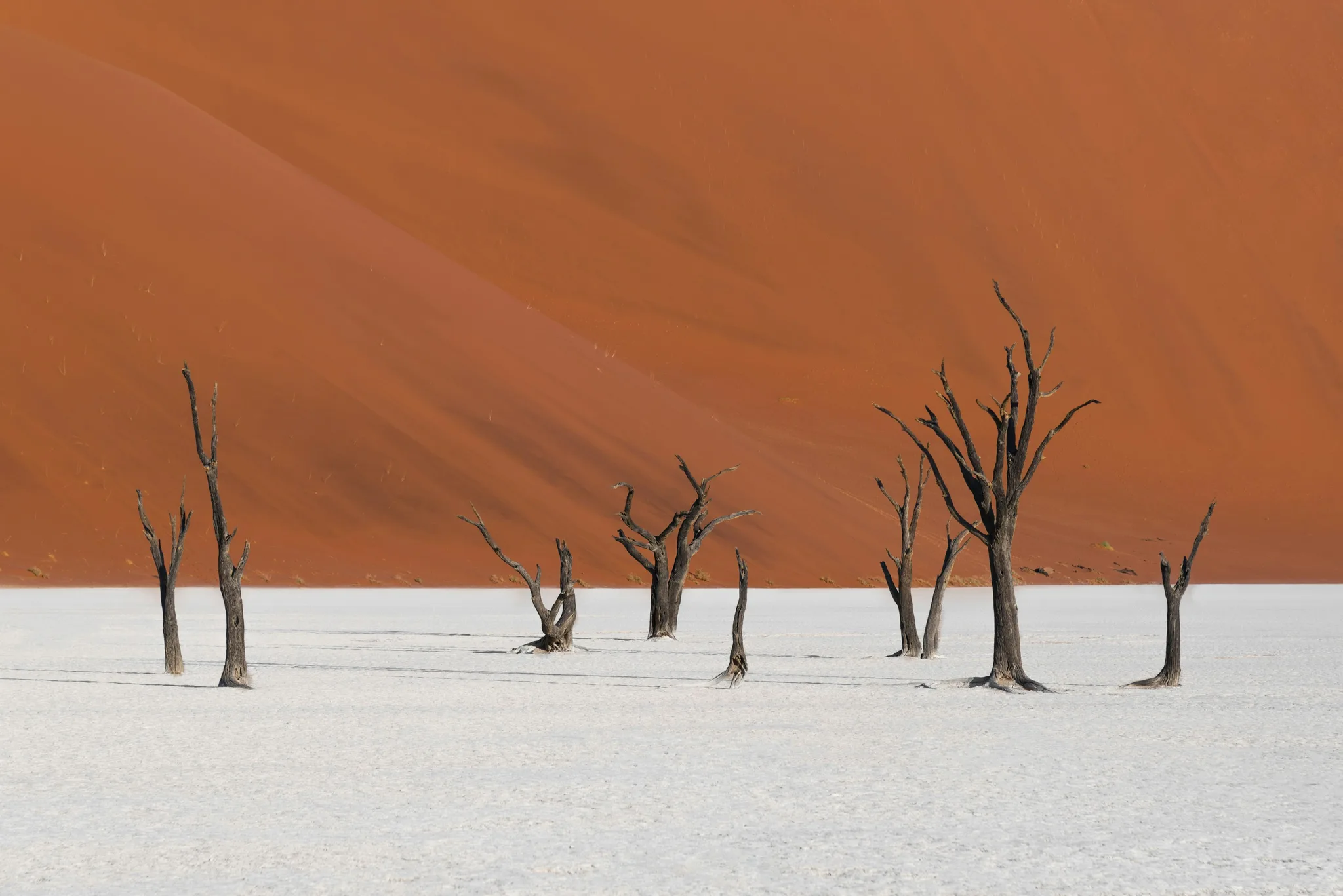
A surreal white clay pan in the Namib Desert surrounded by the world's tallest sand dunes, where 900-year-old camel thorn trees stand blackened and frozen against an alien apricot sky — too dry to rot, too dead to fall.
Dead Vlei was once a living place. Roughly 900 years ago, the Tsauchab River changed course during an extended drought and cut off the water supply to a pan of camel thorn trees (Vachellia erioloba) growing in this specific hollow between the dunes. The trees died. The Namib Desert then became so hyperarid that even the process of decomposition stopped. The dead trunks have stood in this pan ever since — blackened by centuries of UV exposure, preserved by an aridity so extreme that the organisms responsible for decay cannot survive. They will not fall. They cannot rot. They simply remain.
The result is one of the most photographed natural compositions in the world: white clay pan, black dead trees, orange dunes, blue sky. The clay floor of the vlei reflects the sky with a brilliance that reads as white in photographs and pale ivory in person. The surrounding dunes — including the massive Big Daddy, which tops 380 meters above the valley floor — are among the tallest sand dunes on Earth, their color progressing from pale apricot at sunrise through deep burnt sienna at midday to an almost arterial red at dusk. Between the white floor and the red walls, the dead trees stand with compositional precision that reads as arranged. It was not.
Access to Dead Vlei runs through the Namib-Naukluft National Park. The standard route is a 4–5 kilometer walk from Sossusvlei, the adjacent living vlei where ephemeral water still gathers after rare rainfall events. The walk crosses interdune plains in temperatures that reach 45°C in summer. The standard approach is before dawn — leaving the car park at first light to reach Dead Vlei as the sun rises over the eastern dunes and illuminates their faces while leaving the floor in cool shadow. By 10 AM the heat has become oppressive and the light flat. The timing is not a preference; it is essentially a requirement.
The camel thorn trees, despite 900 years of death, cannot collapse. The clay on which they stand contracts and expands with intermittent moisture changes in ways that would dislodge ordinary organic material, but these trunks have desiccated to a structural density that makes them effectively mineralized. The wood has not decayed; it has dried beyond the reach of biological process. Some trunks retain their original branching structure with such completeness that identifying them as dead requires a second look. They are not preserved by anything applied to them. They are preserved by the simple fact that the Namib does not permit decay.
The Namib Desert is between 55 and 80 million years old — the oldest desert on Earth. Dead Vlei is recent geological history by comparison, a few centuries old. But it sits inside a landscape where every scale of time is visible simultaneously: the young dunes built in decades, the ancient Gondwana basement rock exposed over millions of years, and the dead trees in between, blackened and permanent, marking 900 years as if they were a single afternoon.