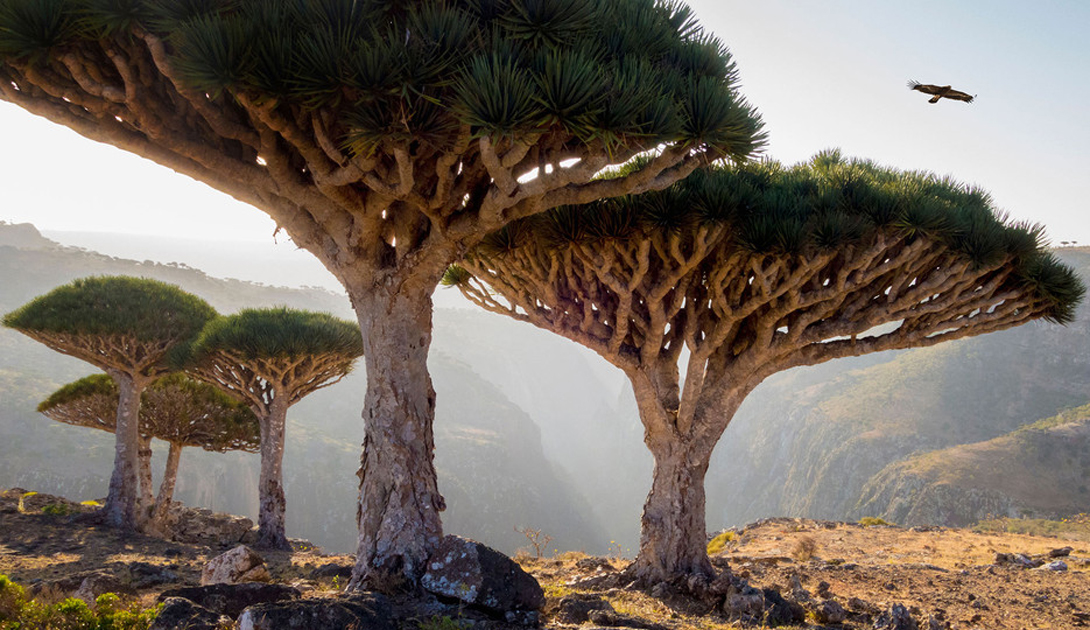
Isolated from mainland Africa for 6–7 million years, Socotra developed 825 species found nowhere else — including the Dragon Blood Tree, whose canopy resembles an inside-out umbrella and bleeds deep crimson resin.
Socotra was isolated from mainland Africa for 6 to 7 million years. In that time, evolution proceeded without interference, producing 825 plant species found nowhere else on Earth — 37% of its flora is endemic. The island was known to ancient traders as the Island of Bliss, believed to be the source of all the world's incense.
The Dragon Blood Tree (Dracaena cinnabari) is its emblem — a tree that looks designed by a committee of dreamers. Its canopy is a dense, flat plateau of leaves balanced on a trunk of impossibly thin branchwork. When cut, it bleeds a deep crimson resin that was traded across the ancient world as a pigment, medicine, and varnish.
The island's isolation has also produced stone, sand, and limestone landscapes so alien they read as planetary. With climate change and the Yemeni civil war, Socotra faces an uncertain future. It is a world that may not remain.