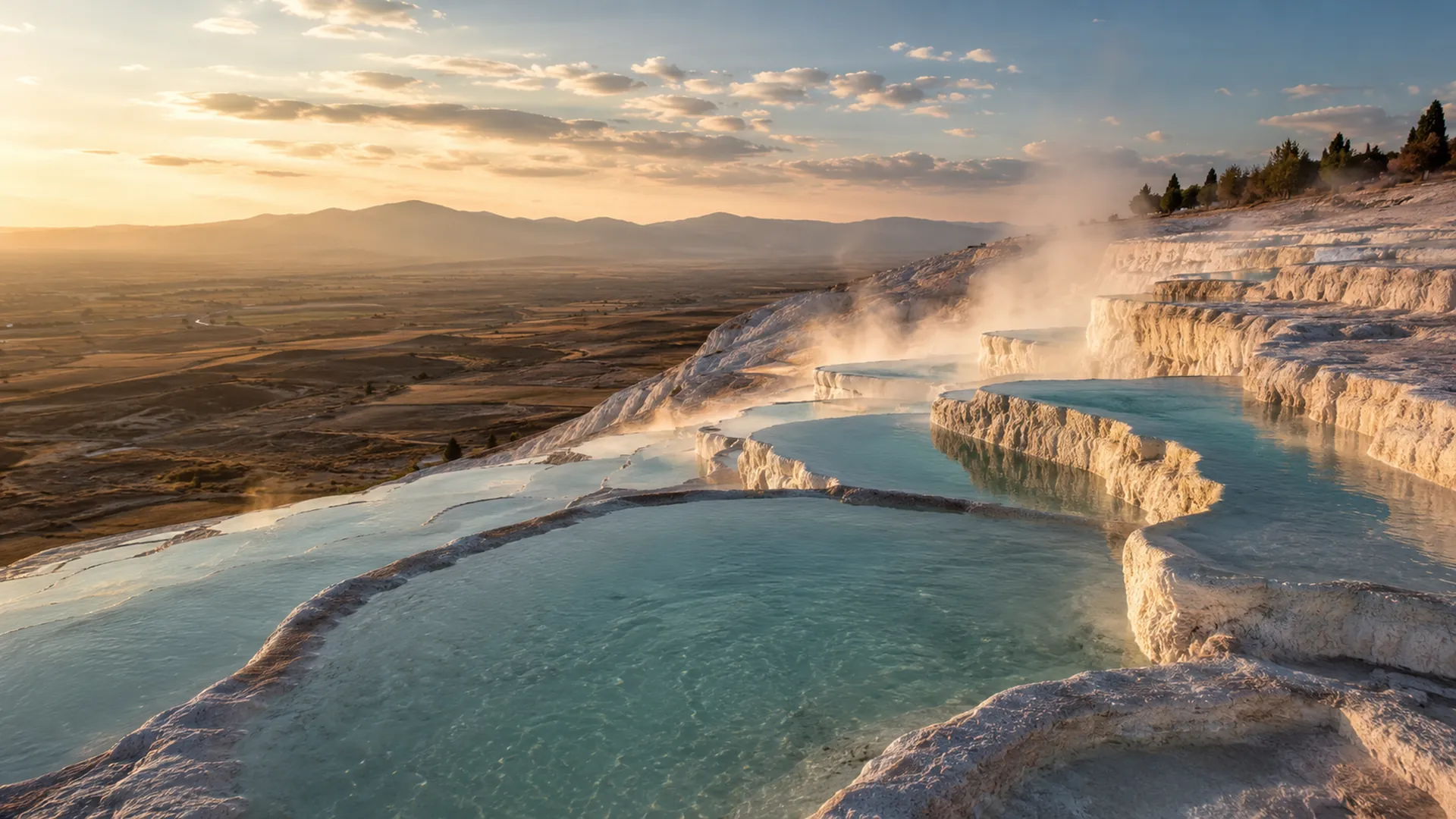
Thermal springs deposit calcium carbonate as they cascade down the hillside, creating brilliant white terraces and turquoise pools. The ancient Greeks built the spa city of Hierapolis here, believing the waters divine.
For thousands of years, mineral-rich thermal water at 35°C has been flowing down a white limestone hillside in southwestern Turkey near the modern city of Denizli, leaving behind calcium carbonate deposits that solidify as the water cools. Each deposit adds a small increment to the terrace structures that have been building here since well before any human presence in the valley. The process is geological and unhurried: each millimeter of travertine terrace represents decades of precipitation from water that carries approximately 2.5 grams of calcium carbonate per liter. The result, accumulated over at least 400,000 years, is a hillside of brilliant white terraced pools — each one a shallow basin of turquoise and blue-green water against blinding white travertine — descending 160 meters from the plateau edge to the valley floor.
The ancient Greeks who encountered Pamukkale in the second century BCE did not need long to decide what it was. They called it Hierapolis — Sacred City — and built a substantial settlement on the plateau above the terraces. By the Roman period, Hierapolis was a significant spa destination: bath complexes, temples, a theatre seating 15,000, and a growing necropolis that testifies to how many people came here to heal and died here in hope. The mineral-rich thermal water was believed to have curative properties for joints, skin, and the eyes. Roman emperors visited. The city continued to be inhabited through Byzantine and Seljuk periods. Today the ruins of Hierapolis occupy the plateau directly above the terraces, and the thermal pools visible at the base of the ancient pool complex — where marble column fragments lie among sacred carp in 35°C water — are a UNESCO World Heritage component as significant as the terraces below.
The travertine terraces that give Pamukkale its name — in Turkish, "cotton castle," a reference to the white landscape visible from the valley — cover approximately 2,700 meters along the hillside and up to 500 meters in width at the broadest sections. The pools are naturally shallow, their edges built by the calcium carbonate deposition, their floors slightly soft with new mineral deposit. The water flowing through them is warm enough to be comfortable and clear enough to see the bottom. Visitors walk the terraces barefoot — shoes are prohibited to protect the formations — and the sensation of warm mineral water at 35°C on feet that have crossed the white travertine is consistently reported as one of the more disorienting and pleasant physical experiences available in a UNESCO site.
The terraces have faced significant management challenges. During the 1970s and 1980s, hotels were built directly on the travertine surface; water was diverted for tourism purposes; foot traffic without restrictions caused extensive damage. UNESCO listing in 1988 triggered a management review: the hotels on the terrace were demolished, water flow was redirected to allow natural recovery of the formations, and visitor access was reorganized onto specific barefoot paths. The terraces have partially recovered over the following decades, though some sections remain white only where water is currently flowing and grey-beige where the water supply has been redirected.
The best conditions for visiting Pamukkale are early morning and late afternoon, when the low-angle sun illuminates the white terraces obliquely and the turquoise color of the pools is most saturated. Midday brings both the highest visitor numbers and the flattest light. The thermal pools on the plateau above — at the ancient Hierapolis site — are accessible for swimming, and the submerged marble architecture of the Roman period pool is visible in the clear 35°C water. Standing in a Roman-era thermal bath, among 2,000-year-old column fragments, above a hillside that has been depositing mineral terraces for 400,000 years, is an experience in vertical time that Pamukkale offers without ceremony or effort.
Safety information
Safety information is not available yet.
Before visiting this place, check current safety guidance, access rules, local restrictions, and official updates on other trusted websites. Our editorial team does not have verified safety information for this location at the moment; it will appear here later.