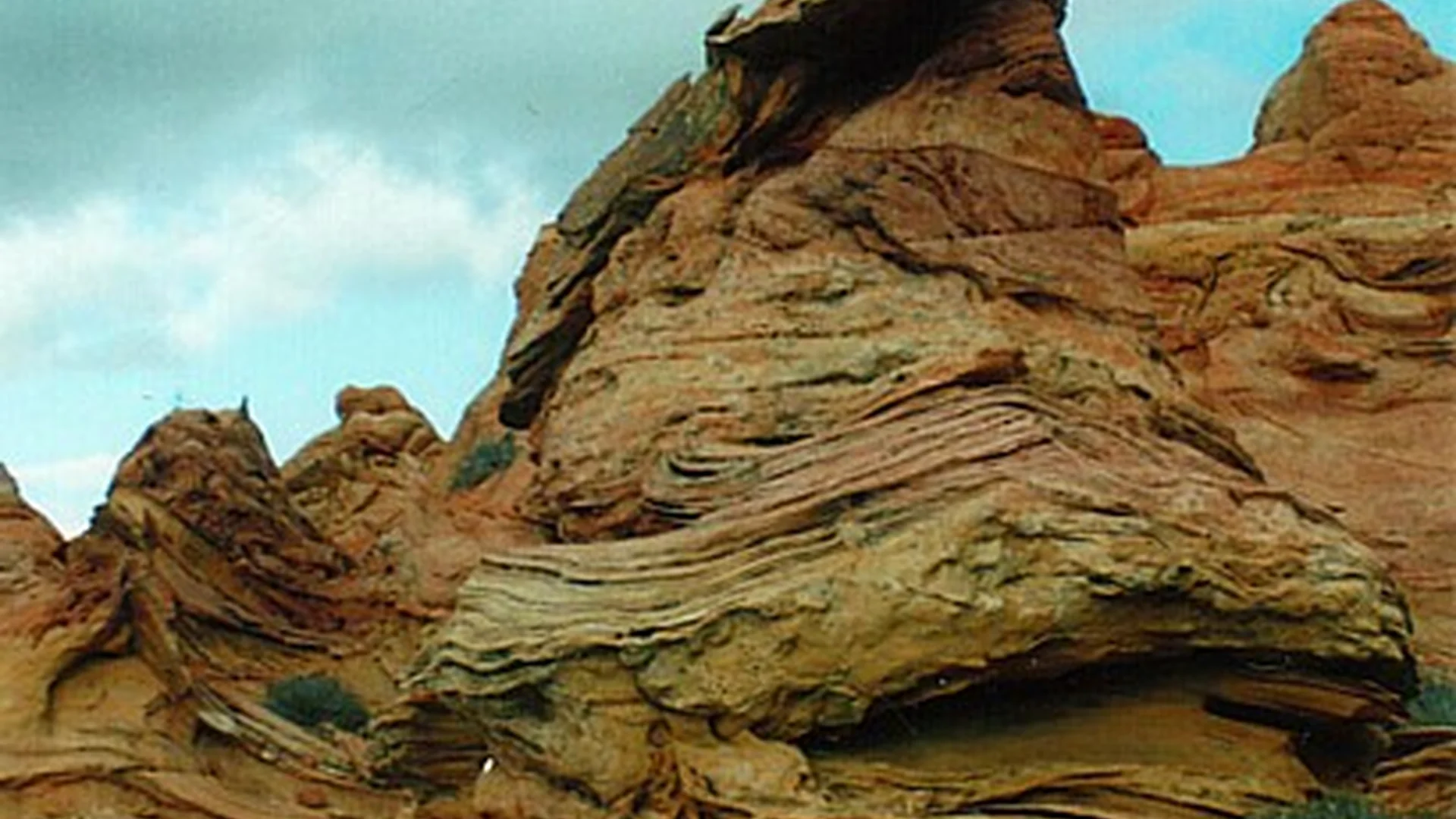
A flowing sandstone formation of rippled, swirling strata in the Coyote Buttes area — access strictly limited to 64 people per day by permit lottery, one of the most beautiful geological formations on Earth.
The Wave was formed from ancient sand dunes — Jurassic-era aeolian deposits that were buried, compressed into sandstone, and then slowly exhumed by erosion over millions of years. The colors in the rock are iron oxide in varying oxidation states: hematite for deep red, goethite for orange and yellow, with occasional intrusions of pale cream where the iron was leached away.
But the shape is what makes it impossible to describe accurately. The sandstone has been eroded into undulating troughs and ridges that follow the original bedding planes of the ancient dunes — the concentric layers of a sand dune preserved in stone and then sculpted by water into three-dimensional curves that flow into each other without interruption. The rock moves. Not literally, but visually — it curves and sweeps in ways that suggest motion frozen in geological time.
The United States Bureau of Land Management issues exactly 64 permits per day to visit the Wave — 16 by advance online lottery, 10 by in-person lottery the morning before. There is no trail. You navigate by topographic map and GPS coordinates to a location that has no signage. The difficulty of access is not accidental. The formation is fragile: the cross-bedded sandstone erodes easily under foot traffic, and 64 people per day is already more than some geologists consider sustainable.
Photographers come here for the hour after sunrise and before sunset, when the low-angle light deepens the reds and the shadows define the curves. At midday, in flat light, it is still extraordinary. At dawn, before anyone else arrives, standing in the curved bowl of rock with the sun just clearing the canyon walls, it is the closest thing to being inside a painting that geology can offer.