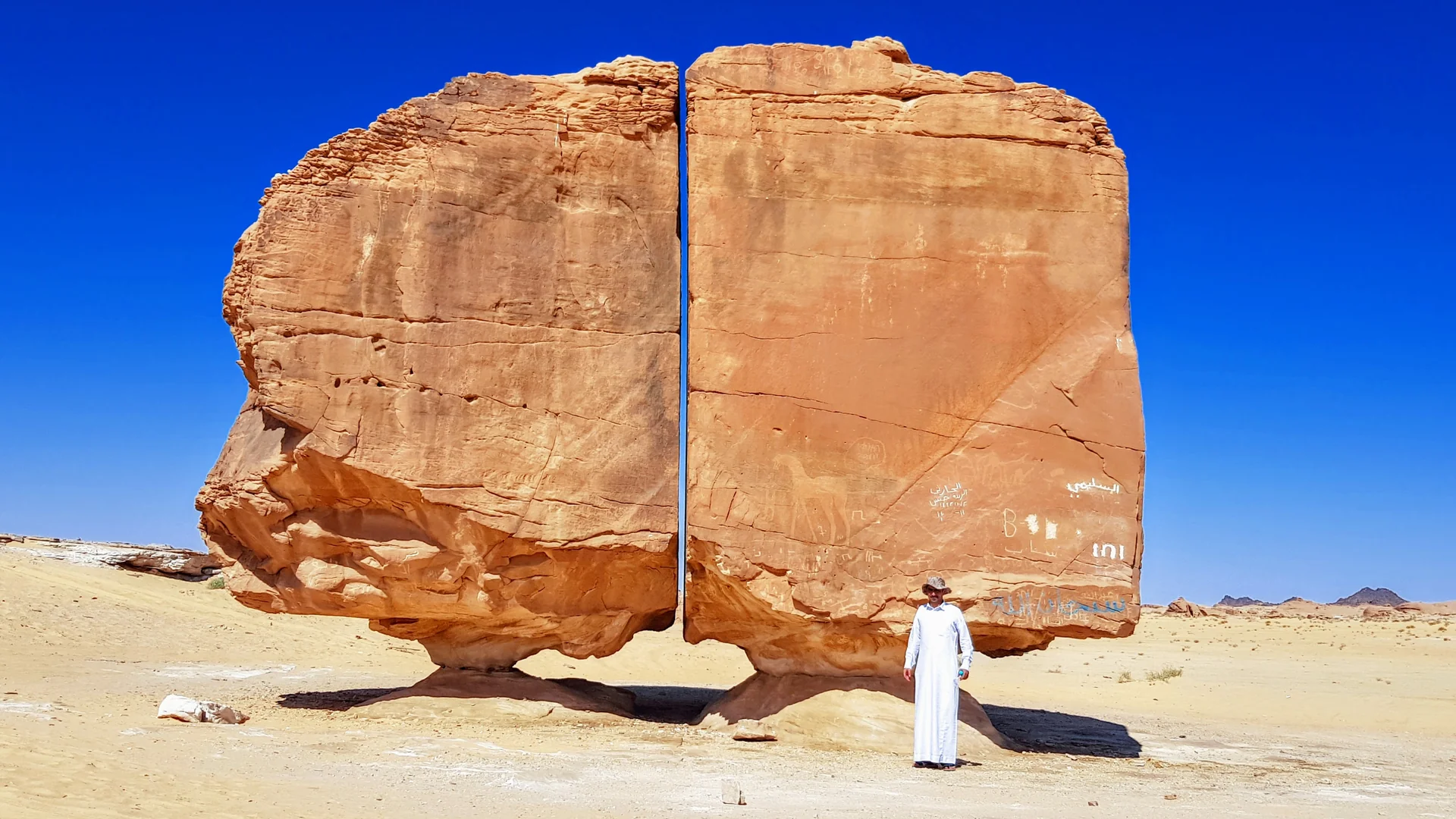
Two enormous sandstone pedestals in the Saudi desert, each balanced on a small rock base, bisected by a perfectly vertical split so precise that conspiracy theories about lasers and ancient technology have accumulated around it for decades.
The Al Naslaa rock formation consists of two large sandstone blocks, each balanced on a small natural pedestal — a geological arrangement that requires a very specific set of erosion conditions and is already unusual enough. But what makes it famous is the split between them.
Down the center of the formation runs a vertical crack so straight, so clean, and so geometrically precise that it appears to have been made with a cutting instrument rather than by any natural process. The faces of the crack are smooth. The two halves align almost perfectly. The gap between them is consistent from top to bottom.
Geologists have explanations: differential weathering along an existing joint in the rock; the slow movement of a pedestal causing the crack to propagate along a natural fracture plane; freeze-thaw cycles expanding a pre-existing weakness until the split became complete. The Tayma region does experience frost in winter. The sandstone is layered and has natural weakness planes.
These explanations are probably correct. The internet has other ideas. The formation has been cited by proponents of ancient advanced technology, ancient laser weapons, alien intervention, and a half-dozen other theories, all of which agree that no natural process could produce something this straight.
The formation sits in the Tayma Oasis area, a site of considerable historical significance — ancient Tayma was a major stop on incense trade routes, mentioned in Babylonian chronicles and in the Bible. The area contains pre-Islamic rock art dating back thousands of years. The Al Naslaa petroglyph site includes carvings on the rock faces. The split formation is remarkable. But so is everything else here.