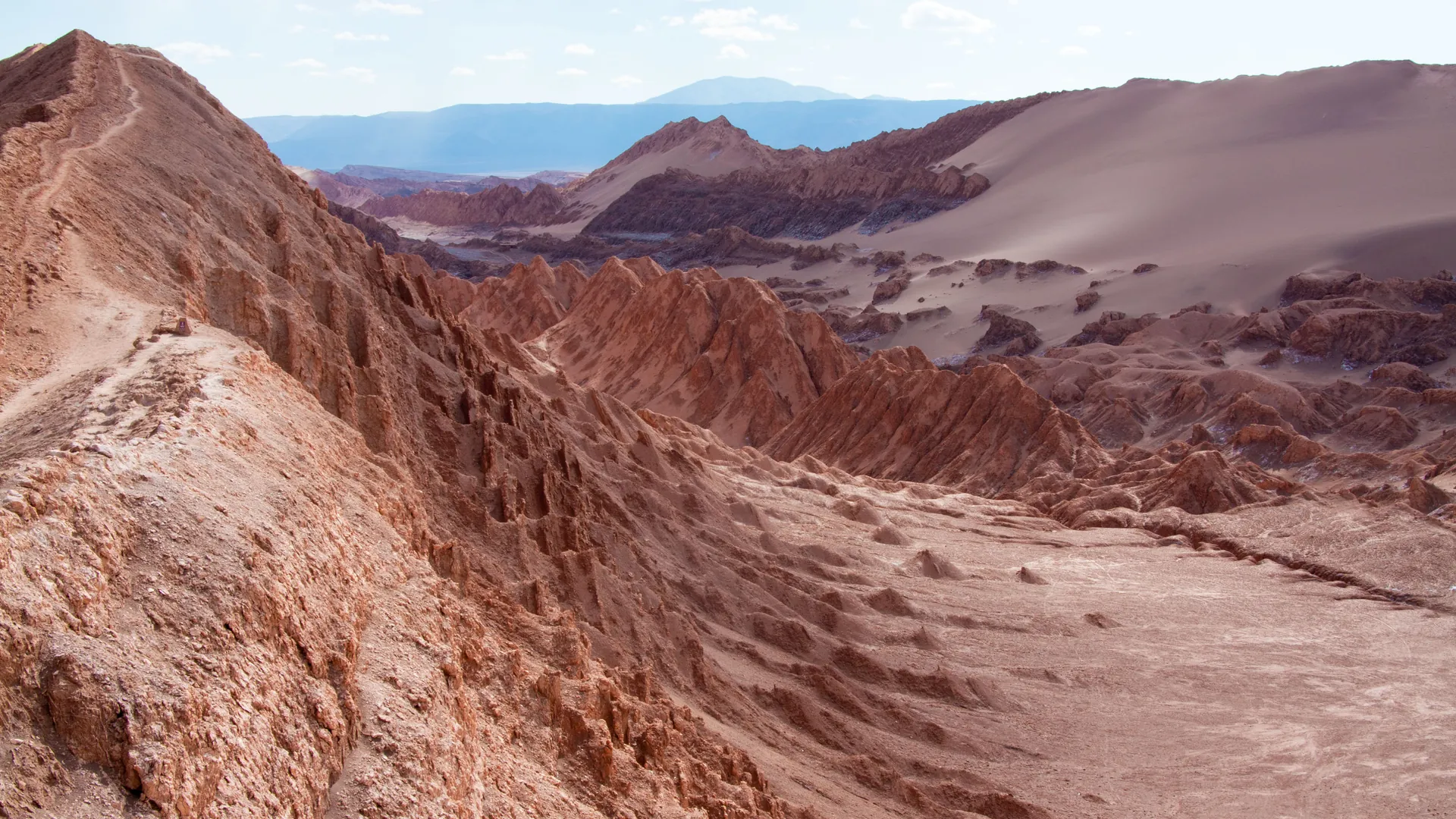
Wind, salt, and geological time have sculpted the Atacama Desert into an alien valley of crystalline ridges and amber cliffs that glows at dusk as if lit from within.
The driest desert on Earth spent millions of years working on this valley. It had the material — ancient seabed salt, volcanic ash, sedimentary rock in colours from cream to deep rust — and it had the tools: wind that never entirely stops, rare floods of extraordinary violence, and time beyond counting. What it produced looks like another planet.
The Valle de la Luna sits near San Pedro de Atacama in Chile''s Atacama region, at 2,400 metres above sea level in a basin surrounded by the Domeyko Range. The valley floor is a landscape of crystalline salt formations, eroded ridges, and smooth dune-like mounds of gypsum and halite. Walking through it, there is an absence of biological reference — no trees, no grass, no birds, no insects. Only rock, crystal, and wind.
At dusk, the light transforms it. The low sun strikes the salt crystals at an angle that makes them glow orange and amber from within rather than simply reflecting. The ridges go golden. The shadows deepen to violet and indigo. For fifteen minutes before dark, the valley looks exactly like a photograph taken on the surface of another world — specifically the one that Viking landers photographed in 1976, on Mars.
The comparison is deliberate. NASA tests Mars rover prototypes in the Atacama specifically because it is so Mars-like: hyper-arid, high altitude, intense UV radiation, ancient mineral deposits, and an almost complete absence of organic chemistry. Valle de la Luna is a preview of something four light-minutes away.
Safety information
Safety information is not available yet.
Before visiting this place, check current safety guidance, access rules, local restrictions, and official updates on other trusted websites. Our editorial team does not have verified safety information for this location at the moment; it will appear here later.