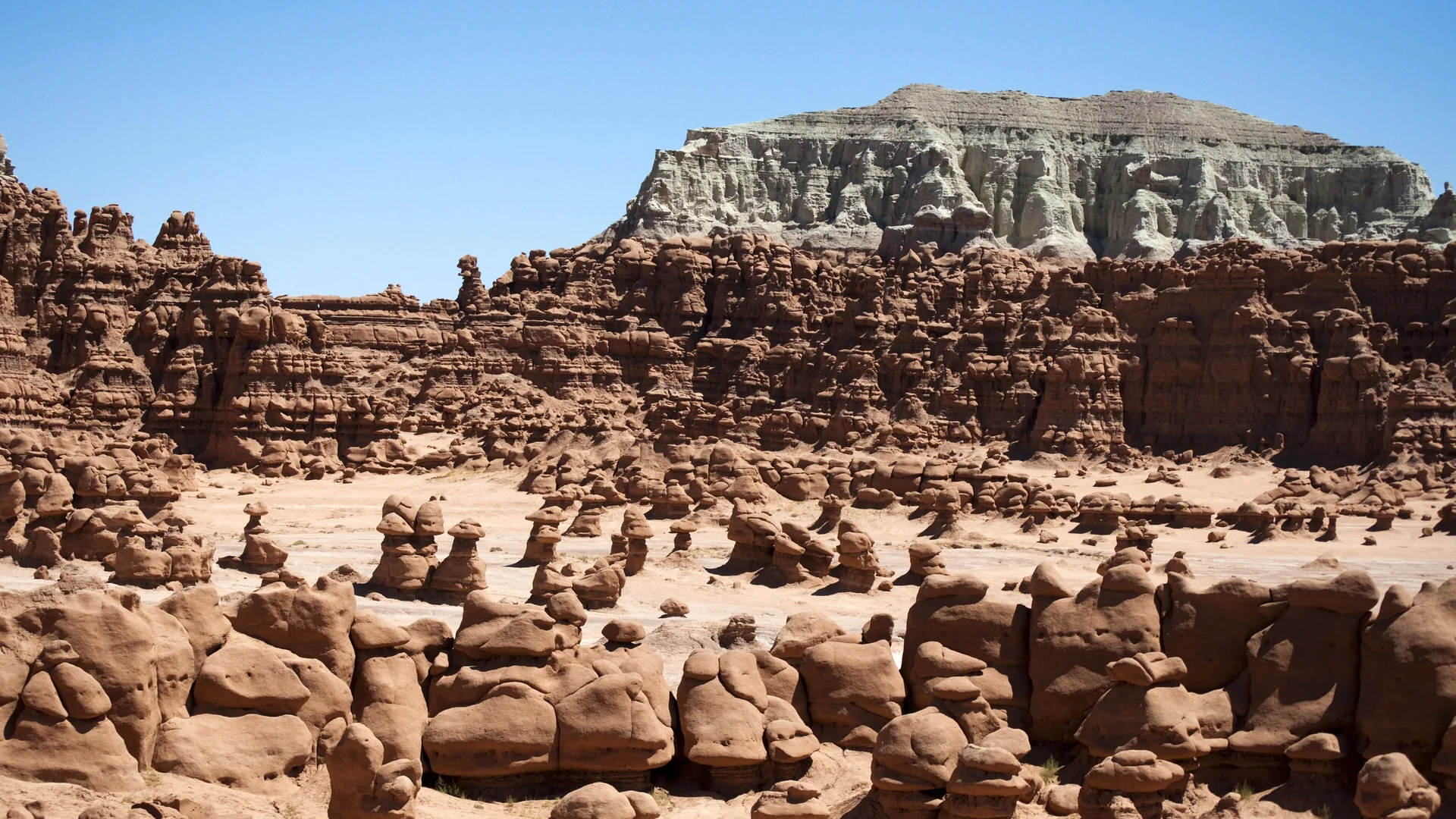
Hundreds of thousands of identical mushroom-shaped sandstone hoodoos called goblins rise from a Utah desert floor, the result of 170 million years of differential erosion.
The Utah desert south of Green River does not prepare you for what Goblin Valley contains. The approach is red rock and sagebrush, standard-issue canyon country. Then the road ends at a viewpoint, and below you is something that should not exist.
The valley floor is covered in mushrooms. Not actual mushrooms — sandstone formations, thousands upon thousands of them, bulbous-headed and narrow-stemmed, ranging from knee-height to the size of a car, densely packed in clusters across every square metre of red ground. The Entrada Sandstone that formed them was laid down as a sea floor 170 million years ago. Overlying rock protected different sections at different rates as erosion chewed away at the softer material, leaving behind these squat, rounded pedestals of harder rock. The process repeated until the valley was full.
Each formation is different in subtle ways, but the overall effect is of an industrial repetition — as if something manufactured them and distributed them with mechanical consistency across the basin. Walk among them and the scale reverses. Some are taller than your head. From the valley floor they become a crowd. You navigate between them rather than over them.
No trails exist inside the valley. Access is unrestricted. Visitors walk freely among the goblins, which creates a strange intimacy — you can touch them, sit on them, circle them. This freedom is itself unusual. Most natural formations this extraordinary exist behind barriers. These simply wait in the open, easy to reach, impossible to comprehend.