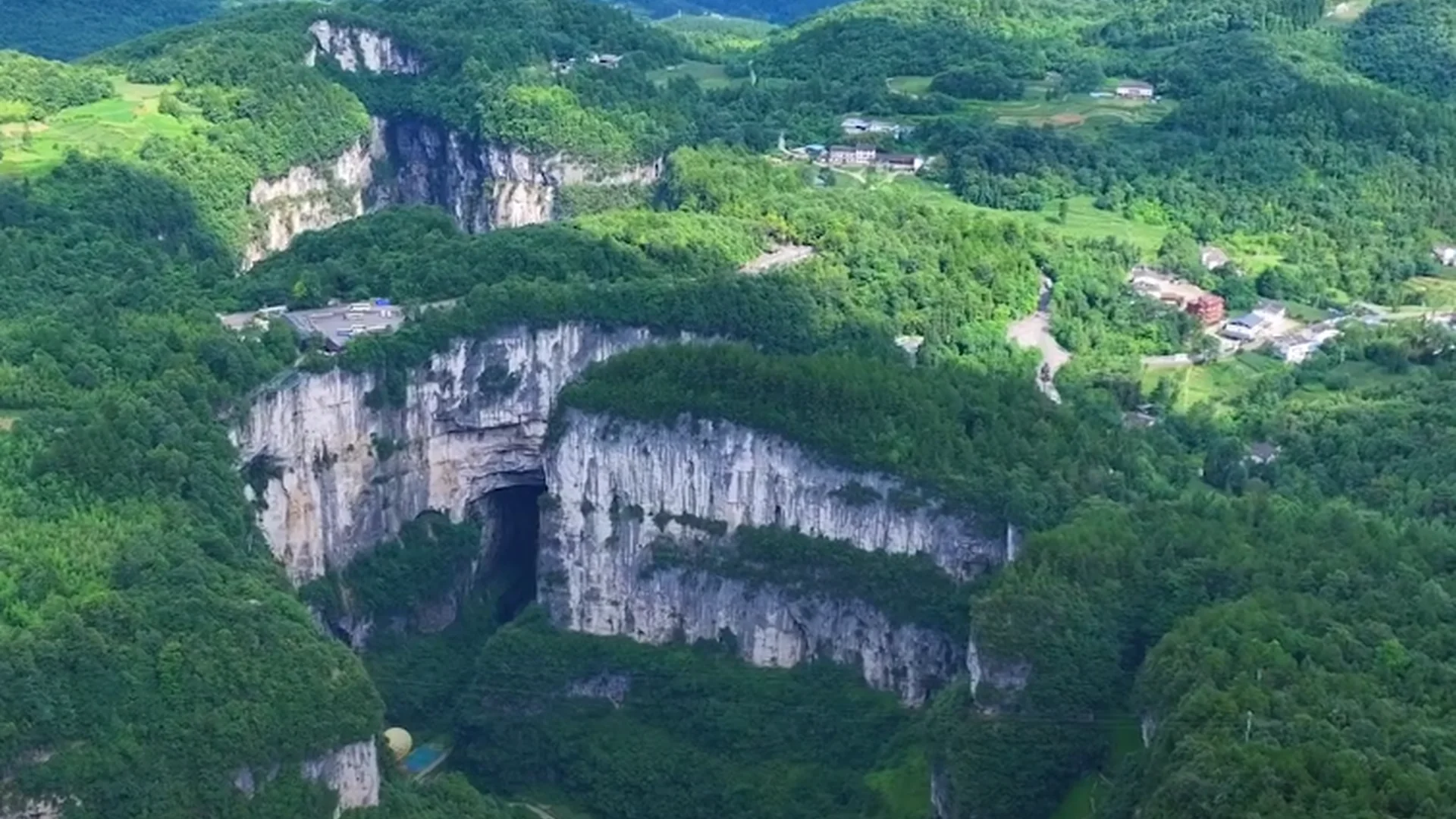
Three of the world's largest natural limestone bridges span a deep canyon in Chongqing — each arch large enough to shelter a cathedral, formed by the collapse of underground river caves.
There are larger natural arches on Earth. There are deeper karst canyons. But nowhere else do three arches of this scale occur in sequence — each one spanning a canyon that drops 200 metres to a river below, each one large enough that the Statue of Liberty would stand comfortably beneath its crown with room to spare.
The three bridges — Tianlong (Sky Dragon), Qinglong (Green Dragon), and Heilong (Black Dragon) — were formed by the same process over millions of years. Underground rivers dissolved the limestone from below, carving cave systems that eventually collapsed. The most resistant sections of the cave roofs survived the collapse and became the bridges. What was once an underground river cave became an open canyon, with the remaining arch sections spanning it.
The scale becomes apparent only when you descend into the canyon. The walls close overhead. The river at the bottom is small from the bridge surface but grows normal-sized as you approach. Each arch spans 200 to 300 metres and rises 100 to 150 metres above the canyon floor. Waterfalls descend from the canyon walls in places.
Ang Lee filmed portions of Crouching Tiger, Hidden Dragon here. The landscape''s verticality and drama suited the film''s visual logic. That same drama is present in person — a sense that the landscape is performing rather than simply existing.